
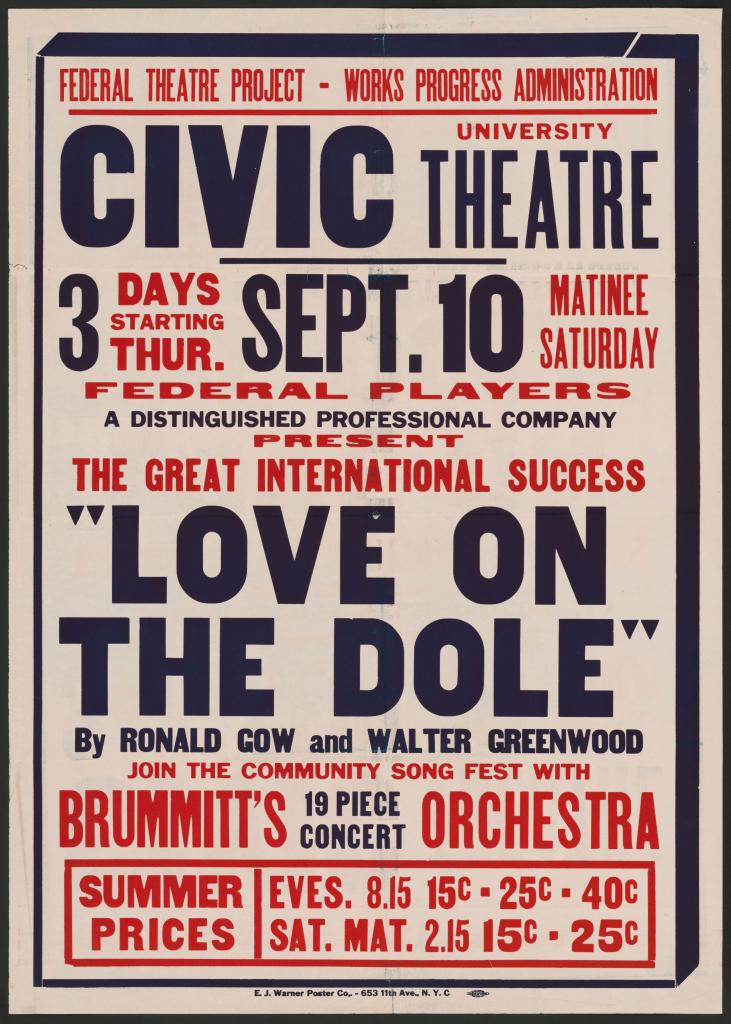
1. The Federal Players’ Poster for Love on the Dole (September, 1936)
This poster for a 1936 US Federal Theatre Players (FTP) production of Love on the Dole is, due to the wonders of the Web and Google Images searches, readily accessible, and indeed can even be purchased as a reproduction poster available on e-bay. Indeed, its contemporary and digital currency now far exceeds the reach of the original paper poster. However, no-one has ever written anything about what the poster might tell us about Greenwood and Gow’s play in the States, or in the hands of the Federal Players, or indeed anything about this production, or the accompanying music or the ‘community song fest’ with ’19 piece concert orchestra’. In this article I will reconstruct what we can about this production – though there is at least one important gap in the knowledge available. I will draw on the poster but also on some much less well-known associated and surviving documents: the FTP programme for the play, which includes a listing of the full music programme, an FTP report on the suitability of Love on the Dole for a Federal Theatre production, a polemical newspaper piece by an advisory committee member for the production, and also a commentary on the play by one of the actors, also published by the local press. I am aware that this article covers quite a variety of material – from cheerful Hollywood hits of 1936 to earnest debates about the politics of drama and of the Federal Theatre Project – but I think that is what is so variously and unavoidably presented to us by this unique version of Love on the Dole.
I am especially grateful to library staff at George Mason University Library, to the Syracuse University Library and also to the Library of Congress for assistance with my enquiries about various of these documents. The Library of Congress now again holds many of the FTP documents (including the Syracuse Love on the Dole play programme), while George Mason University houses the Institute on the Federal Theatre Project and New Deal Culture Records (see https://aspace.gmu.edu/resources/r0021), The Institute offers an excellent concise account of how the FTP papers, stored and forgotten about in a warehouse since 1939, originally came into its care in 1974 (as a loan from the Library of Congress) through the initiative of two English Faculty members, Lorraine Brown and John O’Connor (see https://masonlibraries.org/masonhistory/exhibits/show/independence/ftpcollection). There is, of course, a great deal of existing scholarship on the Federal Theatre Project but none of it discusses this Love on the Dole production, which was probably something of an outlier. I am pleased therefore that I can now (re)introduce the documents and the Syracuse production (if tentatively in some respects) into the world of Walter Greenwood, and indeed FTP, scholarship. I am also grateful to Alamy who were able to grant me a licence to reproduce the poster (though in retrospect I probably did not need this, since the poster was produced by federal workers).
The Federal Theatre Project and its acting companies, the Federal Players, were part of President Roosevelt’s New Deal policy which in the form of the Works Progress Administration sought to address the slump and the subsequent unemployment and widespread poverty in the US by targeted investment to put people, including theatre folk, back into work, if only temporarily, and more broadly to maintain social cohesion by reducing exclusion from entertainment, culture, and indeed public debate about current social issues. Those policies were in many ways very popular, leading to two landslide elections for Roosevelt as President. Nevertheless, the New Deal was not without political controversy, and indeed conservative political opponents, who in the end as a ‘conservative coalition’ brought down the curtain on the Federal Players Theatre, and indeed some though not all elements of the New Deal itself, after only three years (the wikipedia entry on the New Deal is a useful, though substantial, introduction – see https://en.wikipedia.org/wiki/New_Deal).
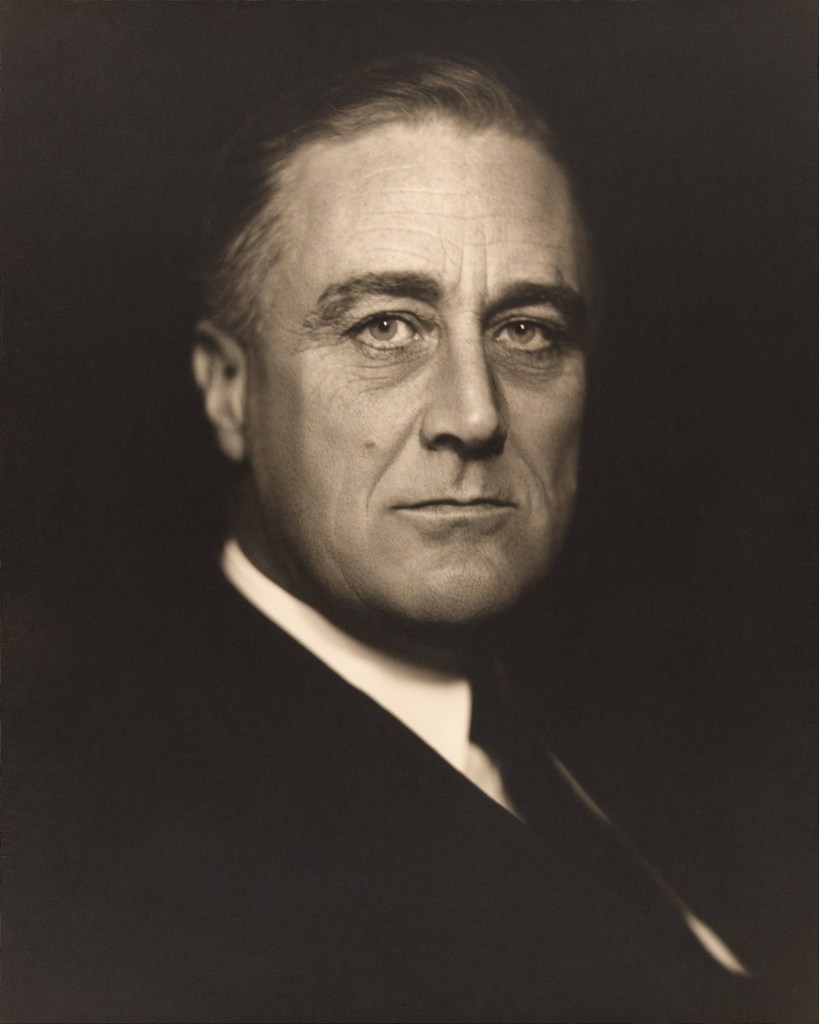
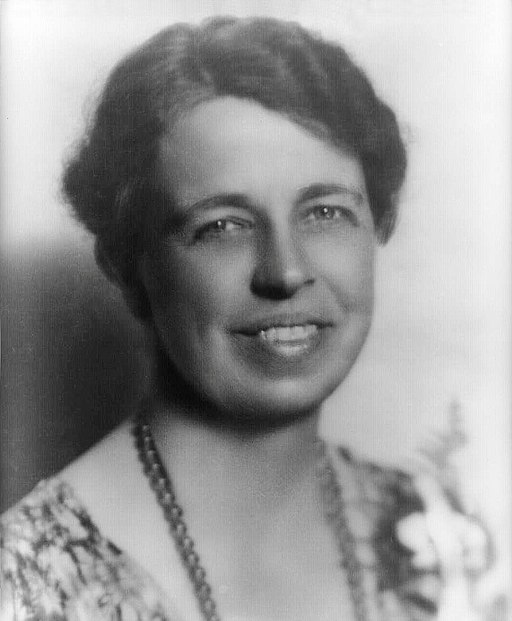
The First Lady, Eleanor Roosevelt, was a keen and active supporter of progressive policies and contributed to the President’s efforts to intervene in the US economy to reduce the harm done by the Depression. It is perhaps no surprise that she went to see the Broadway production of Love on the Dole on 1 April 1936 at the Shubert Theatre, and that she recorded her response in her popular (and widely syndicated) ‘My Day’ column. She saw the British play as dealing with tragic circumstances all too familiar in the depression-era US as well. She felt the play worked through characters who typified the personal and family tragedies bought about by unemployment and the inadequacy of state support. These situations were so undermining of a decent life that they constituted, she wrote, ‘a challenge to our civilisation’. Of Mr Hardcastle she says, ‘the father is remarkably well-played and his cry for help still lingers in my ears. How many men have felt as he does!’. Of Harry and Sally Hardcastle she writes acutely, bringing out one of the ways in which the play critiques the sheer abnormality of the life which unemployment and poverty force upon all their victims, and their need to live somehow, and to make what limited choices they can:
[There is] the boy who got married and was put out by his father for marrying, and the girl who lost her lover, and turning reckless, decided to take what she could of the material things, killing her real self, and yet giving her dearly bought cash for the happiness of those she loved.
She argues, indeed, that these ‘old stories … when presented with such force and ability … are a very valuable contribution to social thinking’. Overall, this seems a remarkably aware notice, likely to be widely listened to by the politically sympathetic across the US. Given her evident support for her husband’s New Deal policies to address the impacts of the Depression, it is no wonder she found the play’s appeal for outside help for Hanky Park highly sympathetic (I am referring to the Indianapolis Times publication of this ‘My Day’ column from 2/4/1936, p.13, but it was also of course published in papers across the USA; newspaper text accessed via the invaluable Library of Congress Historic American Newspapers database: All Digitized Newspapers « Chronicling America « Library of Congress (loc.gov)).
However, those new New Deal contexts of the thirties seem also to have brought some novel – and unexpected – ways of seeing the Syracuse Love on the Dole in 1936, which, as we shall see, differ from what seems to me Eleanor Roosevelt’s acute, but more expected and conventional reading of the play. Those contexts also introduced a highly unusual musical element into the production.
The British play version of Love on the Dole was, of course, a big hit both critically and commercially in the production premiered at the Garrick Theatre, London, in January 1935 and performed there for nine months to full houses, before transferring to the Winter Garden Theatre in October 1935 – only because the Garrick reluctantly had to honour a previous commitment to another show, a revue. There were also two simultaneous Vernon-Lever touring companies which took the play to practically every major city in Britain between 1936 and 1939. A production – starring the original Sally Hardcastle, Wendy Hiller, opened in the US on Broadway in February 1936 and ran till June of that year. It was much praised, as by Eleanor Roosevelt, and much reported on in the press across the US, but clearly was not quite as big a hit as in Britain. That production apart though, I do not know of any other US production in the thirties apart from this Syracuse, New York, one – four performance over three days only. Yet one can see that the play might look like a very good bet for a Federal Theatre Project work, though sadly it does not seem that Greenwood and Gow’s play was in this case brought to ‘thousands in the USA who had never seen a live theatre performance before’. Despite the pretty positive New York FTP report on the play’s potential as an FTP production, it was not adopted for repeated performances, and the Syracuse production itself had a very short run, not subsequently touring despite what seems a huge amount of effort put into those four performances, including into the musical elements.
Despite its wholly text-based rather than pictorial design, I think the poster itself is striking, effective, attractive, and dynamic. It has only three devices or graphic tools: red text, black text and different sizes of a single upper-case font.Only five words appear in the largest black font: ‘CIVIC’ and ‘LOVE ON THE DOLE’. All the accompanying details appear in smaller red font, though of varying sizes and with some words ‘squashed’. This set of textual devices gives a certain drama to the poster, emphasising the key points, but also providing a good deal of variety within the also important red-font supporting detail. Without becoming dull or cluttered, the poster packs in a great deal of information: sponsors, venue, reputation of the play, additional musical entertainment, dates and times of performance and ticket prices. The ticket prices look remarkably and deliberately low: the 15 cent seats would be the equivalent of $3.52 now, the 25 cent seats would be the equivalent of $5.87 now, while the most expensive seats would only be $9.39 (according to the Dollar Times Inflation Calculator: https://www.dollartimes.com/inflation/). This was surely intended to make the play affordable to all (and perhaps even in principle at least, to the unemployed and those on unemployment relief), and to draw in those who were not regular theatre-goers. The music on offer as part of the ticket price is presumably also intended to be attractive to all as a free extra, and in its own right a big draw.
2. What Kind of Production was it?
It would be easier to at least try to answer this question if I had a review, but so far I have not found any by searching the generally invaluable Library of Congress newspaper database Chronicling America (https://www.loc.gov/collections/chronicling-america/about-this-collection/) nor the commercial Newspaperarchive (https://newspaperarchive.com/). There IS coverage in the local Syracuse press, but nothing which we could call a review of the actual production, so that is something of a gap in this study. The theatre and film critic of the Syracuse Herald published two serious-minded articles about the play, but neither is a review, though he usually wrote one for local productions. One newspaper article is an interview with the assistant director, who also acted in the play and the other is a polemical piece about the politics of the play – both are very much about ideas rather than production or performance. We will discuss both pieces in detail later on in the article, and look more closely at their authors.
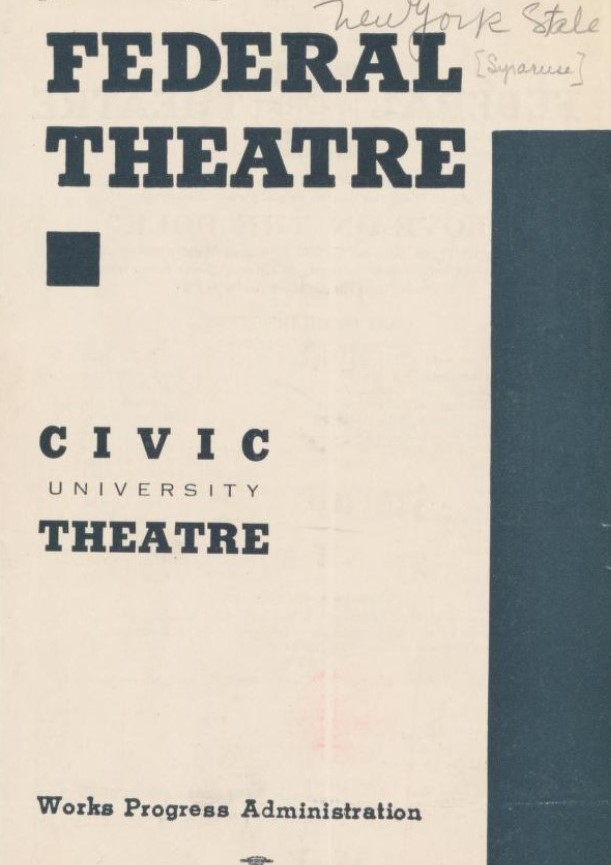
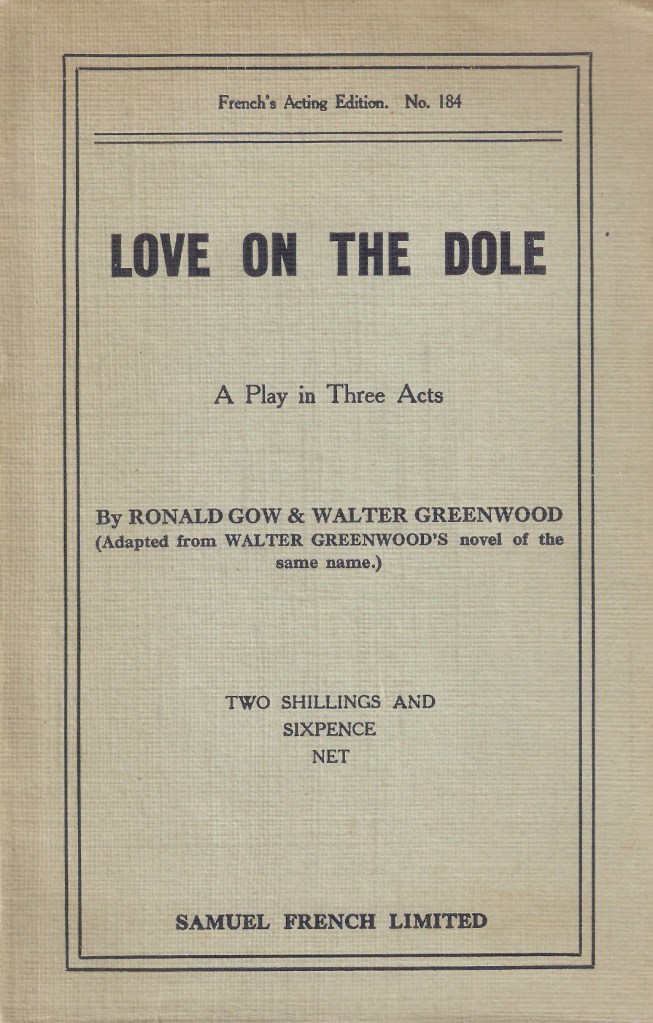
In the absence of a review, the Musical Programme may give us some, though perhaps very partial and unusual, clues about aspects of its style. The Musical Programme is printed in full, including with lyrics for the community song fest items, in the programme for the play, which is preserved in the Syracuse University Library collections and reproduced in the Library of Congress catalogue. The Musical Programme is almost entirely made up of very recent popular American music, which may, perhaps, imply that this story originally set quite specifically in the English northern /midland county of Lancashire is here transplanted to the US. The music programme does not refer to the short fragments from songs which are specified in the two (somewhat different) printed texts published by Jonathan Cape and Samuel French and which I have reconstructed elsewhere on this site (Two/Three Songs, Two Hymns, Two Socialist Anthems, and a March in the Play of Love on the Dole: Act I and Act III, Scenes 1 and 2 (1934/1935) (and a Coda on a Song in the Film, 1941) *). The Federal Theatre programme does though thank ‘Clarke’s Music Store’ for an ‘Electric Phonograph’ and the ‘Western Auto Store for a ‘radio’, so it is possible that, as well as the ’19 piece orchestra’, the production also played some music from gramophone disks or gave the illusion of music from a radio, perhaps to replace the few pieces of onstage singing in the original British productions. This would presumably have been what is technically called ‘intradiegetic’ music, that is within the world of the stage and heard by any onstage characters. The programme though emphasises its live performances of recent American hits as an overture and as entre-act pieces, as well as the ‘community song fest’ between two acts (both kinds of this music would thus be technically ‘extradiegetic’, outside the hearing and world of the onstage characters). It is perfectly possible that American tunes could have been played without altering the British setting and Lancashire dialect of the original play – after all much American music was familiar to British audiences from gramophone records. Nevertheless, I think this might have produced an odd dramatic experience for the audience, a sense of drama and music not matching (though, as we shall see, that is also an issue in other respects). Moreover, Greenwood had envisaged and given permission for adaptation of the play-text towards local conditions. At the end of the ‘Synopsis of Scenes’ section early in the 1934/1936 UK Samuel French acting edition of the play, Greenwood wrote this note:
The phonetic spelling of the Lancashire accent , which appeared in the earlier edition of the play, has been more or less eliminated in the present edition. This has been for the convenience of the cast, who may choose to speak in the accent of any other industrial town (unnumbered page).
He went further in the US Samuel French Acting / Library edition of the same year which rewrote this note, and indeed again revised the text of the play to some degree:
The present version of the play has been especially prepared for the United States. The phonetic spelling of the Lancashire dialect has been eliminated, and certain modifications have been made to make the play more acceptable to the American public (p.6).
So far no one has compared the texts of the UK and US Samuel French acting texts (I had better add this to my Greenwood to-do-list), but it seems reasonable to think that the Federal Players might have liked to make use of this permission from the author (or authors – the note might well stem from both Greenwood and Gow). I am going to make the assumption for the present that there was some inflection towards a US setting, or at least the smoothing over of some more evident Lancashire and British cultural accents which might make understanding and enjoyment more difficult for an in principle broad American audience.
Since I have a gap in knowledge about the actual performance due to the lack of a review I am going to turn now to what we do have extensive knowledge of: the Music Programme (though I would very much welcome information about a review in the Syracuse press, if any US readers of this website can locate one). I will deal first with the music which frames the play and explore if or how closely it was related to its themes. I set out to use US recordings wherever possible since that seemed likeliest to catch the spirit of the Federal Players and Bill Brummitt’s Orchestra, but this has not always been possible due to availability, length and sound quality. As so often I am grateful to vintage gramophone record collectors for their knowledge, often fine original gramophone players, and their Youtube channels (I am not always sure of the copyright status of recordings, that not always being indicated).
2.1 The Musical Programme
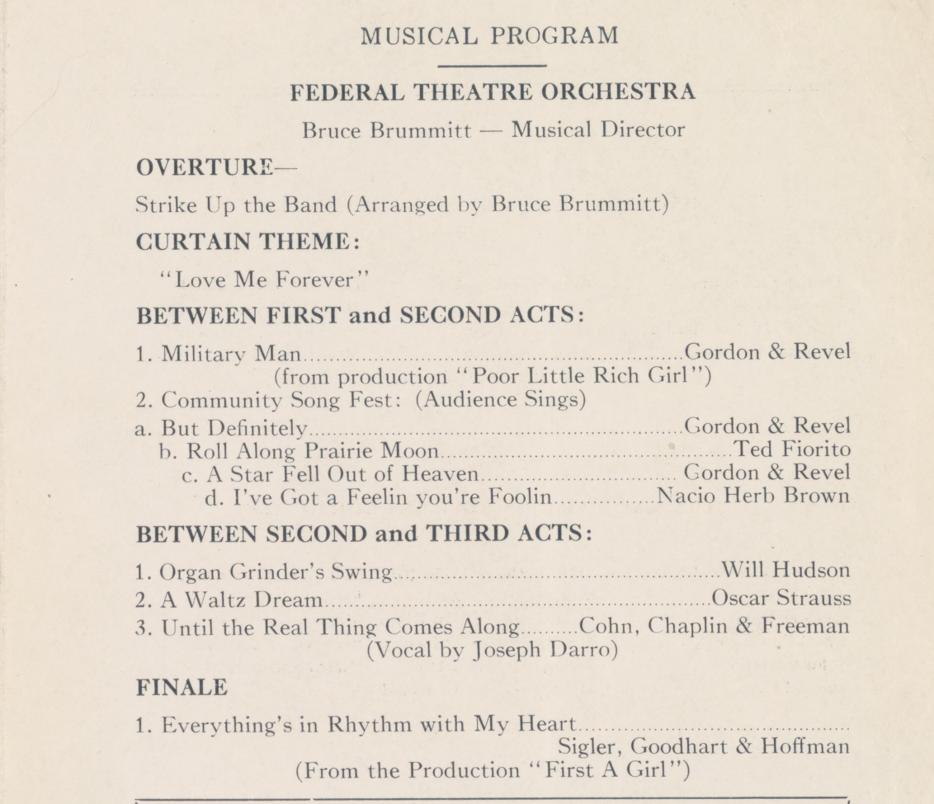
For all the recordings which follow, I assume that readers/ listeners/viewers will follow their own preferences – those who tend toward the completist might play all the pieces, while others may gain enough sense of the style of the show’s music from sampling each. You can watch and hear the videos embedded in this Word Press site by hitting the play button in the centre of each image. The music programme opened with what it termed an Overture, which was a version of ‘Strike Up the Band’, written in 1927 by George Gershwin for piano and voice, with lyrics by Ira Gershwin for the show Strike Up the Band. At Syracuse it was arranged for orchestra by Bill Brummitt himself, but sadly I have not found a recording of that (indeed I have found no trace of Bill Brummitt’s Orchestra in searches in the US press, and for Gramophone records). However, there are numerous recordings of orchestral arrangements including this 1935 Victor gramophone record played by the Boston Pops Orchestra:
I do not think this number has any specific reference to Love on the Dole, but functions generically here to warm up the audience with the promise of an exciting show (whether the tune would lead one to expect a play quite like Greenwood and Gow’s is an open question).
There then followed what the Programme calls the ‘Curtain Theme’, presumably played for a few minutes before the curtain went up. This was ‘Love Me Forever’, a song from the 1935 hit film of the same name (directed by Victor Schertzinger, produced and distributed by Columbia Pictures). The female star was the singer Grace Moore and here is a 1935 recording of her doing the number:
This seem a little more relevant to Love on the Dole, and especially to the first Act where Harry Hardcastle’s feelings for Helen Hawkins and Sally’s for Larry Meath are introduced – though the poverty-stricken world of Hanky Park is hardly that of the aspiring opera singer played by Grace Moore.
Between Acts 1 and 2 came ‘Military Man’, a song from the 1936 Shirley Temple film ‘Poor Little Rich Girl’ (directed by Irving Cummings, distributed by Twentieth Century Fox). The Shirley Temple character’s situation could not in the main be further from that of the Hardcastles: her father is very wealthy but too busy with money-making to take any notice of his daughter. She runs away and is unofficially adopted by two singers and dancers who have hit bad times: when they perform with the talented child in a radio show she feels cared for and they all three make it big. Below is a 1936 gramophone recording by the British Jack Payne and his orchestra, with the singer Billy Scott-Coomber (but if you prefer you can watch a clip from the original film with its three stars singing and dancing the number: https://www.youtube.com/watch?v=NNJIZn37gvg). Act 2 in the play further develops Sally and Larry’s relationship and has the only scene set outside the industrial landscape of Hanky Park in which Larry and Sally climb up onto the moors and talk about both their own feelings and why working people like them cannot have access to better lives. There seems no obvious match between this song and the play. The play is much more about a poor poor girl.
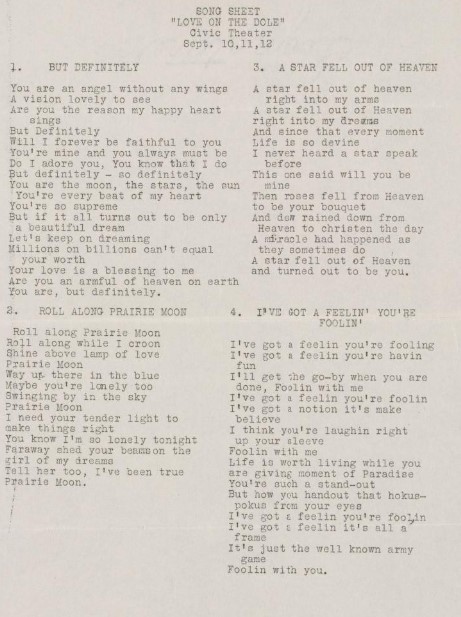
Next came the ‘Community Song Fest’ (what in Britain we would call a ‘sing along’!) which must have introduced quite a long interval into the drama because it consisted of four separate numbers, which if I am to reproduce the audience experience I need to put in at this point. The programme specifies an interval of ten minutes, and I think these four songs would be likely to take up at the very least the whole of that time.
2.2 The Community Song Fest
First in the community song fest was another Shirley Temple number, and again from Poor Little Rich Girl, titled ‘But Definitely’. Here is a gramophone recording by Ray Noble and his orchestra (but again by all means listen instead to Shirley Temple and co-stars’ performance in the original film during their radio show: https://www.youtube.com/watch?v=959OspL4q5w). This is a love song and might again pick up on the relationships of Harry and Helen and Larry and Sally, which are going well at this point in the play.
Next the audience got ‘Roll Along Prairie Moon’, another song from a recent film called Here Comes the Band (1935, directed by Paul Sloane, produced and distributed by Metro-Goldwyn-Meyer). Again, it is a love song with a sense that love is fragile. I cannot find this as a film clip, so again let us have a gramophone recording with more of Al Bowlly, and more of Ray Noble and his orchestra.
Next was another hit of 1936, ‘A Star Fell From Heaven’, here in a recording by Hal Kemp and his Orchestra. Yet again it is a love song and again it has a sense that love may often be dream-like as much as real, and therefore hard to sustain in the real world.
Finally the ‘Community Song Fest’ concluded with ‘Got a Feelin’ You’re Fooling’ from the film Broadway Melody, again of 1936 (directed by Roy Del Ruth, produced by Metro-Goldwyn-Meyer). Let’s have a film clip this time, with Eleanor Powell singing the title role of the aspiring musical star. This song with its lyrics about love and honesty and accepting things as they appear to be might have some possible reference to Sam Grundy’s repeated and repeatedly spurned attempts to seduce Sally Hardcastle, with various promises, including blatant offers of money in return for her favours.
The programme included a page of the community song lyrics typed out for for the audience on page 4:
2.3 Back to the Play!
Or at least to music played as perhaps something more integral to the play. Between Act 2 and Act 3 there were three numbers, of which the first was the Organ Grinder’s Swing between Acts 2 and 3 (music by Will Hudson, lyrics by Mitchell Parish and Irving Mills, 1936). This is one of the jazziest of all the Music Programme tunes (the other is Fats Waller’s), swinging a tune allegedly like that of a street musician playing a street organ or barrel organ powered by a cranked handle, and using originally pinned barrels and later paper rolls to produce mechanical music. The photograph below is a little later than 1936 and taken in Australia but gives a good sense of the instrument and the performer and their usual street context.
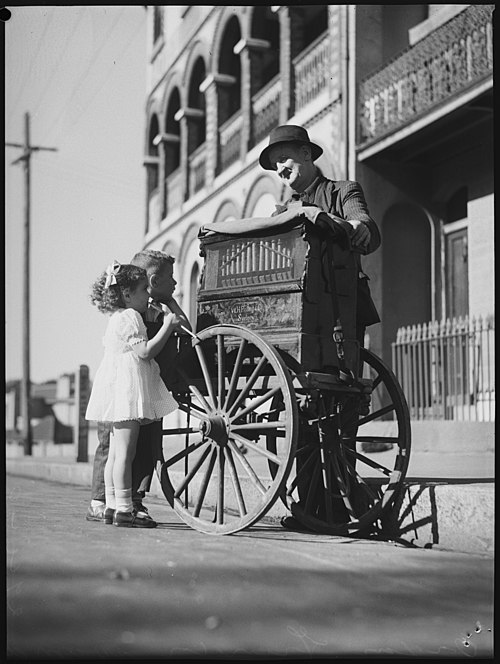
These instruments and the performers were often associated with busking or begging, so the tune might evoke the poverty into which the Hardcastle family have fallen, but this is by no means obvious and may be produced by that critical completist occupational hazard – trying to make everything meaningful and fit in!
The second tune was ‘A Waltz Dream’ (part of an operetta by Oscar Strauss, premiered in Vienna in 1907) This was the oldest tune played at the performance (Note: at 2 minutes 58 seconds of this recording ‘A Waltz Dream’ ends and we flip to the B-side, Franz Lehar’s ‘Gold and Silver Waltz’). The song was recorded on gramophone records as early at 1907, but I have chosen the thirties record below as being more in character with a 1936 sound (the 1907 recordings sound very much of their time). Here we are back again with love as an all too fragile dream-state.
The final entre-acte song was ‘Until the Real Thing Comes Along’ , which is more characteristic than the ‘Dream Waltz’ of the show’s preference for the latest hits, since it too was a hit in 1936, though this particular song had a complex writing/ rewriting story, with a an original version from 1931 undergoing significant reworkings of both melody and lyrics. The 1931 original had music by Alberta Nicols and lyrics by Mann Holliner, while the reworked 1936 version had revised music by Sid Chaplain and L.E. Freeman, with revised lyrics by Sammy Khan (see https://en.wikipedia.org/wiki/Until_the_Real_Thing_Comes_Along ). The version by Fats Waller and his Rhythm was (rightly) a hit in 1936 and I think this is a good recording (not that this exercise is strictly about my musical taste or judgement!).The theme of love providing hope but also being less than solid is again at the centre of this number.
Finally, as the ‘Finale’, and presumably after the last lines of the play and the bringing down of the curtain, came ‘Everything’s in Rhythm with My Heart’, a song from the film ‘First a Girl’ (directed by Victor Saville, produced and distributed by Gaumont British, 1935), starring Jessie Matthews. This is the only British film and singer referred to in the Music Programme. The song was composed by Maurice Sigler, with lyrics by Al Goodhart and A Hoffman (see https://lyricsplayground.com/alpha/songs/e/everythingsinrhythmwithmyheart.html). Jessie Matthews did audition for the part of Sally Hardcastle in the British 1941 film of Love on the Dole, but was not chosen because the director John Baxter did not want to cast actors who would bring with them an established (and in his view distracting) star persona, which Jessie Matthews undoubtedly would have done.
Love on the Dole closes, of course, with an utterly desperate scene in which Mr Hardcastle admits his complete failure as a husband, father and provider, but equally cannot see how he could have avoided this, given the Depression. Sally has just agreed to her terrible ‘bargain’ with the bookie Sam Grundy in which she agrees to become his mistress in return for him fixing up jobs for her desperate father, and also her brother, who is penniless but has a wife and new baby to support. This song therefore scores highest of the whole music programme for its apparent inappropriacy – unless we are to read it ironically, as we do the fragmentary wedding march – ‘Here Comes the Bride’ – indicated in the stage directions of the play as Sally leaves to go and live with Sam Grundy (British Samuel French edition, p.69). This would be in line with the play which is, after all, about the necessity and the impossibility of real, sustainable and simply affordable love on the dole.
3. Love on the Dole – Some Questions of Balance: Music/ Drama; Instruction / Entertainment; Tragedy / Comedy
I think there are some questions we could usefully ask about how this version of Love on the Dole might have worked for its audience, with its musical and theatrical components. It seems a reasonable assumption, as made earlier, that the music was included as a draw, promising entertainment, and presumably of a familiar and popular kind. The same might not be so obviously true of the play. Of course, we have been concentrating on the music because we lack evidence about the actual performance, which may give an undue emphasis to the part the music played. However, I think that it actually is the case that the music was a pronounced feature of the production; the music could be seen as not part of the actual play, but I cannot quite see how the audience could have totally separated their evening’s or afternoon’s experience in the theatre into two unconnected parts, musical and dramatic. I estimate that on average Greenwood and Gow’s three act play might take a little under three hours to perform, not counting the intervals which in this case were clearly wholly or almost wholly taken up with music. If the recordings of the music I have found are reasonably representative then the music programme and song fest would have taken up around 40 minutes of the evening, so was a significant proportion, though the drama did represent the majority of the experience. However, that still leaves a question about how the music and the drama inter-acted, given that on the whole the music is upbeat, if often about wish-fulfilment, and sometimes with a tinge of melancholy, while the play is often, though not wholly, downbeat.
In fact the question this production raises about different modes, moods and genres was one which often arose in relation to Love on the Dole. There were elements of comedy – often described as Dickensian – in Greenwood’s original novel, but in the play adaptation more comedy was introduced, while a strong core of tragedy was maintained. In one of Ronald Gow’s accounts of his first meeting with Greenwood when they agreed to co-write a play adaptation, he highlights the balance between elements in the narrative as part of their conversation, and envisages them as key to the play’s likely success with a wide audience:
It seemed to me that a play about unemployment would not appeal to the general public. Nor did I feel that the English people cared sufficiently about the tragedy in their midst to see it on stage. ‘But’, I said, ‘if we can make a British audience laugh . . . they won’t mind how much we make them weep. It’s the mixture they love’ . . . Two months later our play was written (New York Times, 23 February, 1936, p.XI, under heading ‘Love on the Dole‘).
One notes that while Gow gave two accounts of this meeting, Greenwood never set down any account, so we can only take Gow’s recollections on trust. However, many reviews of the play in its very successful first season at the Garrick Theatre London in 1935 did record what they saw as a successful and moving combination of the comic and tragic modes. The Times review noted that Love on the Dole:
being conceived in suffering and written in blood . . . profoundly moves its audience . . . [Mrs Hardcastle is] baffled by a tragedy for which she cannot place the responsibility . . . Now and then three old harpies drift in and out with their gin-bottle, their gossip, their fortune-telling, relieving and delighting the audience by their dark witch-like drollery (January 1931, p.12, unsigned, as was very usual).
The Tatler in a substantial review similarly highlighted the mixed genres of the play and its combination of ‘instruction’ – though with a light and undidactic touch – and ‘entertainment:
It is, for some few, an uncomfortable play; but it can be appreciated by all who want from the theatre something more than a comfortable escape from reality. Its great merit . . . is that it tells a tragic story in straightforward manner and convincing sequence and leaves the audience to search for cause and effect. Its grimness is relieved by homespun humour. It never preaches (20 February 1935, p. 23).
These reviews suggest that the play itself did offer a fine balance between these two elements, and perhaps at Syracuse the music was adding something in the entertainment pan of the scale – though there might have been a danger that this kind of music was offering too much of ‘a comfortable escape from reality’. One of the characters in the novel (though not the play which necessarily had to strip away some detail) reflects on the limits of mass entertainment of the period. Thus Helen Hawkins who lives in a slum much worse than the poor household occupied by the Hardcastles reflects on dream and hard reality:
Dully, insistently, crushing came the realization that there was no escape, save in dreams. All was a tangle; reality was too hideous to look upon: it could not be shrouded or titivated for long by the reading of cheap novelettes or the spectacle of films of spacious lives. They were only opiates and left a keener edge on hunger, made more loathsome reality’s sores (Love On The Dole, novel, Random House. Kindle Edition, p.65).
Indeed, some contemporaries thought the play overdid the grim reality to the point where it was intolerable for audiences as entertainment. The Victor Schertzinger who directed Grace Moore’s 1935 film Love Me Forever, from which we have heard the title song, was asked in 1938 by a British film and theatre critic during the interval of a performance of the play of Love on the Dole in Britain if he thought it would make a good film. Schertzinger certainly had some major reservations, including a fear that the impact of the film, as in his view of the play, would overall be negative, and might make some audience members feel hopeless and even suicidal. Perhaps bearing this in mind, the Syracuse musical programme was a very necessary addition, especially if the ticket prices and the musical attractions pulled in new audiences not used to serious drama?
Mr. Schertzinger’s personal point of view was that this was not the time to use a subject like Love on the Dole. ‘That is a picture that should be made in prosperous times’, he said, ‘for it is directed at the richer folk; to make them want to help and do their bit. If I was in the position of any of these folk in the play and saw that on the screen I should want to blow my brains out. I believe that the cinema patron should find something in every picture he sees, some idea, some thought of uplift to take away with him to help him on his way’. The material was there in the play he agreed. It had tremendous possibilities, but the ray of hope was lacking (‘Stargazer’ reporting from a performance of Love on the Dole at the Windsor Repertory Theatre in the West Middlesex Gazette, 23 April, 1938, p.15; also quoted as part of a different argument in Five Producers, Four Directors and Two Stars in Search of a Picture: the Tantalising Project of Love on the Dole As Film (1934-1941)* ).
4. Two Syracuse and One New York FTP Document with Serious Intents: Politics and Drama
However, there are three further relevant documents, two from Syracuse, and one from the FTP’s central New York Office. All three documents certainly show that their authors thought that the play itself would have a serious impact on its audience and/or American theatre. It is true that none of them say anything at all about the accompanying musical programme at Syracuse, and indeed they may or may not have known about this framing context for the production (we will come back to this issue). I will deal first with one of the documents with the most direct relationship to Syracuse, though I discovered it by a slightly circuitous route. Page 5 of the Federal Players Programme for Love on the Dole, on the page after the Music Programme, lists committee members with some responsibility towards the production thus:
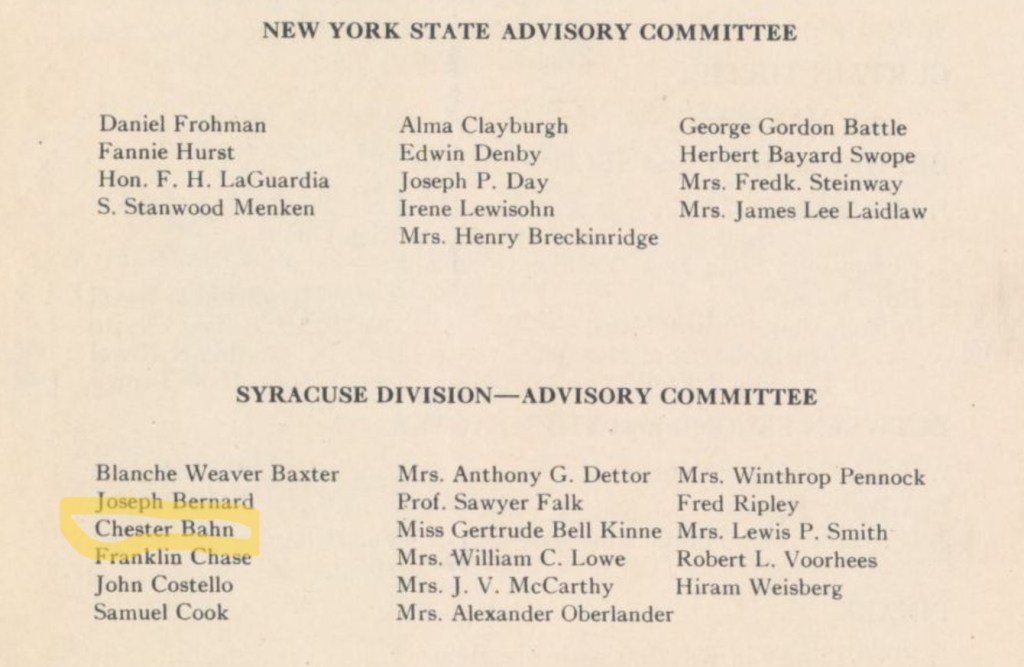
This may not look very fascinating, though no doubt each adviser in each of the two committees made their contribution. However, one name stood out as familiar because I remembered it from an unusual result for a Love on the Dole search in the British Library National Newspaper Archive for September 1936. It was an unusual result because it referred to the republication in the British theatre periodical The Era on 23 September that year of an entire article by Chester B. Bahn originally published in The Syracuse Herald. The article focused mainly at first on the Syracuse FTP production of Love on the Dole ‘here last week’, though it widens its gaze in the latter part of what is a substantial piece. It is titled ‘America’s “Federal Theatre” Plans’ and sub-titled ‘What They Signify’. Bahn argues that the choice of Love on the Dole as an FTP play is indicative of a concerning development in the Work Administration programme: ‘The profound underlying significance of the Federal Theatre Project . . . continues to crop out in a manner both astounding and, alas! disturbing’. He argues that it was agreed at its foundation that the project’s purpose was defined as being to provide employment to theatre people who were out of work either because of the Depression itself or because of rapid changes to the ‘theatrical scene’. Plays produced were to provide ‘relief’, were not to compete with the commercial theatre, and overall the Federal Theatre was to be ‘non-political in both administration and objective’. However,
Since those early days it must be obvious, even to the most casual observer, that the project has departed from the straight-and-narrow . . . Just how far that departure has been is markedly instanced by the production at the Civic Theatre here last week of the English play Love on the Dole and the present plans for multiple presentations of Sinclair Lewis’s controversial It Can’t Happen Here.
Whatever may be the entertainment value of the Ronald Gow and Walter Greenwood piece, it is interesting, certainly, to note that a commentary prepared by Dennis Gurney, actor and assistant play director of the Federal Theatre Players, emphasises its inferred defence of the Works Progress Administration. In more direct words, then, Love on the Dole constitutes at least indirect propaganda for what has been eloquently summed up as the More Abundant Life.
Gurney is listed in the FTP Love on the Dole programme as playing the part of ‘Pat O’Leary an Agitator, and in fact his commentary was actually published by Bahn himself in an earlier edition of the Syracuse Herald and adds yet more valuable material about attitudes to Love on the Dole within the FTP (though Bahn mistakenly thinks from Gurney’s piece that the ‘Agitator’ role is a major one, when though it has impact, it consists of only eight lines delivered across two pages – see Samuel French US edition, pp.76-7). I will first finish Bahn’s article and then turn to Gurney’s views of Greenwood and Gow’s play, which were recorded in the form of an interview with Bahn.
While expressing various kinds of disapproval of the FTP, it is notable that Chester B. Bahn does not criticise Gurney’s view of Love on the Dole as an unconvincing and out of context reading of the British play. On the contrary, he accepts it as a reasonable interpretation and that is in his view what turns a piece of theatre into propaganda, an aesthetic project into a propagandist one. Bahn’s complaint has in its way a valid ground: that US government monies raised from taxpayers are funding a play which supports the current Democratic government policies. These policies were of course those of the New Deal, and in addressing the mass crisis of the Depression were uncharacteristically radical, and though widely supported, were certainly disliked by some more conservative voices. Bahn’s objection seems primarily on a point of principle – that taxes should not fund party political or partisan activity, though he may have other doubts about the Federal Theatre Project too.
His article goes on to cite the very different views of many (probably the majority) involved with the Works Progress Administration and the Federal Theatre who saw the current crisis as one demanding new approaches and escape from usual practice. Thus he quotes several champions of the Federal Theatre who see the new funding models as a chance not only to introduce but even invent a new kind of drama. One of these represents well what disturbs Bahn. He quotes Hallie Flannagan who argues that:
The American Theatre must wake up to an age of expanding social consciousness [and is] out to change the course of playwriting into newer and more virile channels. Everyone of our 158 theatres is clamouring for scripts. Where are the new plays? I spend every available hour reading scripts. they cling forlornly to the skirts of the past . . . If the plays do not exist we shall have to write them (Bahn says this is an extract from an article in The Federal Theatre Magazine but gives no further reference details)
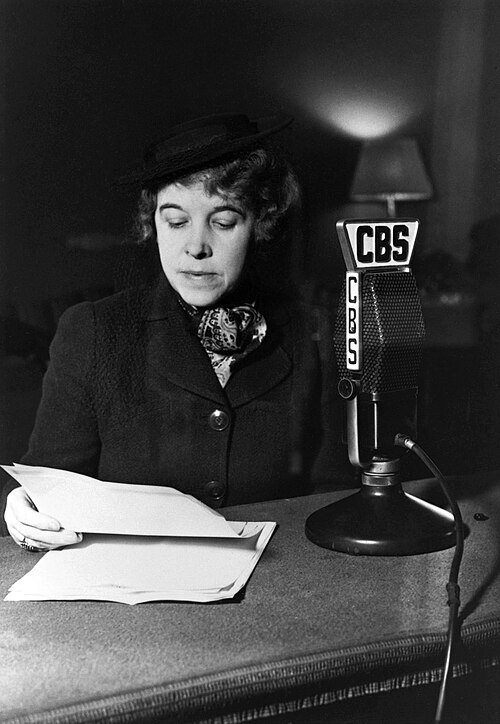
Hallie Flanagan (1890-1969) was Director of the Federal Theatre Project from its beginnings in February1934 till its closure by Congress at the end of June 1939, when conservative voices predominated in echoing Bahn’s concerns and further seeing the FTP’s policies in promoting social justice (‘expanding social consciousness’) as positively un-American and even communist in tendency. Flanagan was (and remained after her FTP days) a significant figure, and indeed a champion and pioneer of new kinds of theatre. As in the quotation above, she clearly felt that existing drama writing and production could not meet the rather different agendas of the FTP, as opposed to those of commercial theatre (for an introduction to her work and useful commentary on the FTP see her wikipedia entry: https://en.wikipedia.org/wiki/Hallie_Flanagan).
4.1. ‘The More Abundant Life’ and the New Deal
Two other references by Chester Bahn above also need some explanation. His reference to Love on the Dole as at least indirect ‘propaganda’ for ‘the More Abundant Life’ quotes a phrase used by Roosevelt which in turn derived from the New Testament. Roosevelt used the phrase at the Inter-American Conference for the Maintenance of Peace on 1 December 1936, held in Buenos Aires, Argentina, when he argued that ‘constitutional representative government based on faith in God’ promoted ‘improved living conditions and enlarged cultural and economic opportunities’ (see the brief but invaluable wikipedia entry on the phrase on which I draw closely for this paragraph:https://en.wikipedia.org/wiki/The_More_Abundant_Life ). The phrase ‘the More Abundant Life’ is not a word for word biblical quotation but derives from The Gospel of St. John Chapter 10, Verse 10, when Jesus says (in the Authorised version): ‘The thief cometh not, but for to steal and to destroy: I am come that they might have life, and that they might have it more abundantly’. The verse is part of a parable centring on sheep, sheep folds, thieves and the good shepherd, and is clearly rich in symbolic and theological meaning, so that the reference to a life more abundant seems unlikely to be primarily about material life. Roosevelt’s rephrasing might perhaps be said to keep the religious aura but to imply that material life will also be more abundant under the conditions he has identified.
Bahn, I think, slightly mocks Roosevelt’s rephrasing exactly on these lines when he sees Love on the Dole as ‘propaganda’ for the New Deal, which he thus implies is a policy about in the first instance a more abundant material life, ignoring any other potential kinds of fulfilment (indeed, there were criticisms from some clergy in Britain that the play was wholly materialistic and lacking any spiritual dimension whatever – see Love on the Dole and the Clergy *). I would argue that, despite Roosevelt’s phrasing on this occasion, his priority was rather a sufficient material life, given the real dangers to ordinary standards of life threatened by sustained unemployment and all the ills of poverty, including slum environments, disease, hunger, childhood deprivation, and desperation. This plea for sufficiency is clearly too one of the central themes of the play of Love on the Dole, which traces how the respectable and hard-working Hardcastle family, despite trying all possible means to keep their heads above water, are finally overcome by the Depression. In better times the family can just make ends meet, but once unemployment strikes – first the son Harry and then the father Mr Hardcastle, leaving only the daughter Sally in short-time employment – they have no reserves to fall back on. The two male workers in the family have to draw the unemployment benefit to which they have contributed while in work and to which they are entitled; the benefit period is however time-limited. Moreover, these payments were calculated at a subsistence rate, and under new legislation in September of 1931 unemployment benefits were reduced and subject to a means test. This is the final straw for the Hardcastles since the time-limit and the means text completely suspend all unemployment benefit paid to Harry. The family face destitution. When, in his heartless arrangement with Sally, Sam Grundy through his corrupt influence ‘finds’ jobs for Mr Hardcastle and Harry at the city bus company, they will not enjoy ‘an abundant life’, but only a more sufficient one. Nevertheless and strange as it may seem, Bahn’s (and Denis Gurney’s) idea that this British play set in Lancashire (if it was in Syracuse) is speaking in support of the New Deal is not wholly without merit, given some cultural translation. Certainly, a key point in the novel and the play is that the long-term unemployed, especially those in the old industrial heartlands of the North of England, Wales and Scotland have no means of helping themselves in a national and international economic collapse. That outside – Government – help is needed is written into the core design of the novel and the play, with their emotional and logical appeal to those who are better-off and in work, including working-class people in the Midlands and South where new (often consumer) industries produced a paradoxical boom in the midst of Depression.
The political controversy which Bahn sees the play exemplifying is though a result of its cultural translation, and of its being produced by the FTP, since it was a notable feature of the play in Britain that it was not seen as politically controversial. On the contrary, while all reviews across the range of newspapers appreciated the validity of the play’s social commentary and accepted the authenticity of its narrative, they equally all agreed that it was neither polemical nor propagandist. Thus The Times review already quoted above continues along these lines:
Presented with the facts, each spectator may for himself select their social or political causes. It is the whole strength and merit of the dramatists that they are content to tell their story and to leave stalls and gallery to preach to themselves (31 January 1935, p.12).
Here the reviewer manages to imply that there is no explicit political message in the play, though any reasonable audience member will find themselves reflecting on the current unsatisfactory state of British society. The play is thus presented as justifiably socially concerned yet neither explicitly political nor socialist. I note also the ‘stalls and gallery’ distinction which suggests that members of all classes will respond to the play’s story with sympathy. I will return at the conclusion of the article to the ways in which being presented by the FTP might in itself alter the politics and reception of the play.
4.2 It Can’t Happen Here and Love on the Dole
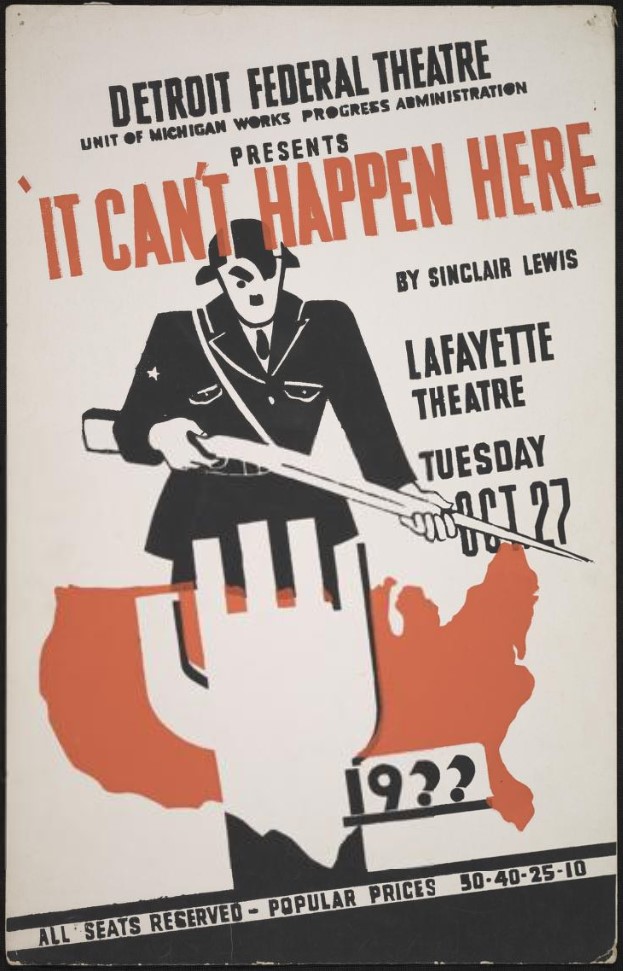
Bahn’s second important reference is to Sinclair Lewis’s play It Can’t Happen Here, which he pairs with Love on the Dole as showing how the FTP has departed from its original ‘non-political founding’ intentions. This was, like Greenwood and Gow’s play, an adaptation of a novel, first published by Lewis in 1935. Novel and play imagined the government of the USA being taken over by a Fascist president who after election subverts the constitution. As Bahn reports, this play was indeed, and unlike Love on the Dole, widely performed by the Federal Players across a large number of venues, with a large variety of posters, some attributed to the ‘Federal Arts Project’, some pictorial. The greater number though were text-based, like our Love on the Dole one (though none, I think have the same dynamism in their uses of text). All four of the example poster images below are borrowed with thanks from the Library of Congress, and reproduced in line with their general guidance that works produced by federal workers are in the public domain (see results for a Library of Congress search for Sinclair Lewis, It Can’t Happen Here: https://www.loc.gov/search/?in=&q=sinclair+lewis+it+can%27t+happen+here&new=true . The first is from the Lafayette Theatre, Detroit, the second from the President Theatre (place unspecified), the third from the Park Theatre (location unspecified), and the fourth from the Adelphi Theatre, New York. The two pictorial designs clearly indicate that the play concerns Fascism in the USA, one focussing on a Facist leader, the other on Fascist followers, though interestingly the hands in the foregrounds of each are used differently: in the second the clenched fist signifies complicity, while in the first the hand raised in a stop gesture suggests at least the possibility of resistance. All four advertise the low ticket prices which, as in the case of Love on the Dole, were part of an FTP policy to help attract wide audiences (and help to fill theatres). None of these productions (nor any other of this play) offered a music programme or community song fest as an additional attraction.
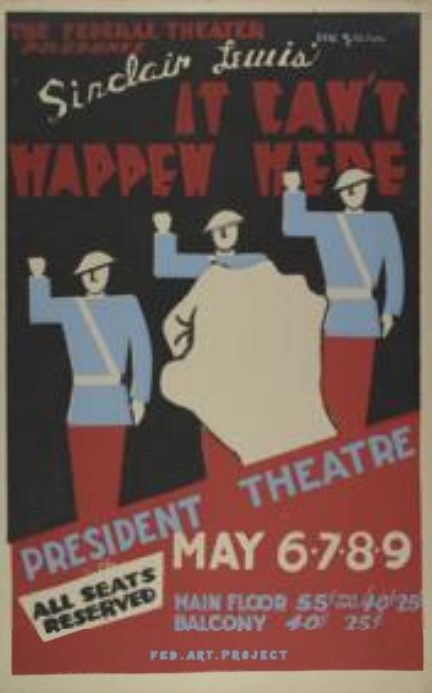
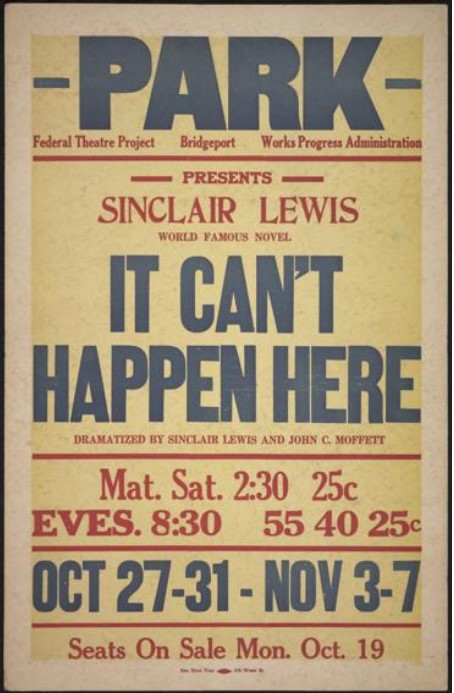
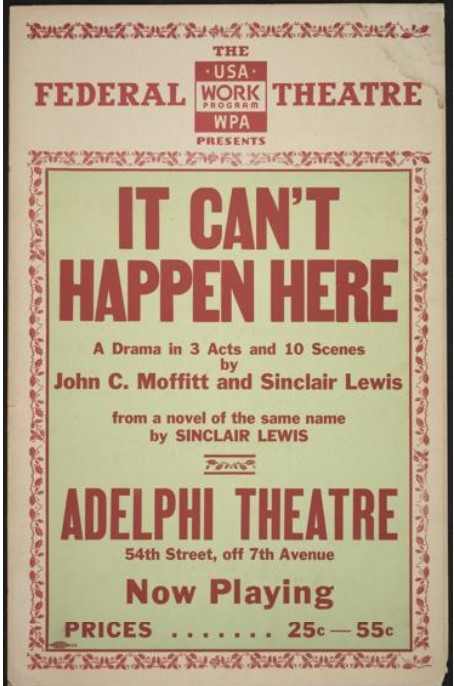
For Bahn, Love on the Dole and It Can’t Happen Here are clearly paired as leftist theatre, and hence illustrations of his thesis that the FTP is parting from its original politically neutral mission. Certainly they are both liberal or leftist in tendency, but seem very different kinds of play. Love on the Dole is about the reality of the here and now for many ordinary people since 1929 – equally one might think in the US as in Britain – while It Can’t Happen Here is a dystopian projection, a what-if narrative. However, as the novel’s wikipedia entry makes clear, the possibility of an attempt by a populist to replace Roosevelt as president and his administration was based on a potential reality. Lewis wrote the novel and the play to undermine the influence and campaign of the populist Democrat (and some think demagogue?) politician Huey Long to win the 1936 elections and introduce more radical (if not necessarily either socialist or democratic) policies to address inequality and redistribute wealth. This makes it, as Bahn concisely suggests, a clear instance of an FTP sponsored piece which intervened in current politics on the side of the current administration. Here again Bahn offers a satirical comment – ‘It Couldn’t Happen Here?’ – suggesting that actually the FTP is itself undermining democracy by disseminating pro-government propaganda on a large scale, just as Lewis’s fictional fascist President ‘Buzz’ Windrup does to repress alternative ideas and dissent. To me the focus of Lewis’s play on specific political movements is more obvious than Greenwood and Gow’s play, which has current social conditions as it main theme, though of course these have political implications.
Given that Chester B. Bahn was a member of the Syracuse Division FTP Advisory committee, publishing his public dissent from a local decision of the group – to stage Love on the Dole – as well as associating it with a nationwide FTP staging of Sinclair Lewis’s anti-fascist play, and developing a critique of the whole nationwide FTP programme, seems an unusual step for a committee member. Presumably however, he would have felt justified by joining an FTP committee which he believed to represent one kind of project only to find that in practice it was supporting projects with values he could not wholly support.
4.3. Denis Gurney’s view of Love on the Dole and the FTP
Chester B. Bahn’s interview has a very short and more or less neutral introduction and then allows Gurney to put his thesis in his own words and at quite substantial length. Bahn says that there is in Gurney’s view ‘something more than merely the desire to amuse or entertain’ (which I do not find surprising as a view of Love on the Dole) in the Syracuse FTP production of the English play Love on the Dole, and that it is ‘at least inferentially a vindication and defense of the New Deal’s WPA and thus ‘certainly not undesirable on the part of the national administration’ . This seems to be perfectly in line with the arguments of Bahn which we have already explored, however to my surprise I do not think Gurney does argue exactly the same thesis as does Bahn. Instead, as we shall see, Gurney regards the English play as offering an important contrast to the American way of doing unemployment and unemployment relief, and thus an object lesson in the superiority of the US approach. Indeed, the article has a sub-heading which makes the topic completely explicit: ‘Love on the Dole contrasts English Aid System’. In this view Love on the Dole does support the wisdom of the New Deal and the WPA, but not so much by evoking sympathy for the the unemployed as by showing how weak in comparison is the British dole system at providing unemployment relief! Gurney opens by noting that though there are isolationist tendencies in the US, it is connected to events elsewhere in the world through ‘wireless, the newsreel and fast transportation’, and that there are things which Americans can learn from observing other nations:
The question arises – does this country take advantage of that which can be observed? In one instance, at least, the answer is an emphatic ‘Yes’. Had it not been for the institution of the dole in England as a means of relief for those people caught in the debris of the post-war collapse of trade, and the subsequent depression, the chances are that the United States Government would not have been able to avoid its vices when the same necessity arose here years later.
That the Government had the good sense to profit from the experience of England is made apparent in Love on the Dole – tragic story of a young English couple who find it impossible to accept even the gift of love while accepting the dole.
Critics, political and otherwise, of the WPA, and fact everyone who is interested in the welfare of the country owe it to their Government and themselves to see this play and observe at first hand how infinitely superior is the WPA despite its possible faults, than England’s dole system. . . . Of course certain conditional differences should be taken into consideration in making the comparison. First and foremost is the difference in the standard of living . . . The balance of the difference in the ratio is made up of the more generous allotment of WPA relief.
It may be and probably is possible for a young couple in America to make ends meet on relief, but it certainly is not possible for a similar couple to do so in England on the dole.
So that unless a job is forthcoming – the chance is small – continuous forced dependence on the dole breed discontent, loss of self-respect through inability to supply even the necessities of life causes loss of freedom to live as nature intended, because marriage is out of the question; and finally induces lack of discretion when the agitator makes his appearance, as he indubitably will
There is a definite lesson to be learned by American audiences, and that is that relief without accompanying employment, or relief on too niggardly a scale, only serves to breed discontent and possible revolution (Syracuse Herald, 10 September, 1936, p.xx).
Gurney gives a very specific interpretation of the play, and while he and Bahn agree that putting it on as an FTP play supports the the WPA and the New Deal, they see that support in differing way. Gurney notes the generally different standards of living between US and British workers, and indeed between the unemployed, something Greenwood had himself observed in a newspaper article written while he was in New York attending the Broadway rehearsals of Love on the Dole. Greenwood wrote of an unemployed family he visited in New York, the Morands that:
Here’s a family . . . that you simply wouldn’t find on relief in Manchester. They’ve a radio, a refrigerator, a bathroom . . . the standard of destitution is higher over here’ (New York Post, 25 April 1936, Vol 1 of WG’s Clippings Book in the Walter Greenwood Collection, University of Salford Archives – see also the entry for that date in Walter Greenwood’s Biographical Timeline *).
Indeed, this higher standard of living might have been reflected in the Syracuse production of Love on the Dole where suppliers of two stage properties – a phonograph and a wireless – are thanked in the Programme. In Britain under the Means Test such ‘luxuries’ would generally have to be sold.
Nevertheless, Gurney also argues that relief payments are simply higher in the US, and also sometimes delivered together with work relief – periods of job creation. The state of being in Love on the Dole thus IS possible in the US relief system, leading to less desperation. I also note that while Bahn appears to regard him as distinctly ‘leftist’ in sympathy, Gurney clearly here presents himself as additionally supporting the WPA programme because it reduces the opportunity for ‘agitators’ to play on discontent to promote revolutionary feeling. In short, Gurney is if leftist then clearly a democratic and not a revolutionary leftist. Perhaps this American inflection explicated by Gurney so explicitly – assuming the actual production managed to imply it though performance – might modify my account so far of the accompanying music programme? I will return to this matter in the article’s conclusion.
4.4 Federal Theatre Project Report on Potential of Love on the Dole, 4 January 1937
George Mason University Special FTP Collection in turn preserves a New York FTP report of great interest, though I note it is written some four months AFTER the Syracuse production, and that it does not seem to relate as specifically to it as the two Syracuse Herald articles. The report considers the suitability or otherwise of Love on the Dole as a Federal Theatre project – probably with an eye to touring the play more widely in the US as part of Federal Theatre work in the thirties?. Here is the document as a whole, but I will discuss it section by section and have numbered these 1 to 3 and have enlarged them slightly below to improve legibility.
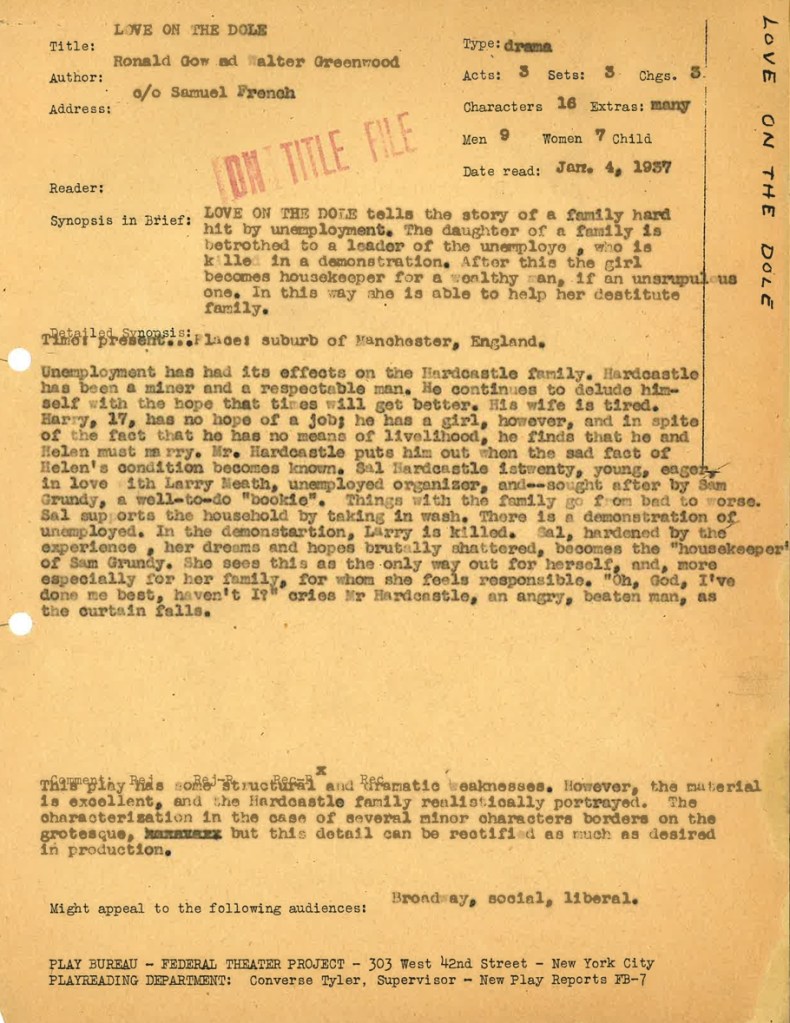
Section 1: essential brief details of the play being reported on
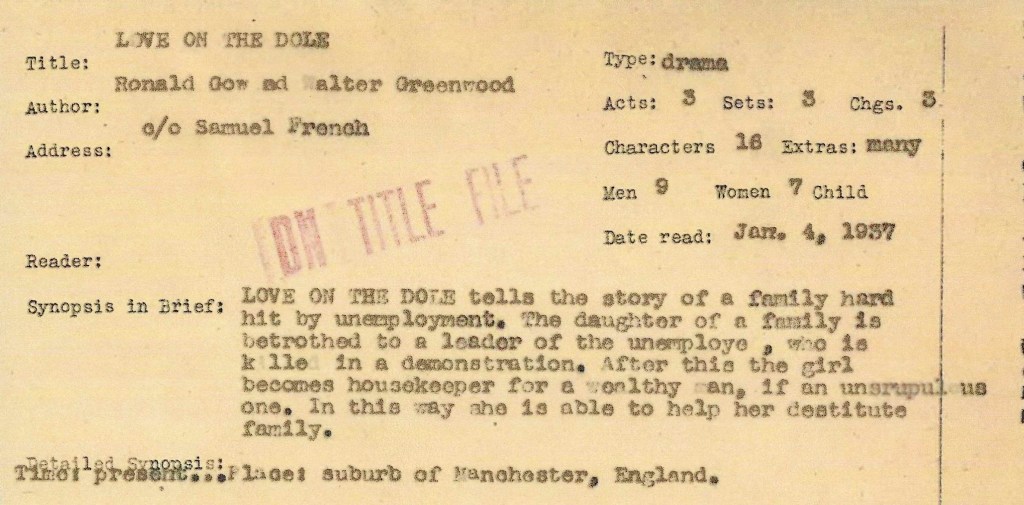
Essential details stated here include authors and their publisher to which any correspondence should be sent, as well as some very practical theatrical parameters, such as the number of sets, number of characters, male and female, main roles and number of extras. Then there is a very concise synopsis, focussed almost entirely on the Hardcastle family, with one reference to the unnamed Sam Grundy. There is no mention of Harry and Helen and their troubles, and nothing about the chorus of three older women, Mrs Bull, Mrs Jike and Mrs Dorbell. Despite Greenwood’s note about the permissibility of setting the play in any industrial suburb, the reader sticks to the original setting of a suburb of Manchester, England.
Section 2: fuller synopsis
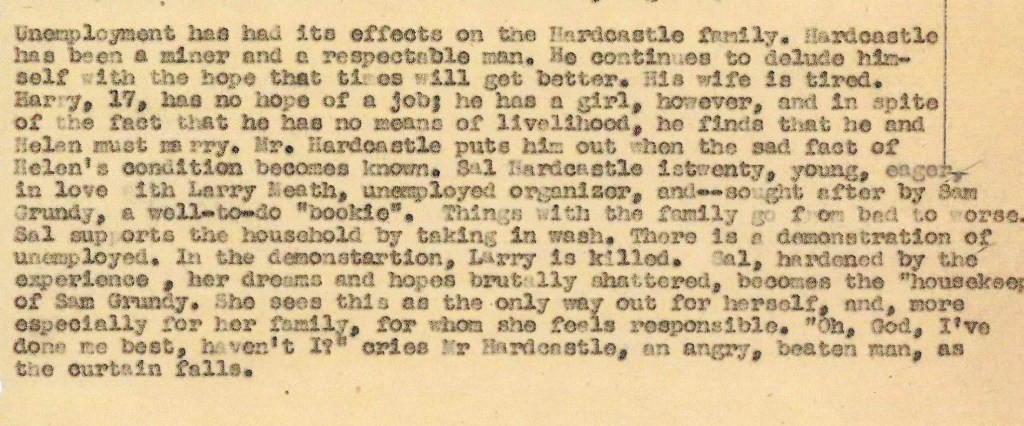
Section 2, the fuller synopsis, does, as one would expect, supply further details: the difficult lives of Harry and Helen, the relationship of Sally and Larry, the circumstances of his death, and Sally’s despair and desperate bargain with Sam Grundy to save her family from destitution. The synopsis even quotes (well, slightly misquotes, omitting a repetition of ‘I’ve done me best;) a line from the play: ‘Oh. God, I’ve done me best, haven’t I?’
Section 3: Judgement on the suitability of the play for the FTP, and types of potential audience
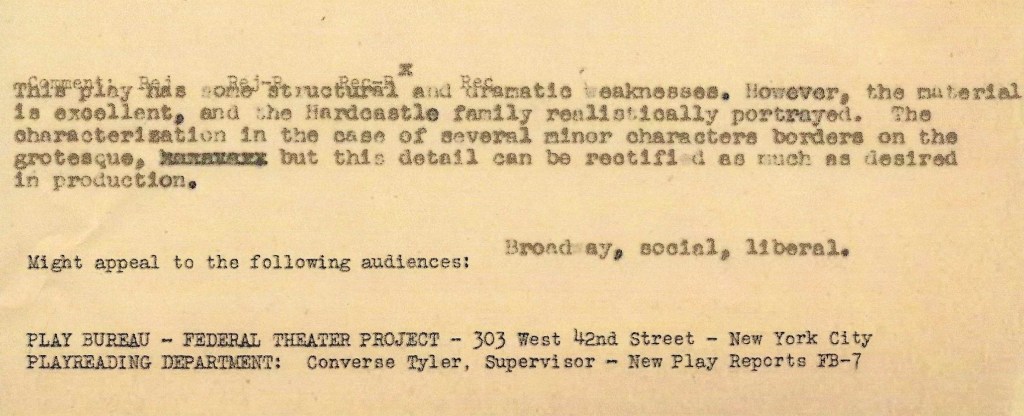
Finally comes the reader’s evaluation, which mainly finds the play’s material strong: ‘excellent’, with ‘the Hardcastle family realistically portrayed. There are two reservations expressed, however: it has ‘ some structural and dramatic weaknesses’, and the reader finds the characterisation of ‘several minor characters’ (I assume this is the first mention of the often-called ‘chorus’ of older women) ‘borders on the grotesque’, but thinks this could be fixed in production to taste. This is a reading which emphasises the serious elements in the play, and which would like to reduce any comic aspects (even grim one) perhaps to zero (unlike The Times reviewer who, if rather gnomically, saw the three grotesque older women as also part of the play’s core themes: ‘the three old harpies ‘ illustrate ‘for the dramatist, the innermost difficulties of the problem he has set out to discuss’, 31 January 1935, p.12). Though difficult to read because it is overtyped by the evaluation, there is also a presumably pre-typed part of the form which the reader has completed, to record their overall view and decision to reject, reject with reservations, recommend with reservation or recommend outright:

This reads: Comment Rej Rej – R Rec – R X Rec
I take it that in the manner of such forms this records through the superscript X the decision to Recommend, with Reservations. Finally the reader suggests likely audiences for this play: Broadway, social and liberal. The reader could be fairly certain about the appeal to a Broadway audience since the play had indeed run for a year on Broadway during 1936, and presumably, unless it means those who go to the theatre primarily for entertainment, the ‘social’ categorisation suggests an audience interested broadly in social plays or issues, but perhaps less clearly politicised than ‘liberal’ audiences. Like Chester B. Bahn, this reader takes the play as a serious work of drama – and indeed would like to make it more serious and more purely realist by reducing the comic-grotesque aspects, that is the chorus of older women (though I would see these as quite central to the play myself). Certainly the New York FTP reader sees no political difficulty with the play, but then he or she is an employee of the FTP so one wold expect their sympathy with such a kind of play. Nor does the reader seem to see the value of Love on the Dole as arising from showing how much worse unemployment and relief measures are in Britain than in the US: there is nothing to suggest that he does not see the play as chiefly focused on the portrayal of poverty and its wearing down of decent people who have no ways left of combatting its corrosive effects, nor is there any suggestion that this portrayal would have no direct relevance to American audiences. Nevertheless, Love on the Dole was not adopted as a widely-performed FTP play.
5. Finale? Some Tentative Conclusions
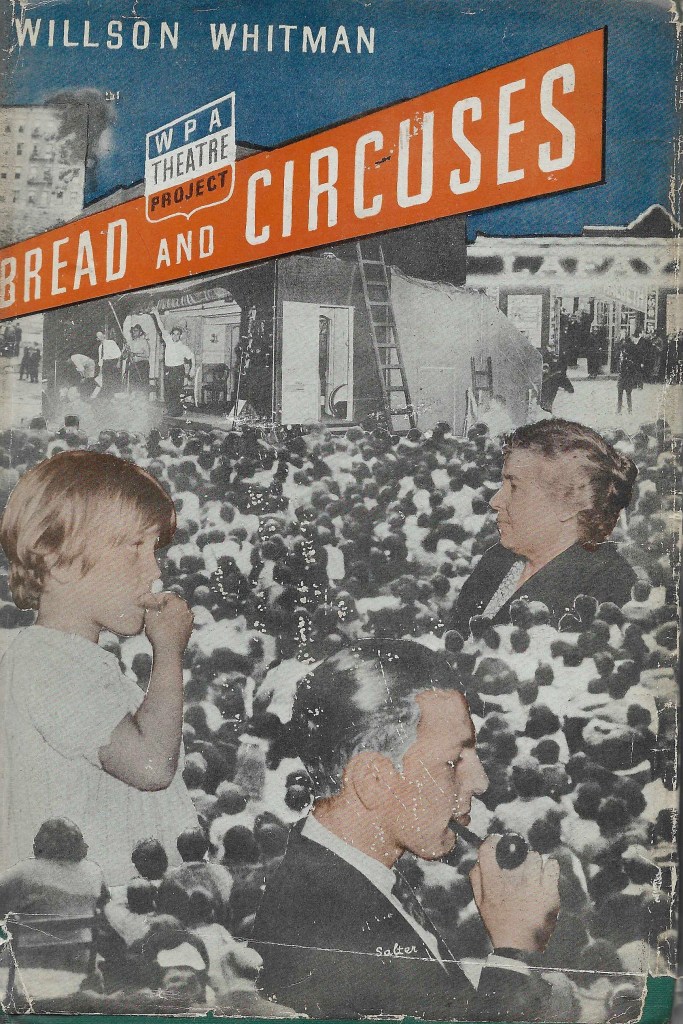
The Syracuse Civic Theatre FTP Love on the Dole of September 1936 clearly had, at least, some unusual features: it was the only FTP production of the play, and indeed probably the only production of Greenwood and Gow’s play in the US in the thirties off Broadway. Thus there is mention neither of the Syracuse production nor of Love on the Dole itself in one of the earliest histories of the Federal Theatre Project: Hallie Flanigan’s own Arena: the Story of the Federal Theatre (Duell, Sloan and Pearce, New York, 1940). Love on the Dole equally is not included in the list of FTP plays produced in the even earlier book by Willson Whitman titled Bread and Circuses: a Study of Federal Theatre (Oxford University Press, New York, 1937), and while there is one reference it is almost certainly to the commercial Broadway production of 1936 not to an FTP production (see p.80, where Greenwood and Gow’s play is compared to the play Class of 29 by Orrie Lashin and Milo Hastings, originally presented on Broadway but then often produced by the FTP).
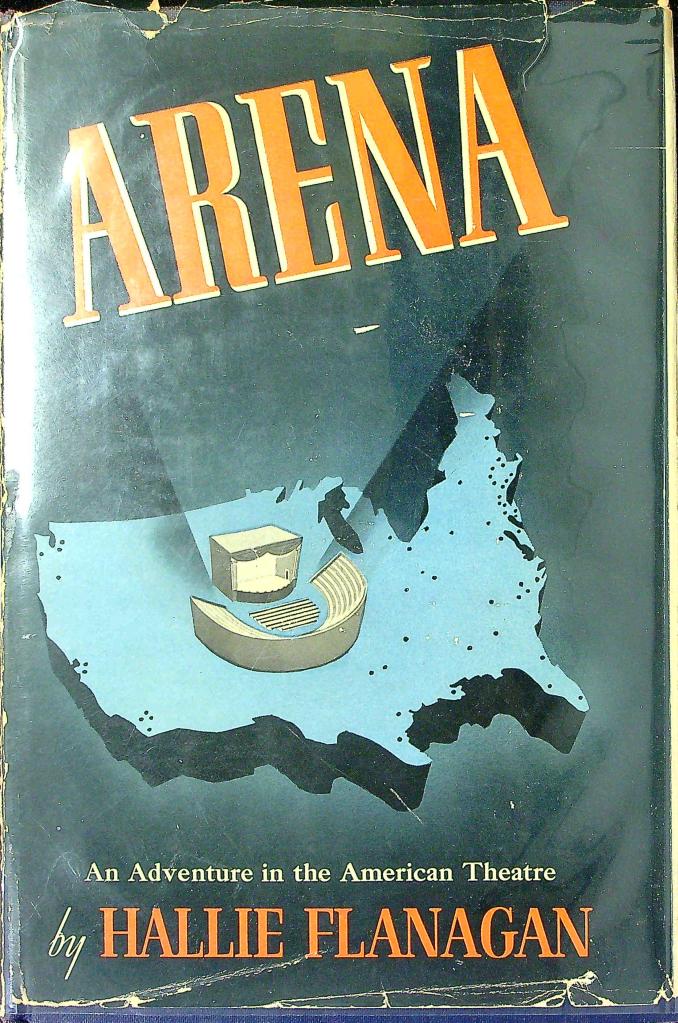
Both FTP history dust-wrappers evoke the Federal theatre Project through their designs, Arena implying a theatre that reaches right across the USA (though it may also suggest a wireless broadcasting across the States), while Bread and Circuses uses photo-montage to suggest the appeal of an FTP play to varied, real and ordinary individuals and equally to those individuals assembled as a mass audience (scans from copies in Author’s collection).
Greenwood and Gow’s play also may or may not have been adapted into a more American version, with different language use and implied background. It was certainly a unique production of Love on the Dole in inspiring debates about the relation of FTP theatre to government, and allegedly functioning as a vehicle for the comparative effectiveness of relief systems. The argument about the play being too close to government would never have occurred to British theatre folk or audiences since at the core of the play was a complaint persuasively put that the British government was doing very little effectively to intervene in the economic and social crisis which had already been in progress since 1929, a view which was often seen sympathetically by a broad range of public opinion – though not necessarily from a single perspective. Lloyd George from the New Liberals and Harold Macmillan from the left of the Conservative Party offered their versions of a New Deal as an alternative to current policies in Britain, but neither gained traction (in the Thirties at least):
It is revealing of the consensus among radicals of all parties that the Labour Party’s new views were very similar to the ideas expressed by Harold Macmillan, a dissident Tory, in his significantly titled book The Middle Way. This was another proposal for a state-managed mixed economy, eschewing both full state control and doctrinaire laissez-faire, and using monetary and fiscal techniques plus minimum wage legislation and generous welfare allowances to raise and sustain the level of demand and therefore of employment . . . Lloyd George was also still active in these years. Echoing Roosevelt’s innovations in the United States, he launched his New Deal with appropriate theatricals in Bangor in January 1935, brushing up his 1929 plans for a huge reflationary public works scheme (Stephen Constantine, Unemployment in Britain Between the Wars (Seminar Studies), 1980, p. 74; Taylor and Francis, Kindle Edition, 2014).
There was another curious feature of the production which might add another layer of complexity: was Denis Gurney’s perspective not solely a typical American view of the New Deal, but one given another filter by his own English origins, which perhaps made him feel overly optimistic about its benefits, given his strong sense of the great contrast with the British experience of the dole? (though the only references to his life in England in the British Library Newspaper Archive are in The Stage, date to the mid-nineteen-twenties, refer to theatre roles, and give no sense at that point of any particular political commitments). Historians have not always been as optimistic about the impact of the New Deal since, as Stephen Constantine (who of course did the first serious research on the play of Love on the Dole as a key historical event) suggests:
For all the bustling activity of Roosevelt’s New Deal there remained much that was incoherent, even contradictory, in its conception and operation, and with 13 million Americans out of work in 1933 and still almost 8 million in the best year 1937, it did not seem conspicuously successful (Unemployment in Britain Between the Wars (Seminar Studies), 1980, p. 78, endnote 5, Taylor and Francis. Kindle Edition, 2014, where Constantine summarises some of the comparative work of P.S. Bagwell and G.E. Mingay in Britain and America: a Study of Economic Change 1850–1939, Routledge & Kegan Paul, 1970).
Constantine, Stephen. Unemployment in Britain Between the Wars (Seminar Studies) (p. 108). Taylor and Francis. Kindle Edition.).
The Syracuse production was also unique in having a full musical programme and a community song fest (though we know that music did play an important if much more concise role in the original British production of the play – see Two/Three Songs, Two Hymns, Two Socialist Anthems, and a March in the Play of Love on the Dole: Act I and Act III, Scenes 1 and 2 (1934/1935) (and a Coda on a Song in the Film, 1941) *). Even after all this discussion, though, there remains considerable uncertainty about how the musical frame and the play itself related or interacted. Surely as Advisory Committee member Chester B. Bahn would have known about the plan to part-sell the play through the music, and surely also saw a draft of the poster? Likewise, as assistant director and actor, Gurney must have known about, and rehearsed and acted with, the performed and full musical programme? Yet neither Bahn nor Gurney make any reference to it. Perhaps this implies that for them it was of no real importance, not part of the play proper, and with no serious impact on what they both regarded as weighty matters of politics and drama. Perhaps the importance of the live music was only to get people into the Civic Theatre and to have a full house and a good night (or matinee) out – but still it seems to me that it must have become to some degree part of the overall audience experience at the play, and effort was put not only into the musical performance but presumably also into the choice of music which accompanied the play somewhat more directly, and the choice of song fest numbers. Certainly employing the musicians fulfilled another FTP aim – to keep creative workers in employment, or get them back into work. But was the whole show in tune or rhythm with itself? Perhaps if Gurney’s thesis that the point of the production was to show how much better off the American worker (even if unemployed) was than the British worker, then the audience might have felt they did have things to sing about, and could indulge in some upbeat (if sometimes consciously escapist and wish-fulfilling) music between the acts of Greenwood and Gow’s tragi-comic BRITISH story? Perhaps they went home happy even after Love on the Dole? I leave these questions with you . . .


