
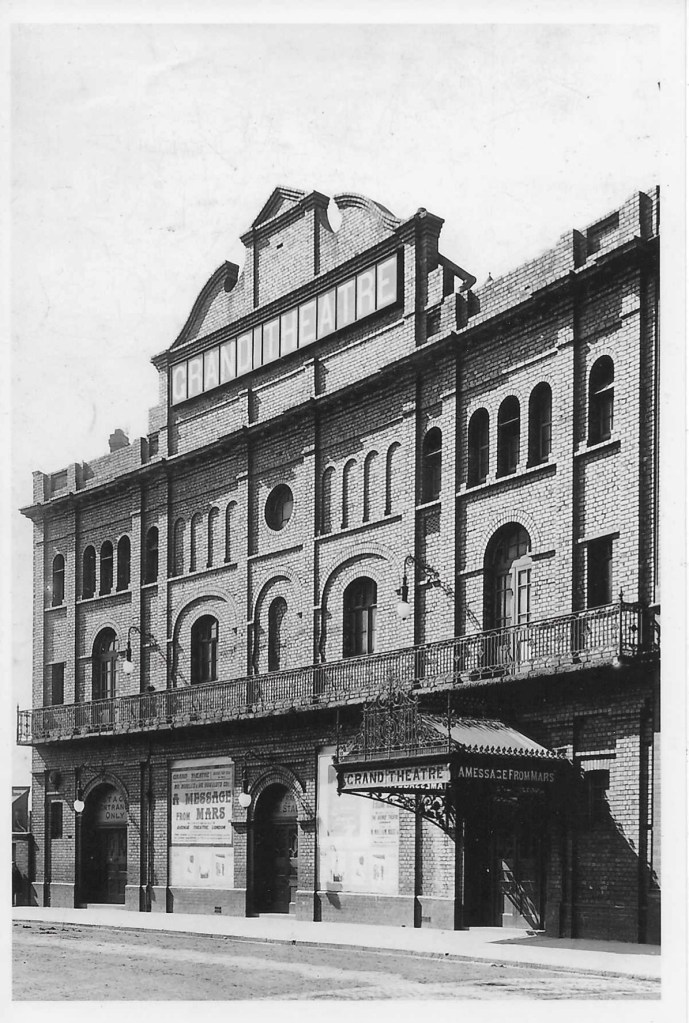
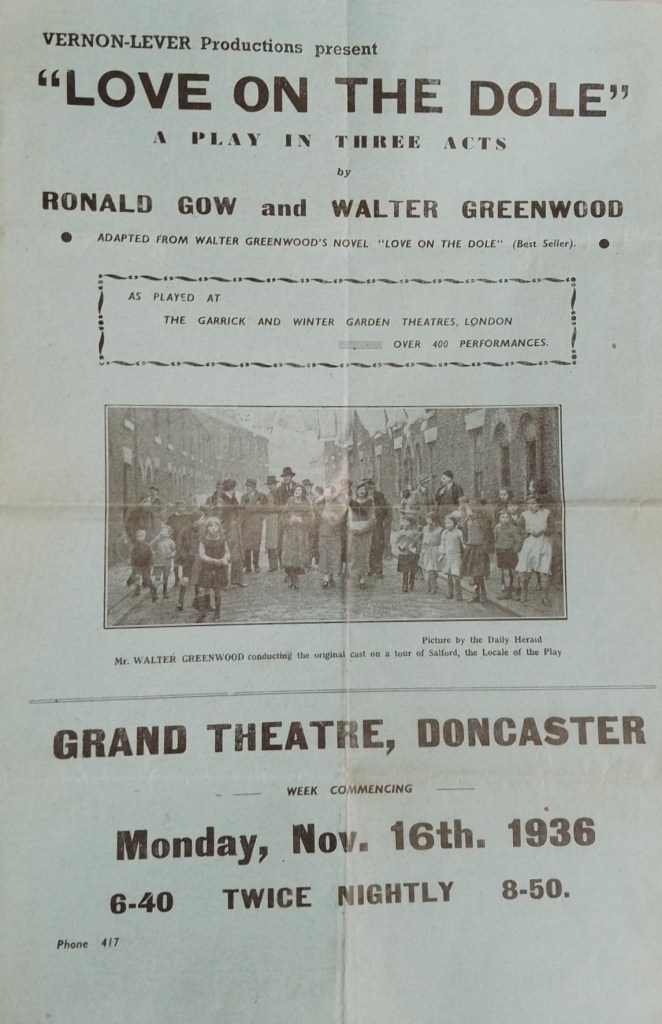
Vernon-Lever was the production company which toured Love on the Dole throughout Britain not only after its great success in London at first the Garrick and then the Winter Garden Theatre in 1935, but also before, with their provincial trial tour of 1934. They surely did very well financially from their support for the play, and were indeed as vital to its success in their way as authors, producers, actors, reviewers and audiences. I have recently bought an item of Greenwoodiana of a kind which I have never seen before in the last sixteen years of keeping an eye out for such things. It adds to our appreciation of the effort Vernon-Lever put into making sure the play succeeded and is a large double-sided flyer (10 inches x 16 inches) for the Vernon-Lever Love on the Dole as presented at the Grand Theatre, Doncaster in mid-November 1936. For readers outside Britain it might be helpful to say that Doncaster is a city in South Yorkshire, and an important railway terminus – see https://en.wikipedia.org/wiki/Doncaster. The nineteenth-century Grand Theatre, Doncaster, seated about 1,300 in the thirties and looked like this (It is now sadly disused and its environs rebuilt – see https://en.wikipedia.org/wiki/Grand_Theatre,_Doncaster).
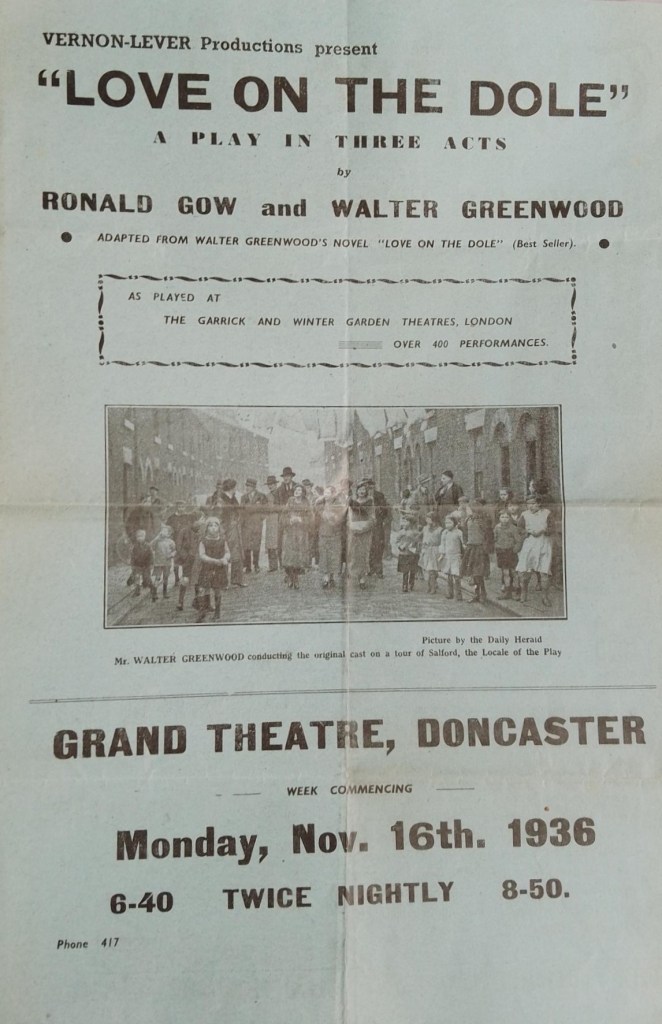
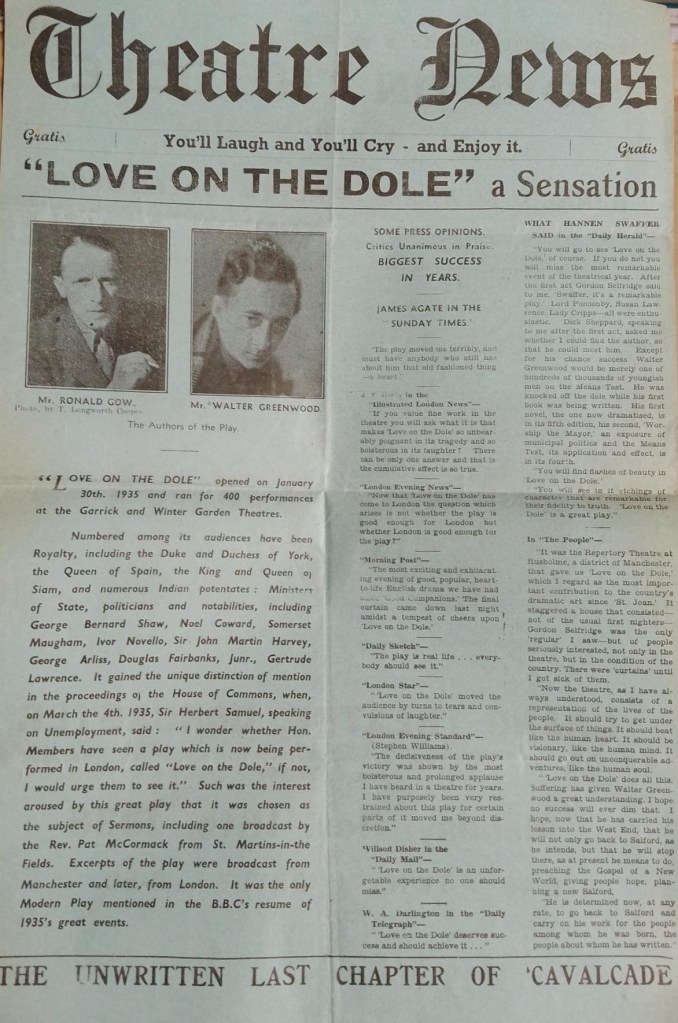
Considerable effort was clearly put into the flyer so it seems strange if it was not used for other venues in the tour, but I have not seen any others, or maybe they have not survived well given the fairly large format. The first side had the essentials needed to advertise the performance, but also included a photograph at the mid-point, while the second side had a concise history of the play’s success, photographs of its two authors, and extracts from reviews in eleven different newspapers, with four signed by some of the best-known theatre critics of the day. In the reproductions below the paper looks grey but is really a light blue in the original, which was larger than these images. I will enlarge some details further below for clearer and closer reading,
The photograph in the centre of Side One is interesting in itself in showing the cast of the play getting a sense of context for the play in a tour of Hanky Park led by Greenwood himself, who had, of course spent his childhood and early adult years there – between 1903 and the success of his novel in 1933, which enabled him, his mother and his sister to move to a somewhat better area in Salford. The photograph is credited to the Daily Herald and is perhaps not that clear (the folding of the flyer does not help – but then it presumably had to be kept safe and tidy for a period of ninety years now). An enlarged image may help somewhat.
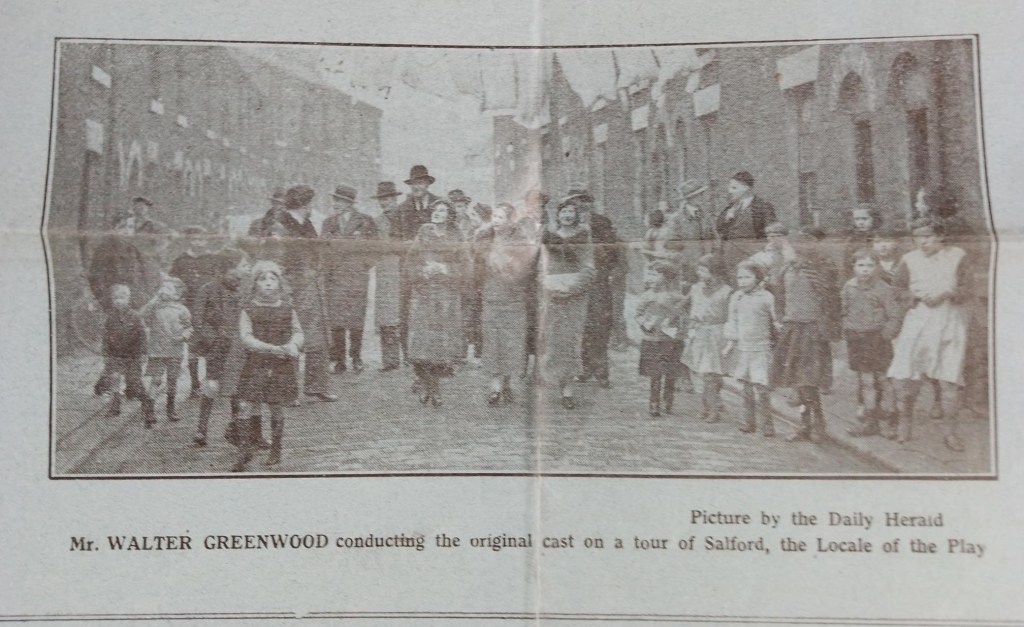
So far I have not been able to find the edition of the Daily Herald in which the photo appeared but will keep searching the British Library National Newspaper Archive. One might think that it would be relatively easy to identify most of the cast members, but actually I cannot with much certainty. I am not even sure which of the male figures is Walter Greenwood, One of the group of three women slightly right of centre must surely be Wendy Hiller – and I guess (but no more) that she is the dark-haired woman at the right end of the row. Blowing the photo up larger does not much help because the enlargement is fairly blurred, given the quality of newsprint photos at the time.

Nevertheless, the photo offered the excitement of seeing a cast which was now very well-known, in a visual context both entirely relevant to the play and yet actually surprising in that it was not a scene from Love on the Dole with one of its sets as background but a photograph of a real street. One of the things early reviewers praised about the play was its ‘authenticity’, ‘sincerity’ and ‘reality’, and this photograph perhaps reinforced that approach to Love on the Dole, showing the cast absorbing the environment of its origins. The cast are well-dressed, apparently for at least moderately cool weather, with over-coats for the men, and what look like fur-coats for the three women in the foreground. The children, who have presumably tagged along in the hope of some diversion – are notably less-warmly dressed, though they could certainly not be described as looking particularly poor or like slum-children.
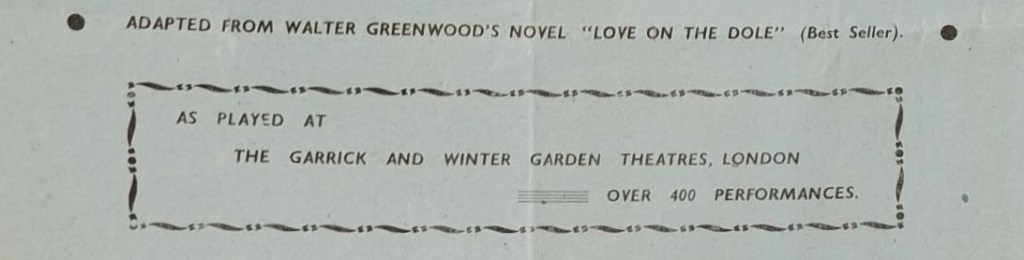
Apart from the photo, which offers a detailed and quite intriguing entry to the play, the rest of Side One sticks mainly to the essentials – place, dates and times of the performances (though not I note ticket prices), and box-office phone-number. There are though two economical expansions advertising the play’s already proven quality – ‘Best Seller’ and its performance history:
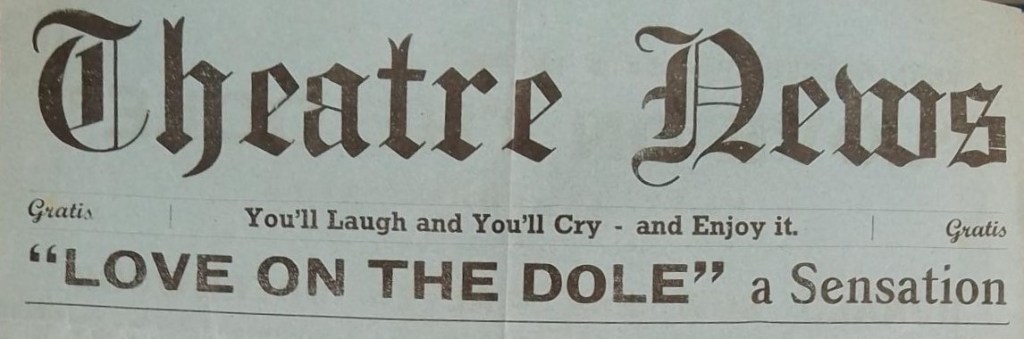
Side Two is much more complicated, with denser and smaller text, though there are two further photos. I think Side Two is based on the assumption that Side One has hooked the reader sufficiently to make them invest further in the greater concentration needed to absorb that second page. In fact, Side Two is presented as a miniature newspaper called Theatre News, and its whole layout with the photos, the columns and the headline mimics that of a newspaper – even down to the price, which in this case is gratifyingly ‘gratis’ or free.
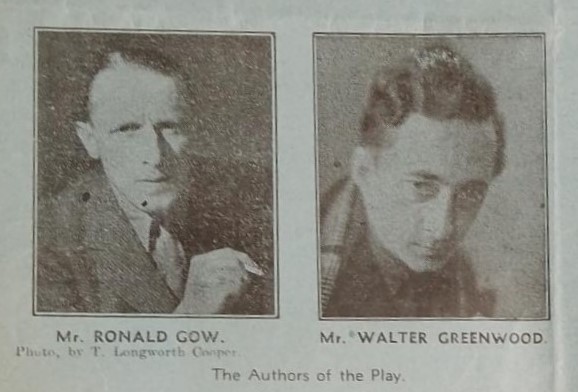
The two photographs give us images of the authors – especially valuable for Gow who was not that often photographed – and puts faces to the names of two authors much discussed in the press over the previous two years.
The column in the larger font beneath the photos tells you a number of remarkable things about the history of the play so far – indeed Greenwood himself repeated many of these achievements at a key point in his career, when arguing against British Board of Film Censor’s blocking of a film adaptation of Love on the Dole in 1940 in a series of phone calls and letters to the press, including one to the Manchester Guardian, published on 26 February, 1940 (p.10). But here is the Doncaster Flyer statent of these achievements, four years earlier and in a very different context:
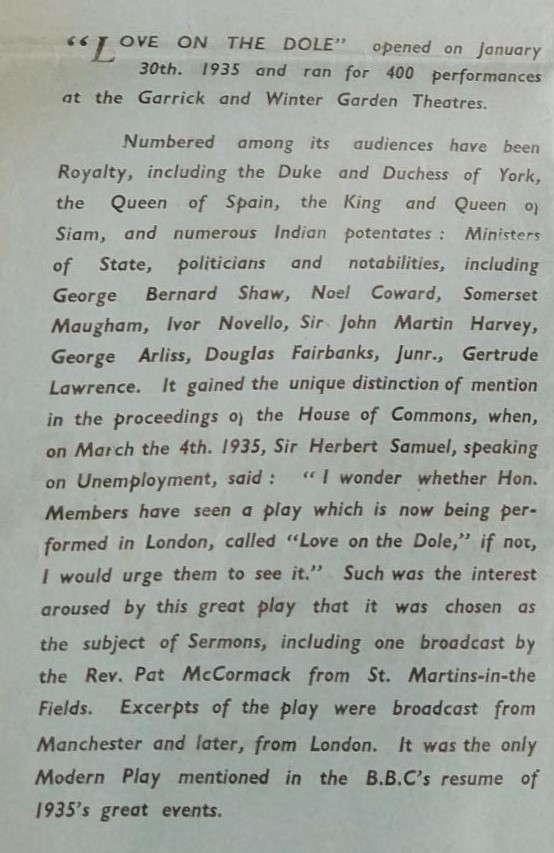
The achievements listed fall into six types: number of London performances, famous audience members, reference in a speech in the House of Commons, the interest of the clergy, radio broadcasts and finally being singled out by the BBC as ‘a great event’ of 1935. The celebrity audience members listed include first a number of monarchs and princes, then a group of authors, most notably George Bernard Shaw, certainly seen as the greatest Anglophone playwright of hs day, as well as a younger but also very successful writer for theatre (and actor) Noel Coward, and the very famous novelist and short story writer, Somerset Maugham. As a matter of fact, Bernard Shaw was impressed by the play’s star Wendy Hiller, but not so much by Love on the Dole itself, about which he gave no public opinion (for his private opinion, see George Bernard Shaw, Wendy Hiller, and Walter Greenwood * ). Next are listed a group of actors with current reputations in theatre, film and radio – two, Arliss and Douglas Fairbanks Junior, were Hollywood stars, though Fairbanks had moved to work in Britain in 1934 (partly, ironically, because Warner Bros in the US had asked its stars to take a cut in their pay because of the effects of the Depression – see https://en.wikipedia.org/wiki/Douglas_Fairbanks_Jr.).
In short, these were audience members to boast about and add to the hints about authenticity of Side One of the flyer, claims for the play both as serious drama and as having, despite its subject matter of poverty, an association with royal, theatrical and film glamour. Next comes serious political notice with reference to the ‘unique distinction of mention in the proceedings of the House of Commons’ [known as Hansard after its official printer from 1776 on]. While this sounds like theatrical hype, it is no more than the truth. The Sheffield Independent reported that ‘a copy of Hansard was posted up outside the Garrick Theatre’, constituting ‘an unprecedented advertisement’ (13 January 1935, p.6). This again points to the authenticity of the play’s portrayal of unemployment and to its status as a national political ‘document’ (though it is not that exactly). The claim that the play is the subject of numerous sermons reinforces the seriousness claim, while also adding a religious dimension and implying that it is suitable for those of religious commitment (the play really was a text for a number of sermons, though there were also clergy who argued in the press that it was far from a work underpinned by Christian understanding and not particularly suited for Christian enlightenment – see Love on the Dole and the Clergy *). Finally, there is the taking up of the play by the BBC – at that time surely an arbiter of what was suitable and of cultural value for the general public.
The wide audience approval of the play – though witnessed here only by attendance at the Garrick or other kinds of recognition rather than by any detailed response to the play’s style or content – is thus covered by Column 1 of Side Two. That leaves Column Two, though it is made up of two columns, to give somewhat more, if not very, detailed critical responses to the play from theatre reviewers. The much smaller font-size here might signal that this is the least important section of the flyer to read or be based in an assumption that a serious reader will still persevere with this size of text and this level of detail. In fact, even when enlarged to twice original size the two side by side columns are difficult to read in the slightly smaller reproduction size (and not that easy in the original size).
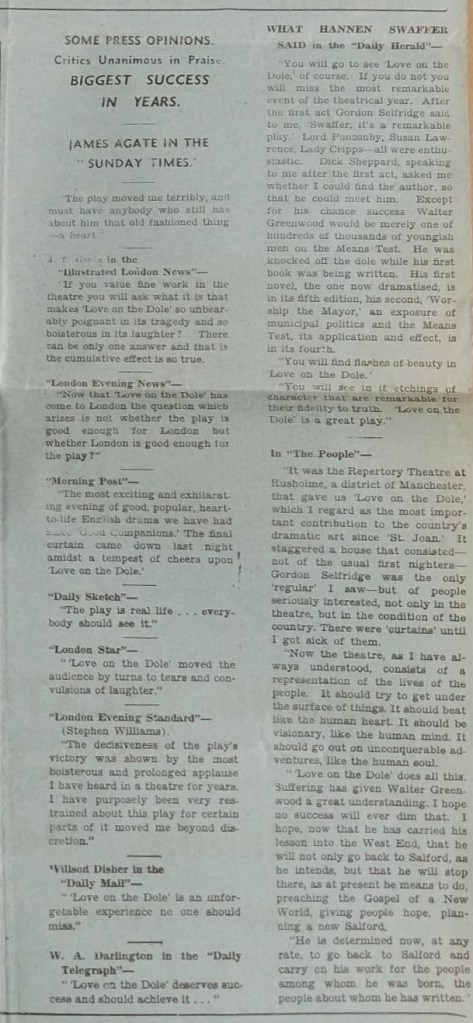
The only solution seems to be to break this up into sections and enlarge each column individually so they can be read and discussed in turn.
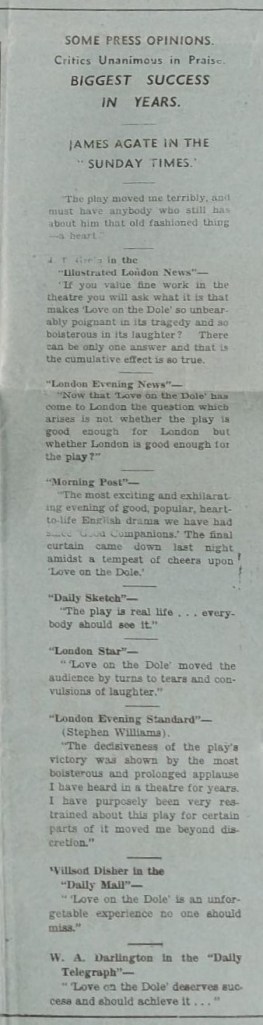
Though I promised ‘somewhat’ more detail about the play itself on the second side, column one certainly does not overdo its engagement with the detail. The praise of the play here is very general and more focused on audience reaction and the mood of the play, with emphasis on its tragi-comic hybrid, perhaps partly to suggest that it will satisfy all genre-tastes – which it usually did. Thus we have: ‘so unbearably poignant in its tragedy and so boisterous in its laughter’ and ‘moved the audience by turns from tears to convulsions of laughter’. Other quotations describe audience responses: ‘the final curtain came down amidst a tempest of cheers’, ‘the play’s victory was shown by the most boisterous and prolonged applause’, and bear witness to the authenticity of Greenwood and Gow’s play: ‘the cumulative effect is so true’, ‘the play is real life’ and ‘an unforgettable experience’. One quotation takes an interestingly different tack, making a point about the value of Love on the Dole as measured against London life: ‘the question is not whether the play is good enough for London, but whether London is good enough for the play?’. This may make an unflattering contrast between London – maybe its frivolity and lack of real understanding of the whole of Britain – as against the serious Northern social and economic analysis and representation of the play. However, so far we have had nearly no reference to the actual Northern setting, the Hanky Park area of Salford, the Hardcastle family and the economics under which they live – the economics of declining heavy and light industry, of the Means Test and of course the Dole itself. That kind of contextual detail is left for the second column of the second side – and perhaps has to be a goal sought by the most determined readers. While column 1 has quoted several famous theatre critics including James Agate, Stephen Williams, Willson (with a reversed n letter-type) Disher, and W. A. Darlington, the whole of column 2 is given over to Hannen Swaffer, who gets closer to the play (though not that close) in his two reviews in different newspapers.
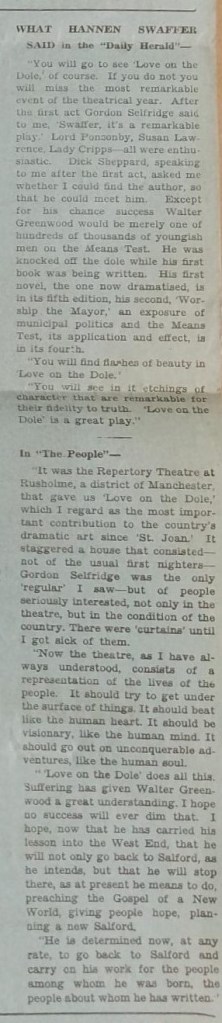
Swaffer was a notable theatre reviewer and quickly became a great supporter of Love on the Dole, no doubt because he admired the play as drama but also because it chimed with his own complete disapproval of the actions of Ramsay MacDonald’s National Government, with its cuts to unemployment benefits and its introduction of the Means Test. In his first article he stresses the unique nature of this play and therefore urges people not to miss the chance of seeing it, and then introduces celebrity witnesses – though a completely different set from those listed in the first column of the flyer. Matthew Ponsonby (1904-1976) came from an aristocratic background but was not perhaps particularly distinguished in any other way, but the other three were public figures. Susan Lawrence (1877-1946) was a Labour politician, who held a variety of positions in the London County Council and then was elected as MP for East Ham, serving in the two Labour Governments of the twenties. In 1931 she refused to join MacDonald’s National Government and lost her seat in that election, but continued to work in several capacities for the Labour Party. In 1936 she and Hannen Swaffer would clearly have been in accord about Greenwood and Gow’s play and its evident critique of the National Government’s treatment of the unemployed. Lady Isobel Cripps (1891-1979) was the wife of the important Labour figure Stafford Cripps and again likely to be sympathetic to Love on the Dole. Dick Sheppard (1880-1937) who asked to meet the author (I have always taken him to mean Greenwood rather than Gow) was the famous Christian Socialist Pacifist Canon at St-Martin-in-the Fields in London, which he opened as a centre for the poor and homeless. It was he and Isobel and Stafford Cripps who introduced Greenwood to the artist Arthur Wragg and encouraged then to produce a book together – which became the wonderful The Cleft Stick (see Walter Greenwood and Arthur Wragg’s The Cleft Stick (1937)*).
At this point Swaffer makes a move not directly to the play but to its origins in Greenwood’s life-experience: ‘except for his chance success Walter Greenwood would be merely one of hundreds of thousands of youngish men on the Means Test’. Needless to say I do not quite agree with this – Greenwood had not written his novel by chance and had a good grasp of narrative though his subject and milieu was naturally what he knew and blazed with indignation about. However, from Swaffer’s point of view this ‘randomness’ made the author more typical of his origins and added a layer to his own praise of the ‘fidelity’ of Love on the Dole. He does make one directly aesthetic point, declaring there are (unexpected?) ‘flashes of beauty’ in the play.
The column then switches to another review by Swaffer in The People newspaper and while still abjuring any detail about the play does focus on questions about the nature of theatre, linking serious drama to social concern. He begins though by comparing the theatrical significance of Love on the Dole with that of George Bernard Shaw’s St Joan from 1923 (there has been one previous theatrical comparison in Column One, when it is said to be as ‘good, popular and heart-to-life’ as J.B. Priestley’s The Good Companions from 1931, adapted from his 1929 novel). Then Swaffer introduces a theory of what we might call socially responsible theatre, suggesting that the audience came not for the usual ‘first-night’ reasons, but because they were ‘seriously interested’ both in the theatre and ‘the condition of the country’. These audience members thus live up to the condition of true theatre which ‘represents the lives of the people’ and tries ‘to get under the surface of things’. The capacity to write this kind of drama is again assigned to Greenwood’s experience – his ‘suffering’. Finally the author is shown as loyal to his northern working-class background – having brought his message to the West End, he will return to work further in Salford and to preach ‘the Gospel of a New World’ and bring (presumably Socialist) hope. The final sentences must, I think, refer to Greenwood’s role as a Salford Labour Councillor, to which he was elected in 1934 (and served on in until 1937).
That is the conclusion of the flyer apart from what looks initially like a rather perplexing piece of text at the bottom of Side 2:

This refers to Noel Coward’s hit play Cavalcade, which opened at the Drury Lane Theatre in October 1931. It covered, with multiple scenes and sets and an extraordinarily large cast, the history of Britain from 1899 to 1930.
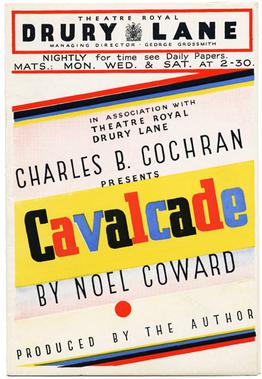
While, as the title suggests, there is an element of a spectacular ‘parade’ in the play, it also has to cover the Second Boer War of 1899-1902 and the World War of 1914 to 1918. As Michael Billington observed in The Guardian of a revival in 1999, the play was seen as a ‘patriotic pageant’ but also had anti-militaristic elements and recorded a decline of opening of century hopes into industrial slaughter and, indeed social uncertainty. The last scene set in 1929 is titled ‘Chaos’ (see https://en.wikipedia.org/wiki/Cavalcade_(play)). If Love on the Dole does not seem the obvious play to pair with it, it actually it does follow on well, introducing the reality and inglorious nature of working-class life in Britain in the nineteen-thirties, which can be seen as ‘the next chapter’ of British history. This cryptic reference is an intellectual, social and cultural one, but also, of course, links Greenwood and Gow’s play to another theatrical hit. The description actually first appeared as part of an advert for the pre-London tour of Love on the Dole to the Preston Royal Hippodrome on January 22, 1935 in the Lancashire Evening Post (p.1). Perhaps it was originally a quotation from a review? I will keep looking.
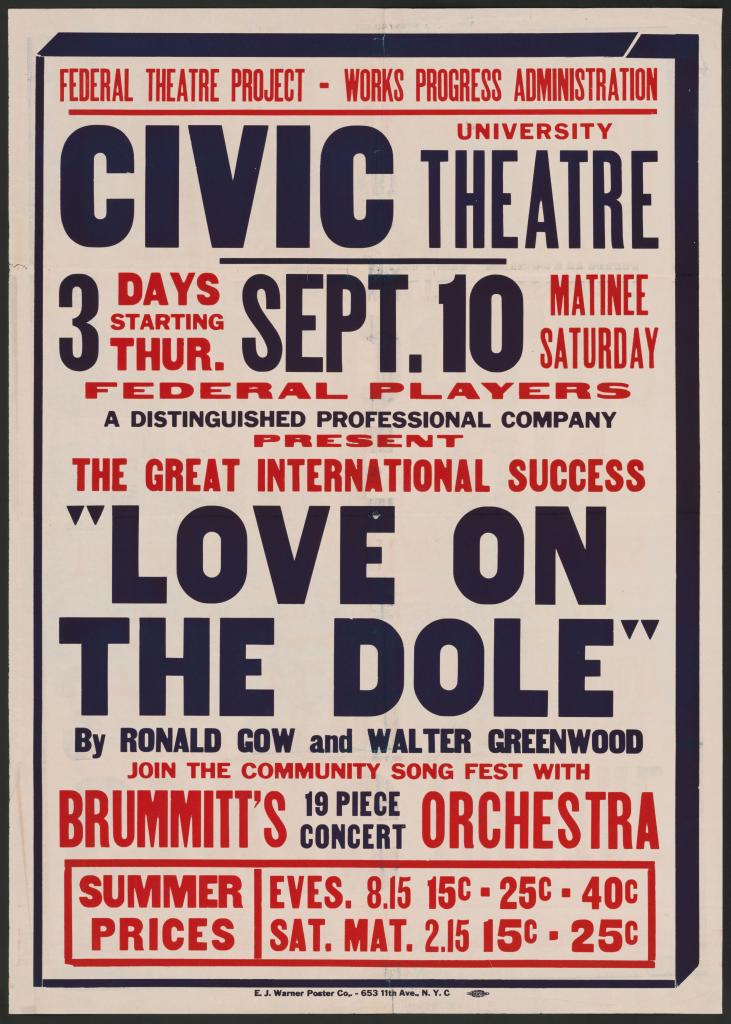
The Doncaster Flyer is close in date to the Federal Theatre Players Syracuse poster, but clearly very different in style. While the US poster is colourful and graphically innovative, the Doncaster flyer sticks to a traditional and mainly newspaper format. However, it is less mysterious than in some respects the Federal Players one is, and all the photographic and textual material is directly relevant to Love on the Dole and to the history so far of the play as a phenomenon (for some mysteries about the US poster and production see The Federal Players Play Love on the Dole at the Civic University Theatre, Syracuse NY, with a Full Music Programme and a ‘Community Song Fest’ (September 10-13, 1936) *).
I think it is fair to say that the flyer starts with easily approachable material and then becomes gradually more demanding on Side 2 though it keeps its intellectual material accessible. It covers a range of material which is intended to be attractive, including the famous cast, the success of the play, its authenticity, its origins in Greenwood’s own experience, its tragi-comic aspects, and its engagement of drama with the problems of the time. I have sadly not found a review of the play at the Grand Theatre, Doncaster so I do not know how it went down or if there were full houses, but given the effort put into the flyer there surely should have been. There were Vernon-Lever productions of Love on the Dole in the following cities and towns – though it is by no means a complete list:
Aberdeen, Aldershot, Boscombe, Bradford, Brighton, Brixton, Chelsea, Chesterfield, Chiswick, Devonport, Eastbourne, Finsbury Park, Glasgow, Hackney, Hartlepool, Holburne, Hull, Kingston, Lancaster, Leeds, Lewisham, Liverpool, Manchester, Nelson, Nottingham, Plymouth, Portsmouth, Preston, Salford, Sheffield, Shepherd’s Bush, Sunderland, Swindon, Wolverhampton, Woolwich.
However, this seems to be the only surviving double-sided large flyer. One Doncaster audience member anyway must have valued the play since they preserved this flyer so carefully for some portion of ninety years: I am very grateful to them because it adds to our sense of how Vernon-Lever brought in audiences to Love on the Dole and how it was a focus for wide public conversations about theatre and society, work and class.

