
Across his forty-odd year career Greenwood gave many interviews to the press, and I have discussed some six of the most important of these in articles on this website so far. This though is another case deserving discussion. It was the first time he made a press appearance, while Love on the Dole was still forthcoming, and marked the notable turning point in his life when he could say that he was indeed an author (27 April 1933, p.1). In his first introduction of himself to the public he made some points about his life so far and most importantly some key aesthetic and social points about his novel and its ambitions.
And also rather notable was the headline: ‘Turned Idle Days to Money’. It must be the least flattering headline Greenwood was ever given, and immediately appears to proclaim a hostility to the unemployed, who are apparently by definition ‘idle’, which does rather imply a choice. Perhaps there is also a certain hostility towards writing – which can only be justified as a money-making activity, and even then the transformation of ‘Idle Days’ to ‘Money’ may imply this is an unfair use of that time: writing and making money at the taxpayers’ expense, maybe? In fact, Greenwood in his ‘Author’s Preface’ to The Cleft Stick (1937) denied having been idle, though rather confirms that his writing was unwittingly subsidised by public funds: ‘I have never been unemployed in the sense of being an idle man subsidised by the Government: these stories and a huge stack of unpublished literary endeavour bear witness to that claim’ (p.7). Money well-spent?
There is then a sub-headline which is still rather ambivalent, not to say sniffy, but may be read as expressing a more positive attitude: ‘Unemployed Man Writes a Book’. This is still an impersonal, external description, and suggests that it is a feat beyond ordinary belief, as it if surprising to find an unemployed man able to write at all, let alone an extended prose-work. However, after those two headlines, which might be expected to catch an unsympathetic audience (some not on the dole were certainly quite hostile towards those on the dole in the early thirties), there is a much more sympathetic editorial paragraph easing the reader into a more positive frame of mind:
Love on the Dole, a book which will be published in the near future by Jonathan Cape, may bring fame to a Salford author who has taken his place in the queue at a local labour exchange and has demonstrated with fellow-unemployed against the Means Test (p.1)
It is as if the the paper’s readership must be brought gently towards the idea that an unemployed working-man can become a writer (though see my conclusion for another explanation). After that there is a further gentle and more personal introduction:
The author is Mr Walter Greenwood of Lower Seedley Road, Pendleton, and he is not yet thirty years of age. Today he told a representative of the Manchester Evening News the story of his struggles to earn a living and enter the world of literature.
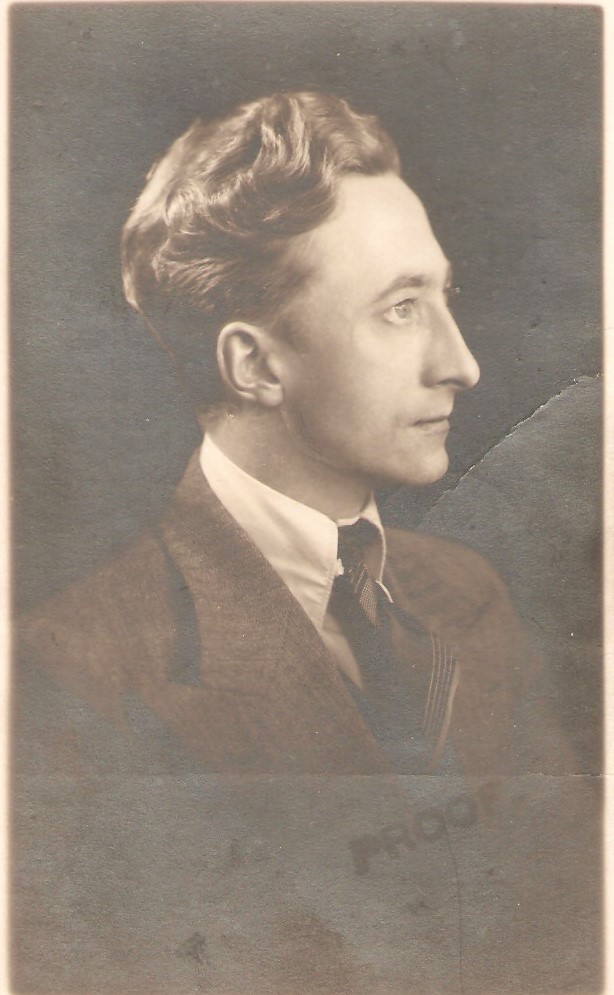
Thereafter for the remainder of the article Greenwood’s own voice is reported sympathetically and in his own words, under three sub-headings: ‘Hanky Park’, ‘Clash with Police’ and ‘His Next Book’. Greenwood starts out by explaining that he has had ‘all the traditional set-backs of a writer’ and there is ‘nothing romantic’ about them.
I have been unemployed two or three times and I have devoting myself to writing these last two or three years. Now I am working and still writing. Sometimes I have been unemployed for six or seven months when nobody seemed to want a book-keeper and clerk.
This covers the years back to at least 1930, and probably, given the references to repeated and intermittent unemployment, back to 1928, when Greenwood said in the ‘Author’s Preface’ to The Cleft Stick that he began writing as a ‘ ‘prentice hand’ (p.9). In the more recent period probably from 1930 he was working as a clothing company agent - like Mrs Jike who collected the due payments on clothing from Alderman Ezekiah Grumpole’s ‘Good Samaritan Clothing Club’, that being the only means by which people in Hanky Park could manage any new clothes at all (and the clothes were often worn out before the payments could be completed). We know this from a Daily Herald article published in 1937, where a fellow Salford working-class novelist called Edward A. Hibbitt recalls meeting Greenwood when his novel, Love on the Dole, had just been taken by Cape, in 1933. Hibbitt (himself then trying to make a living selling vacuum-cleaners door-to-door) noted that at that time Greenwood was working as a ‘credit draper’s canvasser’ – a somewhat complicated way of referring to a clothing club agent (article headed ‘Authors of the People’, Daily Herald, 17 February 1937, p.8: for more on this see A Second Walter Greenwood? Edward A. Hibbitt, Salford novelist ). No wonder Greenwood showed such a detailed knowledge of how clothing clubs worked in his post-war book on Lancashire in the chapter on ‘Lancashire Women’ (Lancashire, Robert Hale Ltd, London, 1950, pp.17-8).
Greenwood then gave an important and very carefully-phrased rationale for why he had written Love on the Dole, which is quite often quoted by critics but rarely correctly referenced to this early origin (it is sadly not right on p. 253 of my book which gives only a second-hand reference):
I have tried to show what life means to a young man living under the shadow of the dole, the tragedy of a generation who are denied consummation in decency of the natural hopes and desires of youth. I have given some relief to grim realism by introducing the characteristic humour of the older inhabitants of Hanky Park.
The focus on ‘a young man’ is a little odd given that the novel pays very considerable attention to its female characters, younger and older, but suggests a male-centred novel in Greenwood’s view at this point. This would centre the novel on Harry Hardcastle and Larry Meath in particular, in which there is some truth, though an older man like Mr Hardcastle, and younger women such as Sally and Helen, and older women such as Mrs Hardcastle and Mrs Cranford, and Mrs Dorbel, Mrs Jike and Mrs Bull also receive considerable coverage. Presumably young women in Hanky Park are also ‘denied consummation in decency of the natural hopes and desires of youth’. ‘Tragedy’ and ‘consummation’ are both particular word choices of great interest. Clearly, Greenwood is very conscious of his genre choice: the reality is a tragic one and his novel reflects that in shaping a tragic story-arc. ‘Consummation’ is equally clearly a word chosen partly for metaphoric reasons but also evidently for literal sexual reasons, both of which senses work very well together in expressing the range of deprivation induced by unemployment, poverty, and the dole. The natural hopes and desires of youth are presumably independence, financial security and satisfying work, but also sexual expression in conditions of ‘decency’, which indicates, no doubt, privacy and private space, and lack of harmful consequences, including premature parenthood, premature marriage and the inevitable reproduction of poverty through lack of knowledge or access to family-planning and insufficient means. These are indeed key (if sometimes discretely expressed – censorship was a risk) themes in the novel, and Greenwood was evidently analytic as well as creative in the way he reflected on his writing. I will shortly be publishing a separate article dealing with ‘dole humour’, including in Love on the Dole, but note here that Greenwood sees the humour in the novel as both derived from reality, and the older generation in particular, and as a formal structural and generic device in his text.
In the next section Greenwood linked some of his experiences as an unemployed man to some events depicted in the novel, and also gave a sense of his experience of being a writer during that period:
One chapter is devoted to the protest against the means test. I took part in a protest in 1931 and there was a clash with the police. I was not arrested perhaps because of my agility. Partly the novel is autobiographical. This will be my first novel to to be published. I have written short stories with some success but on the whole they were too realistic for the average magazine. Messrs Capes have an option on my next three novels.
I think this is the only place when Greenwood says he was particularly agile, and wriggled out of or slipped away from arrest (at the protest and aftermath remembered in Salford history as the ‘Battle of Bexley Square’)! (1) Greenwood’s wording when giving the story of his writing career so far is carefully phrased: he had indeed successfully written probably twelve well-shaped short stories (later published as the core of the fifteen Cleft Stick story collection), but to be precise only one had been published, ‘The Maker of Books’, by The Story Teller magazine in 1931. Others had been rejected as good in themselves but too depressing, when short-story readers wanted distraction and entertainment. The careful phrasing is completely understandable – no point in undermining his own achievement at the very moment it was bearing fruit. Indeed, once Love on the Dole was published, Greenwood was able to publish two more of these early stories in newspapers in the following year: ‘Mrs Scodger’s Husband’ appeared in the Daily Herald (14 July 1934, p.17) and ‘The Practised Hand’ in London Mercury (1934). (See Walter Greenwood’s Forgotten Short Stories).
Greenwood naturally wants then to alert readers to his next novel, and emphasise the (surely miraculous-seeming?) establishment of his writing career with his three novel contract with Jonathan Cape:
My next book upon which I am working is about man who is anxious to get on in municipal affairs and it will probably be called His Worship the Mayor. I have also written a very long novel called Prosperous Years, but it was a premature effort and I shall work on it again.
His next novel was indeed published the year after Love on the Dole under the title of His Worship the Mayor, and was again a considerable success (as with Love on the Dole, a play adaptation followed his second novel too: see Walter Greenwood’s Other Books and Walter Greenwood’s Plays (1934 – 1971)). Greenwood later referred to The Prosperous Years as a trilogy, suggesting that it really was long! It was not published during the thirties and two volumes were destroyed when Greenwood’s London studio flat in Ebury Street was hit in the London Blitz in 1940, as he noted on the one remaining volume, the second, which survives in manuscript at the Walter Greenwood Collection in the Salford University Library Archives (as item WGC/1/1/1). Greenwood’s comment that it was ‘a premature effort’ shows a certain modesty in acknowledging that he has been an ‘apprentice’ until recently, but also marks out that his writing is a matter of hard work and craftsmanship: it is not luck, he has worked for his success.
The article ends with what must be an important declaration of belief, and a statement that he is a Socialist writer, who has sprung at least partly from local political and community engagement, as well as from a commitment to national politics:
I am an enthusiastic member of the Labour Party in Salford and founded the Salford Labour League of Youth. As far as I am concerned I have ‘sold’ unemployment for I have now a very full programme drawn out.
The Labour League of Youth was the Labour Party’s youth organisation, aimed at young people aged between sixteen and twenty-five. One of the things which followed the publication of Love on the Dole was indeed Greenwood’s further active engagement with politics when he stood as a Labour Councillor in Salford, being elected at his second attempt in 1934. His experience of practical ‘municipal affairs’ in the years leading up to becoming a candidate presumably also influenced his narrative in His Worship the Mayor (1934).

At his first appearance before the public in the Manchester Evening News – and after its forbidding headline decisions – I think Greenwood gave a straightforward but thoughtful sense of himself. His comment that the novel is ‘partly autobiographical’ is important and the life-events he specifically refers to tend to assure the authenticity of the experiences it narrates; there were however elements in the novel that were not autobiographical: he had never, like Harry and Larry, worked in an engineering works (except as a clerk), largely because his mother wanted him to work in what she regarded as more secure clerical work (see There Was a Time, 1967, p. 110), and he had never I think been a trade unionist, though clearly he had some experience of being a Labour (junior) leader. Some of the ingredients of the novel drew, as he discussed in a 1935 interview, on the experiences of his then fiancée’s family, and some aspects of Larry Meath as working-class intellectual drew on a fictional source – Robert Tressell’s The Ragged Trousered Philanthropists (1914). (2) He could though truthfully claim authentic experience of many of the events and emotions in his narrative, and just as importantly also show in this press interview the qualities needed to make sense of it to others: a work ethic, self-confidence, but also modesty, self-reflection and self-criticism, an acute and analytic mind, an ability to shape genre and narrative, and a down-to-earth articulacy through which he could speak directly to all sorts and conditions of contemporaries, and often win their sympathies. The ‘idle days’ headline was not a sympathetic start, but Greenwood’s case in his own words might show his first performance in winning over the general reader to a more sympathetic reception of the circumstances and suffering of the poor, the unemployed, and those on the dole. Of course, it might well also be that the headline (and sub-headline) was the work of a sub-editor, while the interview was that of a reporter with a noticeably different attitude. Still, if it drew attention for the first time to the story of ‘Mr Love on the Dole Greenwood’, it did a good job whatever its original sentiments. (3) Greenwood is clearly also hugely relieved to have ‘sold’ unemployment and to have the conviction that he has before him a ‘full programme’ as a professional writer. Through hard-work and creativity he made that a life-long reality – he was not a one-novel author, not just author of Love on the Dole.
NOTES
Note 1. For a full eye-witness/participant account and context by Eddie Frow see: https://libcom.org/article/battle-bexley-square-salford-unemployed-workers-demonstration-1st-october-1931. For many years this was part of the Working Class Movement Library website, but seems not to be there any longer, though the text is unaltered at this new location.
Note 2. See Walter Greenwood: ‘Tragedy Behind the Play’ Interview (Hannen Swaffer, Daily Herald, 1935)
Note 3. A nomenclature celebrating the unbreakable link between author and work – though not used until 1940 (in an article ‘from our London correspondent’ about plans for the film of Love on the Dole, Bradford Observer, 13 November 1940, p.4 ).
 Walter Greenwood: Not Just Love on the Dole