
This newly-found concise letter surely shows how excited and fully engaged Greenwood was by his entrance into the new world of professional authorship between 1933 and 1934 (I purchased it from Lasting Words Ltd Fine and Rare Books of Abingdon on 18 August 2023). Though neither work is actually named, the letter undoubtedly refers to the current success of the play adaptation of Love on the Dole at the Manchester Repertory Theatre shortly after its first performance in late February 1934, as well as to a simultaneous positive reader’s report on the draft of his second novel, His Worship the Mayor, which was indeed published later in the same year .
The handwriting, as usual with Walter Greenwood’s manuscripts, is quite nicely legible. However, the blue-black ink is now (or was always?) a little faint, so I will provide a transcript below for ease of reading.


117 Tootal Drive
Salford 6
Lancs
March 6/34
Dear Percival,
You’re independent.
The show’s booked up except for Saturday
matinee. You see, your independence will now
mean your having to stand.
Edward Garnett’s now reported on
The first draft. Wren Howard writes “Garnett
on the whole, likes it.” His criticisms are
those of involved sentences which would have
been revised anyway.
So I’m working all hours to finish
It off. But this play business is taking up
a deal of time. Still, I’m not hurrying with
it. I want to make it into a good job of work.
Cheerio
Walter Greenwood.
Sadly, I do not know at present who the addressee Percival was, but Greenwood’s informal address by first name and informal sign-off, ‘Cheerio’ suggests he was a friend, though equally the allusive discussion of ‘independence’ suggests that Percival wanted to give an independent critical view of the play (maybe he was also, for example, a reviewer?) Perhaps he had therefore not accepted the offer of some complimentary tickets from the co-author and now Greenwood humorously (or is there a tiny edge to it?) is saying in consequence he’ll only be able to see a matinee and then will have to stand as well! The letter then switches topic to the novel draft, which must be Greenwood’s second, His Worship the Mayor. At this point Greenwood refers to two important figures he is corresponding with who were working for Jonathan Cape at this period, and who were in a broader way both major contributors to British publishing and literature: Wren Howard (1893-1968) and Edward Garnett (1868-1937).
Wren Howard (1893-1968) was in 1921 the co-founder with Jonathan Cape (1879-1960) of the highly successful publishing house of Jonathan Cape Ltd. One of the first actions of the partnership was to recruit the already well-known publisher’s reader Edward Garnett, who had previously worked for the publishers T. Fisher Unwin and then Gerald Duckworth and Company. Before Garnett joined Cape his reader’s reports and then continuing support had substantially established the careers of the major figures of Joseph Conrad and D.H. Lawrence, and soon after joining Cape he also published T.E. Lawrence for the new firm, as well as republishing with considerable originality and with great critical and commercial success C. M. Doughty’s neglected great travel narrative, Travels in Arabia Deserta (first published but little noticed in 1888). Each of the Cape Ltd trio were willing on occasion to take risks on unknown, potentially challenging and unusual authors, though they also appreciated popularity, and their good judgement was borne out by the firm’s critical and commercial success as an independent publisher over the years from the twenties until the end of the nineteen-sixties. In addition to his acute sense of business, Howard was also very interested in book design, and is credited with creating a distinct and high quality brand design for Jonathan Cape books which made them stand out among other publishers in the pre-war years especially. There were a variety of views about what made Cape’s books distinctive, but certainly one feature was the elegant Cape logo of an urn or vase containing a branch of (I think) fruit and leaves. Here it is as part of the front cover of the ‘Pocket Books’ edition of Greenwood’s second novel, His Worship the Mayor, first published in 1940 – perhaps broadly to compete with Penguin, but perhaps also with the thought that it would fit into the battledress pocket of a Serviceman, Servicewoman or Civil Defence worker, or could be taken into an air-raid shelter?
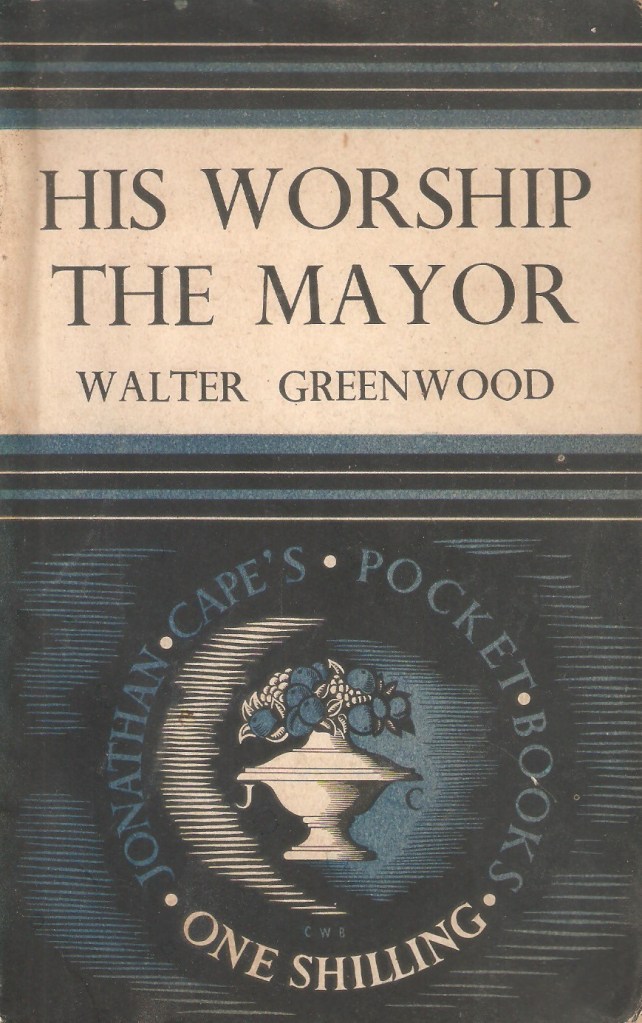

The Times obituaries for Cape and Howard on their deaths in the nineteen-sixties indeed saw them as significant figures in twentieth-century publishing. Jonathan Cape’s obituary paid a joint tribute to all three:
The combination worked excellently. Garnett was freer than ever before to foster and shape a publisher’s list, while Cape’s experience and Howard’s technical skill rapidly brought the new firm to the fore (11 February 1960, p. 15).
It also noted the starry list of authors the firm built up in the inter-war years. Cape himself was then unusual among British publishers in seeking to sign up US authors, and the obituary lists the following (three of whom would later be Nobel Prize-winners): Sinclair Lewis, Eugene O’Neill, Ernest Hemingway, Sherwood Anderson, H.L. Mencken and Dorothy Canfield. It then notes prominent names among Cape’s often newly discovered British authors:
Cape came to represent books of high literary quality, elegantly produced, and efficiently marked. The new names of H.E. Bates, Eric Linklater, Christopher Isherwood and others combined with the fabulous success of Mary Webb to establish Cape as a fiction publisher. Arthur Ransome’s Swallows and Amazons series and the Dr Doolittle books of Hugh Lofting created new fashions in children’s books, while history was well served by the publication of the first works of C.V. Wedgewood, Duff Cooper and A.L. Rowse. Poetry was represented by Robert Frost, William Plomer, Cecil Day Lewis and Andrew Young. Cape’s various cheap series – in particular the Travellers’ Library – held the field until the arrival of Penguin Books, whose potentiality Cape was, incidentally, one of the first to foresee (p.15).
This is indeed an astonishing list of whom perhaps only Plomer and Young’s names have slightly faded in the twenty-first century (though Plomer, in addition to succeeding Garnett as the chief Cape reader – is certainly unfairly neglected, and Young not all uninteresting). To it the Cape authors Galsworthy and Henry Green should also be added.
It was also a list which paid attention to how customers actually used books, as we have already suggested for the ‘Pocket Books’ series, but also in the Travellers’ Library editions highlighted in the obituary, which again offered on the material side a format small enough to be fitted in a pocket and with some added robustness and flexible binding so that it would survive being packed and read in a variety of circumstances, and in the matter of taste a good variety from ‘pure adventure’ to ‘mature scholarship’! The rationale of the Library is carefully explained on the rear dust-wrapper – in this case to the short-story writer A. E. Coppard’s collection Adam and Eve and Pinch Me (first printed, by Cape, in 1921, reprinted in this edition in 1937; Wikipedia gives a brief account of Coppard’s work: https://en.wikipedia.org/wiki/A._E._Coppard ). The dust-wrapper for Coppard’s book, with its ships and castles, and attractive two-tone printing on cream paper, gives a good sense of the folklorish and fantastic worlds which some of his tales enter into.
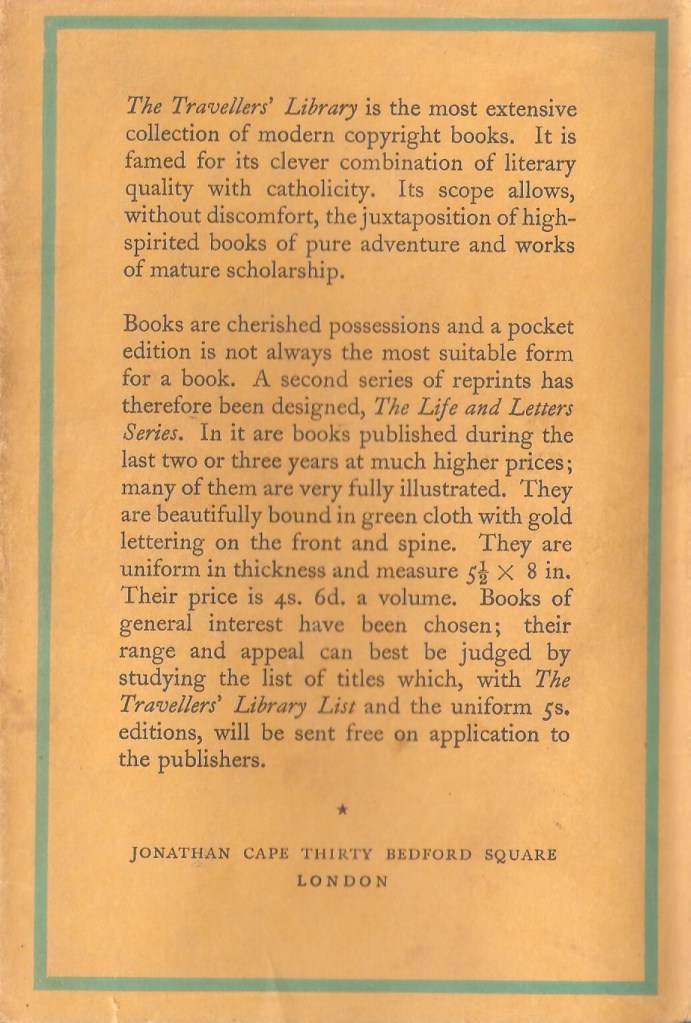
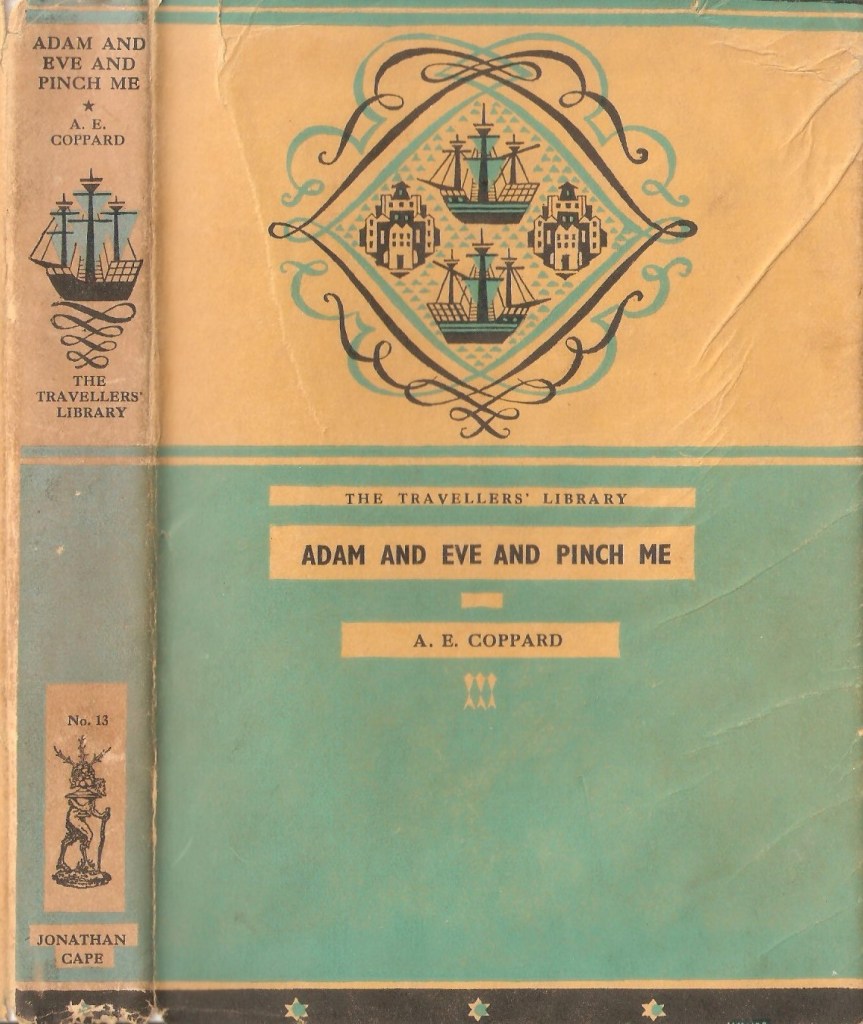
Even earlier Cape had anticipated some aspects of the innovation introduced in 1937 by Penguin with their ‘Florin Books’ series, offering smaller and uniform cheaper editions of successful books printed relatively by Cape themselves in the Florin Books’ series in which every book cost, of course just two shillings. Here is the Florin edition of Love on the Dole itself from 1935:
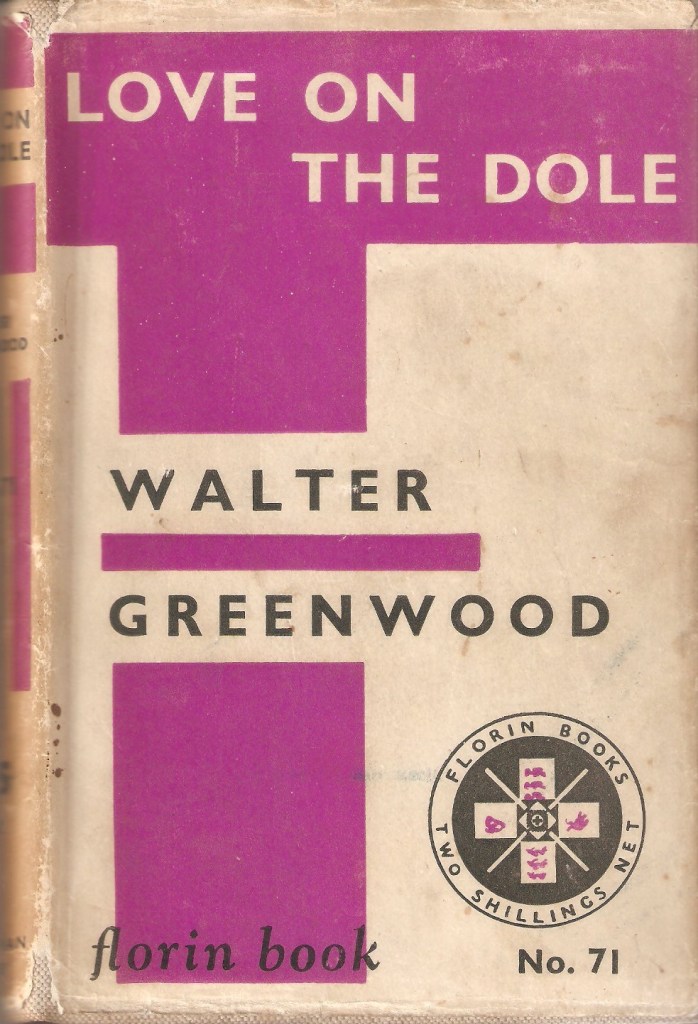
The main feature of the jacket design is a large upper case stylised F for florin, together with a logo in the bottom right-hand corner based on a presumably deliberately abstract design based broadly on but not accurately reproducing the internal geometric shapes of a contemporary coin of the realm and at the same overall size:

George V Florin minted in 1932; photograph from the Wikipedia entry on florins: https://en.wikipedia.org/wiki/Florin_(British_coin)
The Times noted the strength of Wren Howard’s business acumen, his wish to raise the standards of book production, and his deep knowledge of the whole business of publishing (July 30 1968, p.8). Garnett of course died some three decades earlier than this partnership, and while his obituary did identify him as ‘a great discoverer of talent’, its conclusion saw him as most distinguished for his indeed remarkable joint introduction with his wife Constance Murray / Garnett of Russian writers into the British literary sphere:
What Galsworthy called a ‘quiet little revolution in English fiction’ came about more than a generation ago through Garnett’s and Mrs Garnett’s translations from the chief Russian novelists. It is due to their combined interpretations . . . that the writings of some of the most honoured names in Russian literature became familiar to the English public’ (22 February 1937, p. 19).
Later views, including two substantial biographies, put more stress on him as the ‘great discoverer of talent’, especially of Conrad and D.H. Lawrence, and indeed developed in detail what The Times briefly noted as his role offering ‘brotherly, or fatherly, or at need tyrannical treatment of men whose executive powers he believed to be greater than his own’. The ‘tyrannical’ epithet no doubt refers particularly to Garnett’s editing and publication of some of Lawrence’s earlier works without consulting the author! (1)
Greenwood was no doubt delighted to have Love on the Dole accepted by any publisher in 1932, but certainly was lucky and no doubt pleased in being swept up by the capable hands of Jonathan Cape Ltd (even if his advance was only £30) and becoming part of the Cape, Howard, Garnett list. In this letter I think he is still finding it hard to believe the transformations in his fortunes which he had so much hoped for and worked so determinedly towards during his desperate years of unemployment and poverty. He is clearly determined to make sure that the time-pressures from the play of his first novel do not distract him from making sure his second novel is fully crafted and a ‘ good job of work’. I do not think that anyone knows that Garnett was the reader for Greenwood’s second novel, which though it is less-well remembered in general now than Love on the Dole was thought to be a second good novel, and a significant development on his first by some reviewers. The letter is thus an important document which might be the opening step in exploring something not so far studied – Greenwood’s interactions with those key gate-keepers and enablers, the publishers and their professional readers. Garnett may or may not have been the reader for Love on the Dole, but it may be possible to find out with further research, and indeed if he was the Cape reader for any other of Greenwood’s novels before 1937. Certainly Garnett had experience of bringing at least one unusual working-class writer into print in the shape of D.H. Lawrence, so he might well have had a sense of the value of such writers and their work, as well as of the topical relevance of Greenwood in 1933 and 1934. We do know from Greenwood’s ‘Author’s Preface’ to his 1937 short story collection (co-produced with the artist Arthur Wragg and published by Selwyn & Blount rather than Cape), The Cleft Stick, that he did not find it that easy to get into print, with many rejections of his first novel, and with many rejections of stories by ‘editors of popular magazines’ (p.8). He also recalled that period of poor apprenticeship in his later memoir, for example in this passage:
A brisk knock on our door. My hopeful expectation was dispelled the instant the postman handed me a bulky foolscap envelope. The publisher’s letter clipped to the novel’s cover was terse. It regretted that my offering was not suitable for inclusion in his list and it also served as a reminder that the way ahead was to be long, hard and discouraging with no guarantee of ultimate success. This, in turn, opened the door to gloomy thoughts and projected a future wherein I and all like me were to be superfluous for ever and ever (There was a Time, Cape, 1967, p. 205).
Clearly, for Greenwood, it was authorship or bust, and it was Jonathan Cape Ltd which so crucially helped him make it. From that point on, his collaboration with Ronald Gow was also very helpful, introducing him too to the clearly very time-consuming world of theatre production – a successful activity again further reinforced by Cape’s publication of the play of Love on the Dole as well in 1935. I will seek when possible to discover if there is further material in the Jonathan Cape Archive at the University of Reading about how Greenwood finally made it, ‘after six years incessant practice’ (‘Author’s Preface’, The Cleft Stick, p.7), from unemployed man in a depressed Salford slum to an author with contracts who could write about all those in a similar state of deprivation and reach an audience of some millions of British readers, with the assistance of Gow, Garnett, Howard and Cape.
NOTES
Note 1. Introductions to Cape, Howard and Garnett can be found on Wikipedia, though with the exception of Cape’s these are decidedly thin (see https://en.m.wikipedia.org/wiki/Jonathan_Cape ; https://en.wikipedia.org/wiki/Wren_Howard; https://en.wikipedia.org/wiki/Edward_Garnett). If you are a member of a public library you should be able to access the online Oxford Dictionary of National Biography (DNB) and read the concise entries for Cape and Garnett (Wren Howard is curiously not covered). For more substantial accounts see three biographies: Jonathan Cape, Publisher by Michael S. Howard, Jonathan Cape 1971, Penguin 1977, Edward Garnett: a Life in Garnett, George Jefferson, Jonathan Cape, 1982, and The Uncommon Reader – a Life of Edward Garnett by Helen Smith, Jonathan Cape, 2017. None however refer to Cape enlisting Greenwood as one of the firm’s authors.
 Walter Greenwood: Not Just Love on the Dole