This site is about the Salford working-class author, Walter Greenwood (1903-1974), and all his work – including but not just limited to Love on the Dole (scroll down to the blue area below for article titles and down to the white area below that for your selected article)
Love on the Dole and a Case of Theatrical Fraud – Or Was It?: Feltham Police Court and the Central Criminal Court at the Old Bailey (November 1935 – February 1936). *
This court case is another very odd example, I think, of just how famous Greenwood’s novel and then Gow and Greenwood’s play was: perhaps famous enough and influential enough to allow a con-artist and his female accomplice to trick an unsuspecting investor out of a considerable amount of his money: £2,050, to be precise (equivalent, according to the Bank of England inflation calculator, to £120, 687 at today’s values). (1) IF THAT WAS the ‘true’ narrative – the legal outcomes were not in the end as straightforward as one might expect, and aspects of the story remain inexplicable. (2)
The case was first reported by the Liverpool Echo on 28 November 1935, p. 12, with an account of Brookes’ arrest, including a quotation from the Scotland Yard Inspector who took him into custody:
Inspector John Sands . . . said ‘Yesterday I saw Brookes. I told him who I was and read the warrant to him and cautioned him. Twice he replied, “lt is absolutely untrue.” He took Brookes to Scotland Yard, and later to a police station, where, when the charges were read to him, he said: ‘I emphatically deny the charges. which are unfounded.’
A second report appeared in the Sunderland Daily Echo and Shipping Gazette on the following day, 29 November. It was headed ‘Mayfair Arrest’ and ‘Business Man Denies Cheque Charges’ and contained essentially the same information. Neither of these reports made any reference to Love on the Dole.
A week later there was further reporting of the beginnings of the trial process rather than the arrest in the Manchester Evening News (6 December 1935, p.1), under the main headline ‘Said to Have Paid away £2,050’ and then the sub-headline ‘Wanted Interest in Love on the Dole‘. At this point Love on the Dole clearly enters the story by name. A young man aged 28 called Mr John Evered alleged at Feltham Police Court that he had paid a Mr Arthur Arnold Joseph Brookes a considerable amount of money ‘in the belief that he would get an interest in the play Love on the Dole‘. On 15 September 1935, Evered had given Brookes a cheque for £1,000, followed by a second for £500 on 14 October. These cheques were ‘entrusted’ to Arthur Brookes that he might ‘pay a deposit on the lease of the Lyceum Theatre’. The Lyceum was (and is) a major and large West End Theatre dating back to 1765 (though it has been rebuilt several times since then – see https://en.wikipedia.org/wiki/Lyceum_Theatre,_London). Evered had earlier paid Brookes an initial cheque for £500, on February 1, 1935, but this time on the understanding that it was to invest in a lighter piece of entertainment called The Body Line Revue. Arthur Brookes convinced Evered that this first investment of £500 in the revue would give him a half-interest in a production which was to cost £4,000 to put on. There was one further payment of £50.
Arthur Brookes continued to deny the charges ‘strenuously’. The Metropolitan Police and the Director of Public Prosecutions however felt that he had a case to answer and charged him ‘on a warrant on remand’ with variously obtaining the cheques on two occasions ‘by false pretences’ and that he had ‘fraudulently converted [one] to his own use and benefit’. As I understand it, the ‘warrant on demand’ meant that Brookes could be kept in custody while the trial was in progress, while the converting the cheque to his ‘own use’ meant he had paid it into his own bank account and perhaps drawn on it. In fact, the Police Magistrate at the Feltham Police Court granted Brookes bail on condition of the payment of various monies, including bail and sureties, totalling the considerable sum of £1000. The report also gave some biographical information about both men: Evered was ‘training to become a civil air pilot’ when he first met Brookes, presumably at the beginning of February 1935; Brookes was 58, lived at Hill Street in Mayfair and was a ‘business negotiator’. This is a phrase not recorded in the OED, but contemporary uses in newspapers in 1935 often precede the phrase ‘business negotiator’ with the words ‘described as’, suggesting some implied suspicions about what what was actually involved in this occupation – did it imply something like ‘wheeler-dealer’? Newspaper reports several times associate the description with persons accused in criminal cases, including the reports of this case.
At the period of of these ‘negotiations’, the play of Love on the Dole had already been on the stage for a short period after 26 February 1934 (at the Manchester Repertory Theatre), in the Vernon-Lever touring production since 7 May 1934, and in its London production at the Garrick Theatre since January 1935. All three of these productions had been widely reviewed in national and regional newspapers, and indeed the play of Love on the Dole was a national phenomenon, so it was more than possible to be aware of the play and its productions. Nevertheless, John Evered does not seem to have been aware: he appears to have been someone interested in theatre but who knew very little about it – unless money was the predominant interest. He invested his money eight and nine months after Love on the Dole opened in London. However, there was also another element in the story: romance, perhaps.
The Daily News (London) reported the financial details as meticulously as the other newspapers, but was the first to report and make prominent the involvement of Joan, Brookes’ daughter (or was she?), and Evered’s (rapid?) response to her. The headline introduces this new emphasis to the story, which is then firmly sustained by the sub-headings:
BROKEN ROMANCE IN STORY OF STAGE VENTURE
There was a “love interest” in a story of theatrical investments which was told at Feltham (Middlesex) Police Court yesterday. Arthur Arnold Joseph Brookes (58). a business negotiator, of Hill Street. Mayfair, W., was committed for trial at the Central Criminal Court [reports the charges already detailed above by other newspapers] . . .
BUNGALOW MEETING
Mr. H. A. K. Morgan, for the Director of Public Prosecutions, said that Mr. Evered . . . answered an advertisement and went with Brookes to a bungalow at Riverside, Sunbury, where he was introduced to a woman called Joan who, Brookes said, was his daughter. Brookes explained that he had secured the rights to produce Love on the Dole in London and that further capital was required. He also said that a part was being reserved for his daughter, and Evered was offered a part. Mr Morgan said that a cheque for £1,000 which Evered handed over later was paid into Brookes’ account, which at the time amounted to £2, 3s and 4d.
BECAME ENGAGED
John Evered had become very attached to the girl Joan and they had became engaged. Evered went to Switzerland, and on his return Brookes told him that the Love on the Dole deal had fallen through . . . John Evered, of Battersea, in evidence said that his engagement to Joan Brookes was broken off (7 December 1935, p.7).
The report offers no commentary on the ‘romance’ aspect, leaving readers to speculate (and perhaps heartlessly, or with a sense of superiority, enjoy its possible interpretations?). Was Joan really Brookes’ daughter or an unrelated accomplice? Why did Brookes take Evered to the bungalow at Riverside Sunbury, rather than meet him at his Mayfair address? Was Evered prone to being quickly bowled over, or was it the excitement of being engaged to an apparent actress while himself suddenly entering the new world of theatre AND the likelihood of substantial financial success? Was the romance and engagement always part of Brookes’ plan or did it just happen to increase Evered’s keenness for investing in Love on the Dole? We do not know if Evered’s trip to Switzerland has any real connection to the rest of the narrative or is just incidental detail. Then the timescale of events is not wholly clear – did Evered immediately break the engagement with Joan as soon as he heard there would no further progress on acquiring an interest in Love on the Dole, or did that happen some time afterwards? There are some intriguing gaps, mainly because the press reporters can only report the bald details from the police arrest and initial police court proceedings. This particular telling does add one significant financial detail though – the low balance of Brookes’ bank account before Evered started making cheques out to him: £2, 3s and 4d. It also adds the interesting detail that Brookes had put out an advert for an investor, which Evered replied to (I have searched for this on the British Library National Newspaper Archive, but so far have found no trace – of course the Archive does not include all British newspapers, as yet).
On the same day the Daily Mail also reported the case though in a shorter two-paragraph piece, and again through its headings emphasised the romance element, though without adding any further detail: ‘HIS DAUGHTER’S ROMANCE’; ‘ENGAGEMENT BROKEN’ (p.7). One interesting detail it did add was about Arthur Brookes’ business interests: a witness (perhaps a character witness for Brookes?) called Frank Rubens, who was general manager for a music publisher, B. Feldman & Co, ‘stated that he had known Brookes for many years and had been associated with him in the running of midget golf courses’. B. Feldman was an important publisher of popular song sheet music (see https://en.wikipedia.org/wiki/Bert_Feldman ). Presumably the ‘midget golf courses’ (I think these were were either putting greens or a version of ‘crazy golf’) was one of Brookes’ ‘business negotiations’ in which Frank Rubens took a part in addition to his music publishing job.
There is no further reporting of the case for a period – presumably the norm while first Christmas intervened and then prosecution and defence lawyers were preparing their cases – until two months later when the Gloucester Citizen published a very short article saying that Arthur Brookes had been found not guilty at his trial at the Central Criminal Court (or Old Bailey):
BUSINESS NEGOTIATOR DISCHARGED
Arnold Joseph Brookes (58), described as a business negotiator, was found not guilty at the Old Bailey today of obtaining money from John Evered by false pretences, and he was discharged. The prosecution called no evidence. Mr. Evered did not appear, and Judge Dodson ordered that his recognizances should be estreated (10 February, p.1).
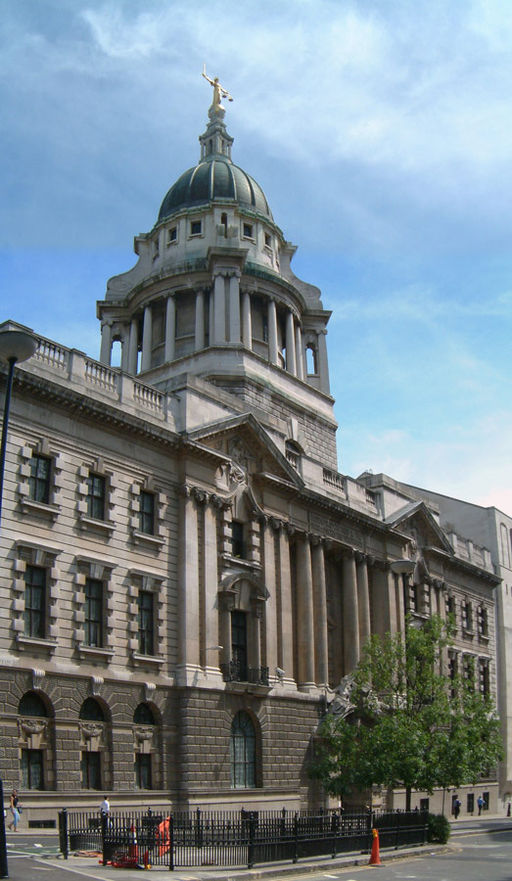
There had been courts at this location since the early thirteenth century, but the modern building dates from 1902 and was opened in 1907. The photograph is part of the Wikipedia entry for the Old Bailey and available under a Creative Commons Licence; the entry provides the brief history in this caption too https://en.wikipedia.org/wiki/Old_Bailey. It was here that Arthur Brookes attended for his trial – but did not face his accuser.
The Daily News also published a further brief report noting that in fact, the judge subpoenaed Evered to appear at the trial, but despite searches the police were unable to find him in order to serve the notice to appear (11 February, 1936, p.7, headed ‘Missing Witness’). The Daily Herald also published a paragraph mainly with the same elements, but with one addition – some quotation of the views of the presiding judge:
‘Judge Dodson said that it might be a hardship on Brookes to be kept waiting ‘while this nebulous individual is traced’ (11 February 1936, p.7)).
I was very surprised to see this follow-up to the original reports and this conclusion to the trial. The acquittal seems remarkable given the details in the arrest and committal to trial reports, where the public prosecutor and Evered seem to offer up what appeared to be strong evidence. However, without this key witness the trial clearly could not go ahead, and that was solely Evered’s fault. In addition, due to his non-appearance at the Old Bailey Evered lost some more money: the ‘estreating’ of his recognizances (I think a sum paid at the Police Court stage) meant that he was fined for not appearing as expected.
The same day the Western Daily Press gave a little more detail of the case, though in a report which was still concise:
BUSINESS NEGOTIATOR ACQUITTED
When Arnold Joseph Brookes (58). described as a business negotiator, appeared at the Old Bailey, London, yesterday on a charge of obtaining money from John Evered by false pretences, and converting money to his own use, Mr L. A. Byrne said that the Director of Public Prosecutions had to offer no evidence. The jury returned a formal verdict of not guilty, and Brooks was discharged. It was stated that Evered did not appear at the last session and had sent a letter saying that he did not propose to give evidence against Brookes, nor did he propose to come to court (11 February, 1936, p.6).
One notes the phrase ‘formal verdict of not guilty’, implying that this legal proceeding found Arthur Brookes not guilty strictly on technical grounds, given that neither Evered nor the Director of Public Prosecutions wished to present any evidence.
This prompts many questions, answers to which are bound to be speculative, given that there is no evidence from the trial to consider. Why, having made the original complaint, did Evered not wish to pursue the case to a conclusion at the Old Bailey? This decision presumably meant that he accepted the complete loss of his apparent investments in Love on the Dole, and presumably also his investment in The Body Line Revue. I wonder if in the intervening two months friends or family had pointed out the folly of investing in a play which was already in (very successful, profitable and famous) production, and for which Vernon-Lever owned the full performance rights? Perhaps he was advised that pursuing the case further would make him appear gullible and indeed foolish, especially if there were further publicity about his involvement with Joan (Brookes)? She might well have been called as a witness.
On the other hand, I also note Arthur Brookes’ repeated assertions of his innocence at every possible point. Perhaps ‘he would say that’, or perhaps he really did have a robust defence which he was ‘reserving’ for the trial itself. Had he actually acted towards Evered in good faith? He did inform Evered when the Love on the Dole possibility fell through rather than keep stringing him along, and also assured Evered that his £1,500 investment was still ‘intact’. However, there seems little support for the idea that there was ever a genuine investment opportunity in the play to which Brookes could offer access, and the details we have do look suspiciously like the work of a skilled confidence-trickster. I am more inclined to think my speculation about shame or embarrassment might have been the motivation behind Evered’s wish to leave the case at the Old Bailey well alone. One piece of evidence I have not yet cited comes from a witness from Vernon-Lever Productions who really were making good money from the play they had backed as a slightly unlikely hit:
George Henry Barrasford, of Garrick Hotel, W1., general manager for Vernon Lever Productions, said he had never offered a part in Love on the Dole to Joan Brookes or John Evered and did not know Brookes (Daily News, 7 December 1935, p.7).
This is as near as we get to anyone with real involvement with the production. This seems to confirm that Arthur Brookes had nothing genuine relating to Love on the Dole to offer Evered. (3)
My almost final speculation is that Brookes was in a position to put pressure on Evered not to appear – perhaps Joan might have had information about aspects of their courtship which Evered might not want made public? Of course, that would add something like blackmail to false pretences. More optimistically, is it possible that Brookes and Evered had come to some arrangement out of court, perhaps even including the restitution of the £1,500 Love on the Dole investment? But would Evered not make that clear in his letter to the Court?
The Body-Line Revue in which Evered invested certainly did exist, and the Daily News article quoted just above tells us that Evered was even paid for his part in that with a salary of £6 a week ‘which he drew for four or five weeks. This was all he got back of his £2050’. The pay seems an odd piece of generosity from a (possible) con-artist – or was it the sprat to catch a mackerel? The first reference I can find to The Body-Line Revue is an advert in the Aldershot News from 15 March 1935 (p.14) which announces it as:
THE LATEST AND GREATEST REVUE “BODY-LINE”
(An EDWARD DOLLY Production)
THE BIG SHOW OF THE JUBILEE YEAR
FEATURING FRED MILLER and MILLIE DEANE.
It was to be presented at the Aldershot Hippodrome during the week beginning 18 March. It really was then a new show when Evered invested his £500 in it. Believe it or not, its topic was cricket, and presumably had some reference to the 1932-3 bodyline controversy – see https://en.wikipedia.org/wiki/Bodyline. However it sounds, as this genre usually was, very loosely structured indeed from the brief review of the performance at Aldershot by someone who was clearly an afficionado of revues:
Liberally sprinkled with pretty scenes, beautiful speciality dances and irresistible humour, Body Line . . . is attracting record attendances. The cast is headed by a clever comedian, Fred Miller, whose inimitable style and fun send the audience into fits of laughter. He is at his best in the scene, ‘Picking the Test Team’, which is an uproarious skit on the selectors. He is ably assisted by Millie Deane in many other laughter-raising scenes. Gorgeous dresses, wonderful ensembles and clever lighting effects are prominent among other features, particularly in ’When I Wore a Wedding Veil’, in which wedding dresses through the ages are presented with the probable dress of the future. Another glorious scene is the ‘Turkish Delight’ in which Marianna and Marq appear in a graceful acrobatic dance. The Head Girls – a perfect twin – give a realistic mirror dance, while Bertram Chantrey delights the audience with his piano-accordion (Aldershot News, 22 March 1935, p.12).
I wonder what role John Evered was given? If he was paid £6 a week, it must have been something more than a mere walk-on part, though not perhaps a dance-spot or an accordion solo. To add one further positive speculation, what if Evered DID get back his investment plus on what was clearly a successful show: might that induce him to drop the Love on a Dole charges against his helpful ‘business negotiator’, Mr Arthur Brookes?
I have searched for both John Evered and Arthur Brookes on the British Library National Newspaper Archive to see if either ever appeared in the public-eye again, but have found no evidence (perhaps once was enough for both?). The overall interest of this curious and somewhat incomplete and uncertain narrative is perhaps that it shows something of the fame and appeal of the title Love on the Dole. I note that at no stage (and thankfully) were the names of the two authors, Walter Greenwood or Ronald Gow, ever mentioned in the reporting of the arrest, the Feltham Police Court hearing or of the Old Bailey Trial. Presumably this was because they did not need naming- everyone knew who wrote the novel and the play of Love on the Dole – maybe even by the end of the affair, Mr John Evered?
There is one further coda to add: Greenwood himself reports a different and slightly differently constructed Love on the Dole theatrical fraud in an article reflecting on his experience of West End theatre from 1937. Greenwood in an interview with the Daily Express about his contribution to a new revue, It’s in the Bag, gives a rather disillusioned and rather puritanical view of London theatre life, recalling that he was ‘lionised’ in 1935 after the success of the play of Love on the Dole, and that he did not enjoy late night theatrical parties ( I have always felt that in general he was not very ‘clubbable’). He then adds a specific disapproval of backers who try to insinuate women friends into play, depriving genuine actresses of employment, before modulating to something worse: outright fraud actually committed on the premises of the Garrick Theatre. He reports that:
During the run of Love on the Dole a confidence trickster stopped a man squiring a pretty girl and told him that for £2000 the girl could have the part of the juvenile lead.
He got the money, but the girl, of course, never got the part for the simple reason it wasn’t vacant (Daily Express, 11 September 1937, p.15).
The juvenile female lead was, of course, Helen Hawkins, Harry’s girl-friend and then wife, a part played at the Garrick by Vera Sherburn. Greenwood and Gow certainly made a considerable amount of well-deserved profit from the play, allowing then both to establish themselves as professional writers, but clearly a few theatrical hangers-on also reaped some dishonest windfalls.
Note 2. I certainly do not have the expertise to outline the criminal justice system of the period, but some basic definitions may help us follow some (if not all) of the story. The Police Courts (there were thirteen) were peculiar to London and each hosted several stipendiary magistrates, known as ‘Police Magistrates’ who were independent from the Police and had a number of duties:
First and foremost, the police magistrate, sitting alone, decided the disposition of any person, almost without exception, charged with a criminal offence either by an individual or by the police. He could dismiss the charge, send the accused for trial at the quarter sessions or the Old Bailey, or, in certain instances, rule on the guilt and punishment of the accused himself. In addition, the Act gave other important powers to the magistrates: to summon any individual of whom they received information or complaint; to issue an arrest warrant if the individual failed to appear; to award costs on hearings or damages; to remand persons for further examination, or to place them upon personal recognizance; and to order delivery of goods unlawfully detained to their owner (‘A Poor Man’s System of Justice: the London Police Courts in the Second Half of the Nineteenth Century’, by Jennifer Davis, Boston College, The Historical Journal, 27, 2, 1984, pp. 309-35, p. 312).
These arrangements were relatively new in the first quarter of the nineteenth century and fully established by 1855, but Davis says that ‘they remained largely unaltered into the twentieth century’ (p.309). The duty of bringing a prosecution had by 1935 been taken over from Police Magistrates by the Director of Public Prosecution, a post established in something like its modern form in 1908 (see the Wikipedia entry https://en.wikipedia.org/wiki/Director_of_Public_Prosecutions_(England_and_Wales) ). Several press reports name Mr H.A.K. Morgan as acting for the Director of Public Prosecution at the police court and Mr L.P. Byrne doing likewise at the Central Criminal Court. In this case the Police Magistrate’s main action seems to have been to send Brookes for trial at the what was colloquially called the Old Bailey but properly, from 1854 onwards, the Central Criminal Court.
Note 3. Very few papers report Brookes’ arrest and the proceedings of the Feltham Police Court, but many local and regional newspapers reported his discharge at the Old Bailey, including at least the Halifax Evening Courier, the Belfast News-letter, the Staffordshire Sentinel, the Hartlepool Daily Mail, the Dundee Evening Telegraph and the Coventry Evening Telegraph. I have not quoted from their reports because they add nothing new, and were presumably based on a single syndicated court report. Still they show a widespread interest, probably more in criminal trials in general rather than theatrical fraud or Love on the Dole in particular. What is more surprising is the lack of interest on the part of national papers – only the Daily News, the Daily Mail and the Daily Herald reported any part of the case. The Times showed no interest. I am most surprised though, given Love on the Dole‘s origins, that the Manchester Guardian did not pick up on the story.

 Walter Greenwood: Not Just Love on the Dole