This site is about the Salford working-class author, Walter Greenwood (1903-1974), and all his work – including but not just limited to Love on the Dole (scroll down to the blue area below for article titles and down to the white area below that for your selected article)
‘Down and Out’ with Orwell and Greenwood (1933;1939) *
1. Introduction
While Orwell has a strong association with the ‘down and out’, Walter Greenwood does not. However, Greenwood published ‘Down and Out’ as one section among thirty-seven about contemporary lives and occupations in his 1939 book How the Other Man Lives, published by the Labour Book Service. This book is one of his most neglected works, and yet his only real piece of written (as opposed to film) documentary work, though that label was often applied, I think rather loosely, to his novels. Potentially the book’s testimonies about occupations in the later nineteen-thirties by thirty-seven witnesses, as well as Greenwood’s own interpretations, are of great historical as well as literary and biographical value, but have seldom been drawn upon. I do not know whether Greenwood knew Orwell’s Down and Out which was published in the same year as his own first novel, Love on the Dole, though it looks possible from the gap of seven months between publication dates, but anyway I think for a number of reasons it is worth making a comparison of the two writers’ responses to those on the very margins of thirties society, and indeed of the rather different initial conceptions of each of what poverty was. I will begin with the ways in which Greenwood’s and Orwell’s reports were presented to the public.
2. Poverty and Beyond: Reporting on the Down and Out
This is the design on the hard-binding of How the Other Man Lives.
It displays the LBS (Labour Book Service) logo of a worker scattering seed, which clearly images the intended purpose of these publications: to broadcast the seeds of Labour thinking about contemporary issues, presumably in the hope of a harvest of belief in Labour policies. The logo was repeated on the inside pages, together with a very careful statement about the relationship between the Labour Party, the books and authors published by the LBS, and a policy of free expression. I have repeated the statement below the first pages image in an enlarged version to make it legible. Below that is an image of How the Other Man Lives with its rare dust-wrapper. The Labour Book Service was established somewhat on the lines of the Left Book Club, with the books only available to subscribers. The scheme was advertised in The Daily Herald on 21 March 1939 (p. 14). The full page of information explained that those enrolling in the LBS would pay no subscription fee but would receive free of postal charge two newly commissioned books each month by ‘prominent’ and ‘famous authorities and authors’ for the price of only 2 shillings and sixpence, way below the market price. Greenwood’s book was in ‘Set 2’ and was paired with The Labour Party Today by Mary Agnes Hamilton (1882-1966), a prolific writer and broadcaster on current affairs, a Labour MP for Blackburn between 1929 and 1931 and later a civil servant in the Ministry of Information (see her wikipedia entry https://en.wikipedia.org/wiki/Mary_Hamilton_(politician)).
All the above images are scanned from copies in the Author’s collection
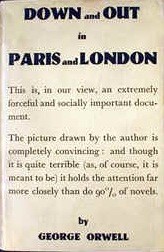
While copies of Greenwood’s late thirties documentary book are quite common, it is rare with the dust-wrapper (I have seen it only on this one copy during the last eighteen years). The dust-wrapper was clearly designed with a mainly textual cover to suit the serious and informative nature of the project (and presumably each LBS book had a similar design of dust-wrapper). I think one might quibble a little with the idea that the work in itself is sociology, but certainly it is based extensively in interviews Greenwood carried out largely but not wholly in Manchester and Salford during 1938-1939, which might helpfully have contributed to current sociology. Orwell’s book also had as its original dust-wrapper a similarly text-based design suggesting its factual witness and serious intent. Unfortunately I do not have access to a really usable image of the (highly collectable) British first edition – which sells for thousands of pounds sterling even without its dust-wrapper. There is a very small image (small for copyright reasons) of the first edition dust-wrapper in the relevant Wikipedia entry which gives a general if not very legible impression and is the best I can do:
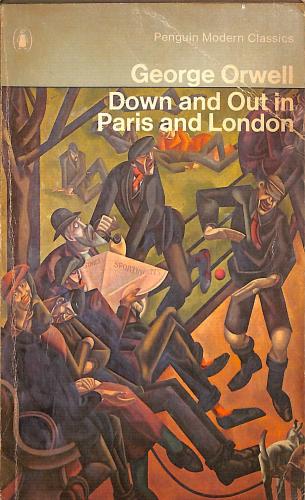
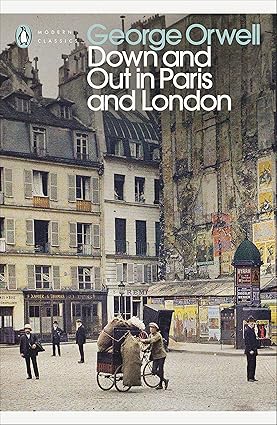
Since 1933 Down and Out in Paris and London has been published with dozens of different dust-wrappers, most vividly pictorial, in line with more recent cover-design aesthetics (though sadly How the Other Man Lives has never been reprinted). Sampled below are four covers just from Penguin editions between the nineteen-eighties and the present. Of course, in comparison to the first edition these can all immediately draw on the fame and image of both the name George Orwell and the title of the book.
These covers date from 1983, 1989, 2021 and 2025 respectively (they are borrowed from Abe Books UK). Clearly some chose artworks while others went for photographs – and each had to make an initial choice about focusing on Paris or London (though the fourth and least relevant cover does not really specify either). I could not say that I exactly like the photographic cover of my own earlier 1978 Penguin edition, but it does have a somewhat repellent fascination for me because of the horrible coarsely-knitted unravelling single mitten! (though I quite see that if you are cold, one mitten is better than none). The image seems more applicable to the tramps of Orwell’s London than the plongeurs of his Paris, and actually for the London tramping section at least I think it does a better job than any of the four covers above.
The framing of the photograph on the middle of the body without showing face or head really draws attention to the hands and the attempts to keep them warm – one with a cup of tea, the other with a very coarse and fraying mitten – while also suggesting that tramps are often denied a full identity. The photograph is credited to Henry Sutton and works well in my view. Book cover scanned by the Author.
Down and Out in Paris and London was published by Victor Gollancz in 1933. It was Orwell’s first published book and was based on his experiences living among very poor people in Paris and London, after he had resigned from the Indian Imperial Police in Burma in 1928 while on home leave in England. Though structurally the book is a continuous narrative it falls into two distinct halves: one-hundred and twelve pages about Paris, and only seventy-eight abut London (using the pagination of the much-reprinted Penguin edition, in my case from 1978). There are considerable stylistic differences between some parts of the Parisian material, while the London material is more consistent. In both parts Orwell reports experiences of being very poor and living on the edge, with utterly inadequate and uncertain housing, clothing and food, but one distinction is that for part of the time in the Paris section he is working – if in the gruelling and exploitative world of ‘plongeurs’ or dishwashers, the lowest of the low, in hotels and restaurants. In the London section he is more categorically ‘down and out’ for he lives the life of a tramp, or officially a ‘vagrant’, on the road: there is no question of any form of paid employment being accessible in the condition he is in, however low-paid and exploitative. Both sections and both experiences have their disgusting, dehumanising and exhausting aspects, which make life barely survivable and of very low quality.
However, it seems initially evident in the narrative itself through a rather transparent catalogue of plot devices that Orwell has sought out these lives rather than exactly fallen into them through circumstance: in Paris his job as an English tutor falls through, another lodger steals all the money from every other lodgers’ room, he returns to England almost penniless, his job as a carer for an invalid is delayed, and he daren’t borrow any more money from a friend. There is some truth in this appearance – he did deliberately seek to share the world of tramps in London, dressing like a tramp before setting out, while being able to return to his more usual life when he wished. However, our very sketchy knowledge of his biography during 1928-1929 does suggest that while in France he became desperately poor as his early attempts to make a living through writing largely failed, and that destitution was less deliberately sought:
In the autumn of 1929 Blair ran out of money and was reduced to taking a job as a dish-washer for a few weeks in a fashionable hotel on the rue de Rivoli (Bernard Crick, George Orwell: A Life, 1980, p. 224, Kindle Edition).
As Crick goes on to say,
Down and Out raises by now familiar problems. How much can it be read as literal autobiography? ‘Nearly all the incidents described there actually happened, though they have been rearranged,’ he was to write in the autobiographical chapters of The Road to Wigan Pier (p.226).
Indeed, as Crick points out, the English tramping experiences in fact preceded the Paris period. There is certainly a literary as well as a documentary element to these narratives – I think we might reasonably say there are fictive aspects to how the author/narrator inserts himself as a witness to these told realities – but nevertheless they certainly record authentic experiences new to Orwell and likely to be new, and indeed news, to his readers. As we shall see, there are fictive as well as documentary aspects to certain of Orwell and Greenwood’s accounts of being down and out. Early reviews of Down and Out in Paris and London across a range of periodicals (higher-brow and more popular) were generally impressed by a sense of grim truths being brought to the surface by a plain-speaking witness and noted little in the way of literary or narrative artifice:
In Down and Out in London and Paris there is ugliness, there is hardship, there is beastliness enough ; but it is written with never a whine. It is not only George Orwell’s experiences that are interesting ; George Orwell, himself, is of interest. When he writes of abuses he writes without hysteria or sentimentality; with a straight, frank reasoning, more telling than appeals to emotion . . . My advice to those who can afford it is: buy this book. If you cannot run to purchase, get it from the library. By one means or other, read it! (Time & Tide, 11 February 1933, p. 22).
This is a plain, undisguised, realistic, sober account of the conditions under which the dregs of our populace must live if they are to live at all. Half the book concerns the life of the down-and-out in Paris at which our withers are un-wrung, for we have no moral responsibility for what goes on in any country except our own. But the second half, which concerns the English down-and-out, including the country tramp, is our business and this book reveals a state of affairs which should make our legislators blush . . . in the meantime it takes a strong stomach to read Mr Orwell’s conscience-pricking book (the Daily Express, 12 January 1933, p. 6).
It is important to recall that the name of the author at this point carried no freight with it – a point reinforced by a paragraph the Daily Express printed after its review:
GEORGE ORWELL. Query? Who is he? His publishers say: ‘Nothing is known of this man except that his book is written under a pseudonym to preserve his anonymity; the story he tells is based on his own experiences as a down-and-out without money, jobs or friends’ (p. 6).
It is noticeable that this final Daily Express paragraph ignores the Paris material, as the article explicitly did, asserting with shocking parochialism that only English social conditions matter or move us. Nevertheless, the paper does regard the authorities as bearing a responsibility for allowing British tramps to continue in these conditions. One might also query the ‘without friends’ statement for the George Orwell of both the Paris and London narratives has a remarkable capacity for making friends among his peers and finding people to chum up with – Boris in France, Paddy and Bozo in England – experts in this way of life, who can introduce him to essential ways of survival, and help him to tell the story of such kinds of existence. Of course, this friend-making may partly be a structural device enabling him to bring expert witnesses into the narrative, but also seems essential to the everyday survival of the Orwell character in the text.
As it happens, Greenwood’s piece was of course solely about London so in this instance (but with more general disapproval as noted!) I am going to follow the Daily Express narrow focus. In the main, Greenwood’s fiction and factual writing focused on poverty among working people, both in the form of a low standard of living sustained over decades and indeed over whole lives and whole generations, and in the form of the acute crisis into which the Depression inevitably plunged such communities. He did not often turn his attention to forms of poverty which were even further on the margins of social living as understood by most people in Britain. In this respect his initial conception of poverty differed from Orwell’s who himself later reflected on Down and Out in Paris and London in ways which showed that he had started from a different perspective. This is pointed out by Bernard Crick in his life of Orwell:
He himself said in The Road to Wigan Pier of his down and out days that to move from a concern with unemployment to living from time to time among tramps was far from wholly sensible (several critics drive this blow home, never noticing that he made the point himself, the mature man of 1936 smiling at the sincere muddles of the youth of 1927):
I knew nothing about working-class conditions. I had read the unemployment figures but I had no notion of what they implied; above all, I did not know the essential fact that ‘respectable’ poverty is always the worst. The frightful doom of a decent working man suddenly thrown on the streets after a lifetime of steady work, his agonized struggles against economic laws which he does not understand, the disintegration of families, the corroding sense of shame – all this was outside the range of my experience. When I thought of poverty, I thought of it in terms of brute starvation. Therefore my mind turned immediately towards the extreme cases, the social outcasts: tramps, beggars, criminals, prostitutes. These were ‘the lowest of the low’, and these were the people with whom I wanted to get into contact. What I profoundly wanted, at that time, was to find some way of getting out of the respectable world altogether (George Orwell: A Life, p. 220; the passage from The Road to Wigan Pier is from p.151 of the Secker & Warburg Uniform edition of Orwell’s works, 1949-1965).
It seems quite likely that the reference to ‘the frightful doom of a decent working man suddenly thrown on the street after a lifetime in steady work’ might indeed be partly at least influenced by the impact on Orwell of seeing the play of Greenwood’s Love on the Dole. Earlier in The Road to Wigan Pier Orwell makes his only ever reference to Greenwood in terms suggesting that he gained key insights from the play about how unemployment destroyed what felt like normal existence even for those who were at best just managing while in work:
Everyone who saw Greenwood’s play Love on the Dole must remember that dreadful moment when the poor, good, stupid working man beats on the table and cries out, ’O God, send me some work!’ This was not dramatic exaggeration, it was a touch from life. That cry must have been uttered, in almost those words, in tens of thousands, perhaps hundreds of thousands of English homes, during the past fifteen years.
He can only have seen Greenwood and Gow’s play in 1934 at the earliest during its northern touring production, but is much more likely to have seen it in 1935 or after when it became famous in its London production at the Garrick, or potentially in the touring productions seen in most cities and many towns, which ran from 1936 onwards (I do not know why Orwell so readily categorises Mr Hardcastle as ‘stupid’).
Orwell had arrived at his reconsideration of how he saw poverty by 1936 but his thoughts as he confesses were very different when he was writing Down and Out in Paris and London before 1933. In that work Orwell sees all poverty rather as near complete destitution, and also tends to relate it mainly not to wider social experience, nor to a particular historical or economic period, but to his own introduction to poverty, and indeed to his own goals and psychology at that time – including his aim to get out of ‘the respectable world altogether’. Early on in the Paris section he explains his sense of what it is to live on a near impossible budget:
It is altogether curious, your first contact with poverty. You have thought so much about poverty – it is the thing you have feared all your life, the thing you knew would happen to you sooner or later; and it is all so utterly and prosaically different. You thought it would be quite simple; it is extraordinarily complicated. You thought it would be terrible; it is merely squalid and boring. It is the peculiar lowness of poverty that you discover first; the shifts that it puts you to, the complicated meanness, the crust-wiping . . .
You discover the boredom which is inseparable from poverty; the times when you have nothing to do, and being underfed, can interest yourself in nothing. For half a day at a time you lie on your bed . . . only food could rouse you. You discover that a man who has gone even a week on bread and margarine is not a man any longer, only a belly with accessory organs (pp.15 and 17).
Some of this is again very individual – I am not certain that most people of middle/upper middle class origin (as Orwell broadly was) did in the thirties always expect at some stage to fall into poverty, nor habitually spend a great deal of thought on poverty before that fated fall. Indeed, much of the underlying aesthetic rationale of Love on the Dole as both novel and play seems to suggest that Greenwood at least thought that people with a class status ‘higher’ than working-class had spent far too little time trying to understand what it was like to live just above the water-line and then to be sunk utterly by the crisis of unemployment, the dole and the Means Test. The task of Love on the Dole was to communicate this situation without invoking the bourgeois defence mechanism that those without work had brought it on themselves by habits of addiction and lack of foresight and thrift.
While the Orwell of 1933 wants to slip out of the ‘respectable’ world and all it means (and for him this undoubtedly included imperialism, and all forms of social hierarchy, and the upholding of the codes which sustained these modes of subordination), Greenwood (and Gow’s) Hardcastle family want most of all to cling on to their definitions of remaining ‘respectable’, but simply cannot do so once their jobs go and their unemployment benefits prove so un-sustaining. Most of the extract (there are further paragraphs expanding these thoughts) moves a little away from Orwell’s psychological focus but is still mainly about what poverty is like for one who has never experienced it before, who has always had the energy for ‘interests’ in odd moments of leisure (reading or writing perhaps?) and has not had to spend all their time on the tedious ‘shifts’ which just make subsistence possible.
Greenwood did not biographically-speaking ever have to experience such an introduction to poverty: he was born into poverty and remained very poor until Love on the Dole began to be a success, when he was thirty-two. Reflecting in 1937 on his alcoholic father’s early death in 1913 when Walter was nine years old, Greenwood stated what was to him and his family an evident fact: ‘My mother, my sister and I were left entirely without provision. Not that this was any real catastrophe since my father’s habits had more or less accustomed us to this’ (ironically Greenwood’s father did have one of the addictions which the middle-classes often far too readily saw as common habits of the ‘thriftless’ working-class). Later Greenwood recalled that until he was paid for Love on the Dole he ‘never knew what it was to have a penny to spare’. (1) In a Radio Times interview with George Rosie in 1971 Greenwood said that even then, three decades after Love on the Dole, he could not get rid of ‘a feeling of insecurity’ and ‘the fear that somehow it [prosperity] is all going to be taken away’ (8 July 1971, p.12 – for a full account of the interview see Walter Greenwood: ‘Old Habits Die Hard’ Interview (George Rosie, the Radio Times, 1971) *).
During his period of unemployment between 1928 and 1932, Greenwood knew very well how unemployment benefit (the dole) and the means test worked, since he was subject to them, as was his family, and the family of his then long-term fiancée, Alice Myles, on whom the Hardcastles, the central family in Love on the Dole, were partly based. Walter Greenwood’s ‘natural’ environment was that of a working-class community which could just, with indeed many ‘shifts’, manage while employment was available, but whose meagre resources could by no means cover the sustained emergency of the Depression. It was this inherited lived knowledge which Greenwood wanted to communicate to a wider British audience who had no real understanding of what this life meant, and which he attempted first in a series of short stories (all but one rejected by fiction magazines as too grim and insufficiently entertaining therefore) and then in his novel, Love on the Dole, taken with such consequences for its author and wider society by the publisher Jonathan Cape in 1932 for publication the following year.
However, if this routine life, or rather subsistence, was Greenwood’s main topic, this is not to say that he makes no reference to life on even further out margins, even apart from his ‘Down and Out’ piece. However, the main marginal existence which the inhabitants of Hanky Park imagined as the lowest they could fall was not tramping or vagrancy, but the workhouse – the remnants of a long-established system which provided a much-feared last resort for those who became paupers, that is to say utterly incapable of keeping themselves or their family. The major historian of the nineteenth and twentieth-century workhouse. M.A. Crowther, notes this fear and also that it became more potent as working-class valuing of ‘respectability’ increased. She also notes the Labour Party’s detestation of the continuation of elements of the workhouse system into the twentieth century:
the real horror of the workhouse was that for nearly a century it threatened the working class as the penalty for failure, whatever the cause of the failure had been . . . To the emerging Labour Party [the workhouse system] was a continued affront, even though many of the Labour movement came from that most solid section of the working-class who were unlikely ever to become inmates. The Poor Law Commissioners had succeeded too well in founding a system based not on physical cruelty but on psychological deterrence, on shame and fear. The growing respectability of the working class made the system more intolerable . . . The more the working class improved its position, the worse the workhouse would seem (The Workhouse System 1834-1929 – the History of an English Social Institution, Batsford, London, 1981, pp.270-71).
Mr Hardcastle in the play of Love on the Dole fears that the dole is not much more than an updated equivalent to the workhouse:
It’s all t’same, any bloomin’ road. We’re paupers, livin’ on charity. Dole or workhouse, it’s all t’ same (Act III, Scene 1, Cape edition, 1935, p.94).
Though this may not technically be accurate, since the dole was in principle part of the unemployment benefit insurance scheme to which employed workers contributed – though the Depression in effect exhausted and exceeded the capacity of this scheme – the workhouse is firmly lodged as a fate to avoid at almost any cost in the minds of the characters in Love on the Dole, being referred to mainly ominously in the novel some twelve times. It was also lodged in Greenwood’s mind and indeed his own family experience: after the death of his father, his mother and her two children had to seek the ‘outdoor relief’ which was a left-over part of the same system for the (minimal) relief of poverty. I have traced elsewhere just how much the workhouse figured in Greenwood’s life, imagination, memoirs and fiction over a long period – indeed How the Other Man Lives has a section on the workhouse titled ‘Seventy Years in the Workhouse’ about a very long-term resident (for all Greenwood’s engagements with the workhouse see Walter Greenwood’s Workhouse Memories (1933 to 1967) *). A deeply embedded theme in Love on the Dole is that Hanky Park is a closed community which it is almost impossible to escape from except through death (as Sally Hardcastle observes in the play, Cape edition, 1935, Act I, p.16), and which is cut off from any effective constructive help from national or local government or other parts of Britain. Since the workhouse is a local provision (originally provided by the ‘union’ of several parishes) references to it continue the sense that even when on the margins no-one can really get away from the economic and social prison which is Hanky Park.
3. In Search of the Tuppenny Lean-over
Beyond the workhouse, Greenwood does though make some few references to marginal lives which are regarded by people in Hanky Park as ranking as even lower than being on the dole or on poor relief or even in the workhouse. Thus in Love on the Dole, in Chapter 15, significantly titled ‘LEANOVER’, presumably to indicate that the chapter as a whole is concerned with the lowest points to which the young people of Hanky Park can fall, including the actual tuppeny leanover. Harry, unemployed and knocked off the dole under means test rules, hears about the fate of one of his former fellow apprentices at Marlowe’s works, Sam Hardie. Killing time at a street corner with another ex-apprentice, Jack Lindsay, it occurs to Harry that he has not seen Sam recently. Jack tells him why:
‘Hey, Jack,’ he said, suddenly: ‘What’s become o’ Sam these days?’.
Jack looked up: ‘Ain’t y’ heard? He’s joined th’ army cause he had to.’ ‘Had to?’ repeated Harry. ‘Aye, bloody well had to. His pa kicked him out o’ th’ ’ouse when he was knocked off dole. Told him t’ clear out ’n join th’ army cause he wasn’t gonna keep him. He wus livin’ i’ one o’ them doss houses i’ Garden Place. Poor devil couldn’t afford price of a bed. Tuk him all his time t’ find for a tupp’ny leanover.’
Harry gazed at Jack, puzzled: ‘Tupp’ny leanover. Wha’ d’y’ mean?’ (Random House. Kindle Edition, p.231).
The Army here is clearly regarded by Jack as certainly something on the margins of ‘normal’ existence for a young man from Hanky Park, even in the Depression (though when in the 1941 film version Harry himself in a desperate moment says he’ll join the Army the new context rather transformed the meaning of the speech). However, that is Sam Hardie’s only way out from his not only marginal but unsustainable period as a ‘down and out’. He has clearly not adapted well to the life of a tramp, though he has taken up busking, and the passage suggests that there are ‘doss-houses’ in Hanky Park, and that marginal lives beyond the workhouse are not therefore completely unknown. (indeed there is an excellent web-article about the model Salford Corporation Lodging House which early on suggests it was opened in 1894 as an alternative to much worse local lodging-houses – see https://chapelstreetsalford.substack.com/p/the-last-respectable-doss-house). Failing even to find the funds for a doss-house Sam has had to go even lower, to a ‘tupp’ny leanover’ – a term which Harry has clearly never met. Jack explains what this is in the next paragraph:
Jack shrugged: ‘Y’ should go ’n have a luk at it. It’s for t’ real down and outs as can’t afford price of a bed. They charge y’ tuppence t’ lean o’er a rope all night. Hell, y’ should see ’em. About forty blokes sittin’ on forms in a line an’ leanin’ o’er a rope … elbow t’ elbow all swayin’ fast asleep, except the old bastards who’re dyin’ and can’t sleep for spittin’ an’ coughin’ their guts away.… Aye, ’n Sam wouldn’t ha’ bin able t’ afford that if he hadna gone buskin’.… Jesus! That’s work for y’ if y’ like.… Trapesin’ streets singin’ in t’ perishin’ cold, an’ sometimes nobody’d give him a stiver. Anyway, he’s joined th’ army,’ pause, then, savagely: ‘Jesus, that’s where honesty gets y’. (p.231)
This is certainly getting close to some of the kinds of material Orwell explored in Down and Out in Paris and London where he gave extensive accounts of the different ‘establishments’ where tramps could sleep (he starts by numbering the different types, up until three, but then abandons this scheme though he goes on to outline a further two types of sleeping quarter). Orwell’s number two is the ‘twopenny hangover’, which I take to be a related term and set-up to Greenwood’s ‘tupp’ny leanover’. Here is Orwell’s description of how the provision works:
The Twopenny Hangover. This comes a little higher than the Embankment. At the Twopenny Hangover, the lodgers sit in a row on a bench; there is a rope in front of them, and they lean on this as though leaning over a fence. A man, humorously called the valet, cuts the rope at five in the morning. I have never been there myself, but Bozo had been there often. I asked him whether anyone could possibly sleep in such an attitude, and he said that it was more comfortable than it sounded – at any rate, better than bare floor. There are similar shelters in Paris, but the charge there is only twenty-five centimes (a halfpenny) instead of twopence (p.185).
The basic description is similar, though Greenwood / Jack’s account lacks the rope-cutting at dawn feature and is much more pessimistic about the possibility of actually sleeping over a rope, though mainly because of the chronic health problems which Orwell describes as absolute preventers of sleep a couple of pages later in his account of common lodging houses (which at least have beds of sorts). Orwell also has a comparative element with his knowledge of ‘similar shelters’ in Paris and the lower prices there. These descriptions make their point very clearly in both authors: what could be more desperate than trying to sleep sitting up and leaning / hanging over a rope, only to be roughly roused (assuming you had slept) at dawn? And having to pay your precious tuppence for the privilege?
However, the evidence trail for such a practice is in fact remarkably thin as the writer Mike Dash details in his compelling discussion of the term on his web-site A Blast from the Past. There are, it appears, few convincing images, drawn or photographic, very little textual evidence going back into the nineteenth century and in fact little textual evidence in the twentieth century. As Dash suggests, most references on the web recirculate the same material, both visual and textual (and usually with no references to any sources). I, like Dash, can find no uses of either Orwell’s or Greenwood’s terms in the British Library National Newspaper Archive in either the nineteenth or twentieth century up until 1933. In fact, there are no references at all to Greenwood’s term, while after 1933 references are somewhat more frequent to the ‘twopenny hang-over’, but are all either direct references to Down and Out in Paris and London or use language which is clearly closely and directly derived from Orwell’s account. Thus the term acquired an appearance of solidity, but only after 1933 and the repetition of Orwell’s reference. Thus a reader of the Daily Mirror who wrote in asking about the truth of the twopenny hang-over in the nineteen-eighties was assured that George Orwell was a witness to their continuance ‘well into the twentieth century’ (9 November 1981, p.24).
OED does not have any entry at all for ‘twopenny hangover’ nor for ‘hangover’ in the relevant sense, nor for either ‘tuppenny/twopenny lean-over/leanover’ or ‘lean-over’, but does give one relevant example of usage under the broader term ‘lean-over’, meaning simply ‘something over which one can lean’. It is overall a remarkably thin entry for the ‘tuppenny leanover’ usage, and ranked by the OED frequency measure as a word very infrequently used between 1880 and 2010. Here is the sole usage in our sense listed: ‘For others, again, there is the twopenny lean-over . . . E[dith[ Sitwell, Victorian of England, xiii, [p]163′. This book was published in 1936 by Faber & Faber (and as we shall see there is more to say about its value as evidence for the tuppeny leanover).
Dash even goes to far as to suggest that the term ‘twopenny hangover’ actually ‘originates’ with Orwell’s usage in Down and Out in Paris and London in 1933, and that the practice may not actually have existed in the form Orwell describes. Dash thinks Orwell’s account may have been based on a misunderstanding of one or other nineteenth-century lodgings which did use a kind of mass rope bed for its clients, but did not involve them sitting on a bench or hanging or leaning over a rope. We will return to these possible origins for the alleged rope hang-over in more detail in due course. I would anyway recommend reading Mike Dash’s article in full to see his detailed reasoning and discussion of the sources of our knowledge (or apparent knowledge): (https://mikedashhistory.com/2021/05/19/the-twopenny-hangover/).
However, at least in Greenwood’s use of a related term and the same idea we appear to have another contemporary use to Orwell’s in the same year, which might give us independent witness to the practice. Nevertheless, before probing this further I should note a rather remarkable pre-internet uncritical recirculation of evidence. As we have seen, OED cites as its single usage of ‘twopenny lean-over’ a historical biography by Edith Sitwell. When I looked out this source, this is what I found in an account in the book of dire poverty in nineteenth-century London:
“In London”, said Engels, “fifty-thousand persons get up every morning not knowing where to lay their heads at night.”2 For some there will be the lodging-houses where they will be packed one on top of each other. To the foul Refuge for the Homeless in Upper Ogle Street, for example, a shelter meant to house three hundred persons, come nightly two thousand, seven hundred and forty living beings (to take an average) . . .
For others again, there is the two-penny lean-over:
Poor devil couldn’t afford price of a bed. Tuk him all his time, t’ find for a tupp’ny leanover! … Y’ should go an’ have a look at it. It’s for t’ real down and outs as can’t afford price of a bed. They charge y’ tuppence t’ leán o’r a rope all night. Hell! y’ should see ’em! about forty blokes sittin’ on forms in a line and leanin’ o’er a rope … elbow t’ elbow all swayin’ fast asleep, except the old bastards who’re dyin’ and can’t sleep for spittin’ and coughin’ their guts away … ay, and Sam wouldn’t ha’ been able t’ afford that if he hadna gone buskin’. Jesus! That’s work for y’ if y’ like… Trapesin’ streets, singin’ in t’ perishin’ cold, an’ sometimes nobody’d give him a stiver! [italics in the original, presumably to indicate a quotation]. Edith Sitwell, Victoria of England, pp.156-7, Peters & Dunlop Kindle edition).
Not the cover of the first 1936 edition, but I do have a copy somewhere. I’ll let this cover from 2018 stand in till I find it!
The reader of this web-article will of course recognise this passage, having read the identical text very recently above. This passage has an endnote number 5, which gives the following reference for the quotation: ‘Walter Greenwood: Love on the Dole (Jonathan Cape, Ltd.)’. There is no page number but perhaps more notably the publication date of 1933 is neither there in the note nor referred to in the text itself which purports to be about nineteenth-century London, rather than nineteen-thirties Salford or Manchester. Edith Sitwell knew Greenwood and his novel, having written him five supportive letters in praise of his Love on the Dole in the thirties, which are now held in the University of Salford Archive’s Walter Greenwood Collection (she also saw and admired the later play and film versions). Clearly here she draws on one striking detail of the novel’s representation of utter poverty (and sought Greenwood’s permission for this quotation in a letter to him on 23 July 1935, now held in the Salford University Walter Greenwood Collection, WGC 2/1/4). Certainly this 1936 usage does not give the term ‘twopenny leanover’ any credible nineteenth-century existence, and strictly speaking it seems to me that OED should have listed the term’s origins as being in Love on the Dole (novel) and dated it to 1933, rather than regarding Sitwell as the originator of her quotation of another writer. These referencing oddities (or even eccentricities) reduce even further the depth of evidence for the term and practice of the rope lean-over in nineteenth or twentieth-century Britain.
Despite this lack of published evidence maybe it was still possible that either the fact or myth of the ‘tupenny lean-over/hang-over’ did circulate among tramps and others who told Orwell and Greenwood of it? However, I cannot help wonder whether in fact Greenwood had read Orwell’s Down and Out in Paris and London and could not resist incorporating in his novel about contemporary unemployment the rhetorical power of this apparently well-documented and wretchedest form of destitution? Orwell’s book was published on 9 January 1933, according to Time & Tide (‘Some Forthcoming Books’, 7 January 1933, p.17) while Greenwood’s novel was published in September of the same year, according to the Sheffield Independent (9 April, 1935, p. 4). It might perhaps have been possible for Greenwood to add this fascinating detail, which fits well into his grim account of life in Hanky Park, to a manuscript, typescript or proof version? If so, then this would be a further recirculation of a single piece of evidence. However, the tuppenny leanover passage is certainly there in Greenwood’s corrected proof copy which I have looked at recently, and also in the final fair manuscript copy of Love on the Dole in the Salford Archives – WGC 1/2/1. Conceivably the reference might not have been there in earlier drafts, but these are not extant so we cannot know.
There is a degree of explicitly indicated indirect witness in both Greenwood and Orwell, which is perhaps not wholly co-incidental. I note that in the Love on the Dole representation of the tuppenny lean-over it is told of by a character, but not directly by the narrator, and that there is then a fictional technique for reinforcing its reality and immediacy. Harry hears of this phenomenon he has never before met from Jack, who invites Harry to go and witness a tuppenny lean-over with his own eyes: ‘Y’ should go ’n have a luk at it’. As Mike Dash points out, there is also a considerable degree of acknowledged second-handness in Orwell’s account: ‘I have never been there myself, but Bozo had been there often . . . There are similar shelters in Paris’. Here Orwell relies on Bozo as his witness, but can assure us of his veracity from his own implied and recent knowledge of a Paris equivalent to the ‘twopenny hang-over’.
Mike Dash finds two potential if not obvious sources for Orwell’s apparently fairly assured knowledge of the twopenny hangover, one American and one literary. The US example is from a book-length account of New York sleeping establishments for the very poor by Jacob Riis (1849-1914) called How the Other Half Lives: Studies among the Tenements of New York (a title the first half of which is curiously echoed by that of Greenwood’s book) published by Scribner in 1890.
As Dash makes clear even here in this fairly early trace of evidence for something like a ‘twopenny hangover’ the evidence is markedly indirect. Riis writes that he has heard rumours of this cheapest of all sleeping arrangements, but has not seen any examples and thinks it might be something practised in some European countries, but not in the US in the period when he was making his photojournalistic explorations in New York (for more on the ‘pioneering photojournalist’ Riis see Dash, and Riis’s wikipedia entry: https://en.m.wikipedia.org/wiki/Jacob_Riis). Dash does identify the most convincing evidence of an actual hangover/ leanover in German visual sources from 1909 and 1930 but does not see these as likely sources for Orwell.
Dash’s other possible and very different kind of source is Dickens’ Pickwick Papers, (though as readers can see from the image below that is not strictly the full title of the work serialised in 1836-7 and published as a book in 1837).
1837 Chapman & Hall cover from the Wikipedia entry on the Pickwick Papers; stated to be out of copyright because the author dies more than seventy years ago (and the same is true of the equally important illustrator). See https://en.m.wikipedia.org/wiki/The_Pickwick_Papers
Here Dash points out that Mr Pickwick’s cockney manservant Sam Weller tells his master of a time when he had been so hard up that he had to turn to what he terms ‘unfurnished lodgings’. Weller does not say that he himself used what he calls a ‘twopenny rope’, but reports its existence. Again, as Dash’s discussion makes very clear, Sam Weller does not by this term mean a ‘twopenny hangover’ or ‘tupenny leanover’. Just as Harry Hardcastle in Love on the Dole has to ask Jack Linday what a ‘tupenny leanover’ is, so Mr Pickwick has to ask Sam Weller what a ‘twopenny rope’ is. And Sam explains very clearly that it is: ‘just a cheap lodgin’ house, where the beds is twopence a night’. He further explains that the beds are supported on ropes so that the lodging-house keepers can untie (not cut) the ropes to awake the sleepers at daylight, when they have had their two-pence worth of sleep, by easily collapsing them onto the floor. This source markedly does not describe a twopenny hangover, but the shorthand term a ‘twopenny rope’ might be close enough to call forth an imprecise memory, especially when associated with hearsay stories of leanovers in Paris. My only reservation about this idea is that Orwell of course knew his Dickens very well, so such an approximate recall might perhaps seem unlikely. In his extended essay of some sixty pages Dickens published in Inside the Whale and Other Essays by Gollancz in 1940, Orwell shows a deep and detailed knowledge of Dickens’ whole oeuvre, referring to and quoting from most of his novels, including numerous allusions to The Pickwick Papers (though alas with nothing on the ‘twopenny rope’). Orwell also observed there that ‘When Dickens has once described something you see it for the rest of your life’ (George Orwell, The Complete Works, Kindle Edition, p.1914).
Mike Dash concludes at the close of his article that while there is no question about the popularity of the ‘twopenny hangover’ as what he terms a contemporary ‘internet trope’ (that is a recognisably repeated phrase, or idea, a trope originally being a rhetorical theme or device in literary writing), he is sceptical at least about any historical factual foundation. That is very much my conclusion too. However, I also take his point that the idea continues to circulate partly because of how the web works but also because it is a powerful image of an immediately ‘vivid’, visualisable, and obviously ‘degraded’ form of living. Even if neither Orwell nor Greenwood had ever seen a twopenny/tuppenny hangover/leanover they were both convinced by and of its rhetorical power to represent utter destitution.
4. The Swag, the Toby-wallah, the Screever and the Spike: Orwell and Greenwood’s Down and Outs
Both Orwell and Greenwood chose to focus their writing on those on the very margins through the key phrase or description ‘down and out’. This phrase has clearly developed a usage as a kind of (technically un-combined) portmanteau adverb and adjective as well as a noun – one can be ‘down and out’ or a ‘down and out ex-miner’ or be ‘a down and out’ or people can be plurally ‘down and outs’. The phrase/word has a deeper and more solid history than the ‘twopenny hangover’, but it too is a relatively recent word. OED lists it first appearances not in this sense but in the specific sphere of boxing, when a boxer is knocked down or unconscious and is out for the count and unable to continue a bout (the OED first example dates only to 1894). From this literal use, the phrase seems to have spread to other sports, indicating a more general kind of team defeat, as well as a technical use in the card-game bridge (OED senses 1 and 2). Early uses seem to be mainly North American and date to the last few years of the nineteenth century and to the twentieth century. In the first decades of the twentieth century, a metaphorical sense relating to destitution comes into use (OED sense 3). Thus OED gives examples from a 1901 popular novel by H. McHugh called John Henry, from a 1923 song, most famously sung by the American jazz musician Bessie Smith, titled ‘Nobody Knows You When You’re Down and Out’, and as it happens its third example is ‘Down and Out in Paris and London (G. Orwell, title), 1933′.
In fact, Orwell uses the phrase only once beyond the title when early on he explains that sinking to the bottom has a sort of compensatory aspect (for him, at least – it may well be an idiosyncratic relief and belief):
And there is another feeling that is a great consolation in poverty. I believe everyone who has been hard up has experienced it. It is a feeling of relief, almost of pleasure, at knowing yourself at last genuinely down and out. You have talked so often of going to the dogs – and well, here are the dogs, and you have reached them, and you can stand it (p.7).
He does elsewhere often use common metaphors based on the similar spatial/social idea of being ‘down’ at the bottom, but also uses the terms vagrant and tramp – both older words dating back to the fifteenth and the seventeenth centuries respectively. Actually, Orwell uses ‘vagrant’ only twice, while he uses ‘tramp’ much more frequently, some 179 times (based on a Kindle word-search of the text). Greenwood uses the phrase ‘down and out’ three times beyond his title, but once as a gloss on another term used by his interviewee. He uses the phrase in the first paragraph which opens his account by explaining how he came to talk to a ‘down-and-out’:
I did not wait for such a day. It just happened that when I set out to talk to a down-and-out the November weather was bitterly cold and a fog hung over London. Street lights were burning vaguely in the gloom; clocks were striking midday. Pedestrians, muffled up to the necks, hurried by, hands thrust into pockets (p.102).
Since this is the fifteenth section of Greenwood’s book the reader by now knows the general framework which is for the author to locate an individual who seems a reasonably typical example of a particular way of living / making a living. Often their trade is given some context in either history (pre and post First World War conditions) or local or national life before a more individual conversation is opened. Though the Evening Chronicle reported (28 September 1938) that Greenwood was staying in Manchester to collect interviews for his next book, a number of the published pieces did not feature Mancunian / Salford interviewees (though many did). For the ‘Down and Out’ section Greenwood clearly felt that London was the best or most typical place to find an interviewee, despite the passage in the novel of Love on the Dole six years earlier which we have explored above and which does suggest some down and out existences in Salford itself. His interviewee is picked at random by seeking in what he thinks a likely area – the Charing Cross Road towards the Trafalgar Square end. While it is never made explicit in any section that Greenwood has had an introduction to his interview by a third party this looks likely to have been the case in many instances. Here however Greenwood makes his own introduction, though this is a touch-and-go moment:
I heard strains of music. Somebody was playing a mouth organ.
Then I came across him, a pitifully dressed young fellow standing in the gutter.
He was hatless, wore a stained grey coat which still retained a little of its former shape, think ragged flannel trousers and broken shoes with pointed toes, the kind worn by young men who wish to be considered ‘smart’.
[. . .] I stopped in front of him [and] he glanced quickly and apprehensively at me, stopped playing and, with a quick gesture, slipped the mouth organ into his pocket and made as though to clear off. This, I learned afterwards, was his intention since he thought me to be a detective. (p.102).
The passage has several purposes: it describes the very poor clothing of the man given the cold and foggy weather (while also noting that he once had enough money to aspire to the cheap but smart going-out-dancing shoes of a young working-class man), and then introduces his fear of the law, a sign of his existence on the margins, a theme to which his witness and Greenwood return several times later. Greenwood reassures his witness (he remains disturbingly nameless throughout) by offering to buy him some food, an invitation which the man readily accepts.
They go to an eatery of the man’s choice and here again as the practical details of their interaction unfold we also learn things about being down and out we might not otherwise know. The young man asks for ‘drip and tea’, apologising to Greenwood that ‘it’ll cost threepence ha’penny’ (p.103). Greenwood presses him to have something ‘more substantial’, but the young man explains that this is the only food the establishment serves and that:
In any case this was what he wanted since it was more sustaining than any other food. The meal turned out to be three thick slices of bread and dripping and a big cup of strong tea. He sprinkled quantities of salt on to the the dripping and put plenty of sugar into the tea (p.104).
As we shall see, Orwell has quite a bit to say about tramps’ staple foods. I am not sure how familiar ‘dripping’ is these days as a foodstuff (probably depends on your background and date of birth), so it seems safest to gloss the term. Dripping is a fat collected from a joint of roasted meat, including pork, lamb or beef, which is then allowed to cool and solidify and will keep for quite a few days. It can be used for cooking or as a cold spread on bread, and probably dates back to at least the Middle Ages.
Wikipedia in a rather thin (as it were!) entry suggests that as a foodstuff or ingredient dripping became less popular towards the end of the twentieth century since it began to be thought less healthy than vegetable oils for cooking. I suspect that dripping may largely also have declined because it is a by-product of the Sunday roast, once an almost universal ritual for most British families even towards the bottom of the class spectrum, but less so since the nineteen-seventies (though it remains a pub staple or rather treat in some places – but I’m not sure what happens to the dripping). Bread and dripping was a staple working-class food especially for children, since it was no trouble to prepare and cheap since it in effect used up a left-over cooking product. However, it sounds as if this down and out man may live entirely on this menu (a point Greenwood may also be emphasising with his perhaps more than local comment that ‘it was the only diet obtainable here’). While bread (undoubtedly white bread at this period) and dripping of course include carbohydrates, fat and no doubt some protein, each of which surely do the cold and hungry man some good, it could hardly be said to supply all the body’s nutritional wants, especially the full range of vitamins and fibre, though the man is convinced it is the best food he can get – or afford? It has at least become his idea of sufficiency.
How the Other Man Lives is of course about how people live/make their livings and next the man helpfully volunteers infirmation on how he earns his subsistence. His mouth-organ playing (I note that Greenwood does not comment on whether he plays well), which he classifies as ‘busking’, is for ‘the winter months only’ (p.104). In the summer he goes ‘fiddling’ for a living – not as it might sound another musical occupation, but working on stalls at touring fair-grounds. There is no pay, but it is the custom to let the assistant keep an amount of the change which he throws on the ground under the stall under the beady eye of the stall-holder. The tramp much prefers ‘fiddling’ to busking for he makes more money – sometimes as much as two pounds a week. He has tried other kinds of itinerant work too: ‘on the matches’ and ‘swag’. ‘On the matches’ is the trade of selling matches and he made a better living at that but he says you have to look reasonably respectable and that his clothes are now too shabby (he also says that having a dog helps you sell more matches, especially, he claims, to women). It seems evident that when people buy matches from a street match-seller they know very well that they are exercising a kind of charity. ‘On the swag’ is selling ‘mechanical toys on the pavements’ (p.105 – OED does not have anything resembling this usage, but perhaps it is related to the Australian and New Zealand sense 4a, ‘swag’, meaning a bundle i.e of goods?). These kinds of (relatively) cheap toy were usually made of printed (offset lithography) tinplate and powered by clockwork – they might include novelties such as clockwork mice, cats, dogs, ships, racing cars, fire-engines and ambulances or characters such as clowns (for an introduction to the topic see https://en.wikipedia.org/wiki/Penny_toy and https://en.wikipedia.org/wiki/Tin_toy – such toys are now of course highly collectable and valuable). Clearly the idea was to attract the attention of passing customers by demonstrating the toys in action. The young man explains that you need significant money to buy your stock of toys – at least a pound or thirty shillings – but that it is hard work continually winding the toys and bending down to retrieve them. The clockwork ambulance below is of the right period and might be the kind of thing the young man sold on the ‘swag’. It is of the right kind of size to demonstrate on the pavement, though I am uncertain if an item like this would have been cheap enough for him to acquire for his stock.
The most wearing thing though is always ‘keeping your eyes open for the cops’ for there is a considerable risk of being arrested by the police for trading without a licence. The penalties are not in themselves that heavy – a five shilling fine or a day’s imprisonment at the local police station, but as we shall see the longer term consequences could be considerable. Orwell also notes in his Down and Out that his friend Bozo for a time tried selling ‘toys from a tray’ – but these must have been smaller toys than Greenwood’s man’s clockwork toys. Thereafter Bozo earned a subsistence from his ‘trade’ as a screever or pavement artist (Orwell ponders the etymology of the word assuming that it must come somehow from Latin scribo = I write: OED concurs and sees it more precisely as coming into medieval English via French escriver = to write). He explains to Orwell that ‘I’m what they call a serious screever . . . Cartoons is my line—you know, politics and cricket and that (p.144). He sometimes gets moved on by the police but his trade is generally tolerated – except if he attempts anything too ‘political’:
Once I did a cartoon of a boa constrictor marked Capital swallowing a rabbit marked Labour. The copper came along and saw it, and he says, ‘You rub that out, and look sharp about it,’ he says (p.144).
Next Greenwood asks the young man how he came to be down and out. The answer is that he was brought up in what we would now call care (‘in a Home’, p.106) – still of course for many a difficult start in life with subsequent challenges in terms of educational and social disadvantage. He has tried for many jobs but since the Home has (surely very negligently?) provided him with no references he is never considered. The young man has always lived in London, but, in the chapter’s second and third usages of the term ‘down and out’, he explains that there is a strong regional origin for most of London ‘down and outs’:
Most of the lads you see ‘on the floor’ (down and out) come from the North and Scotland and Ireland. They come up when they’re out of work and think they’re going to have a good time here. In Ireland the down-and-outs are put in a Home – they aren’t allowed to walk about (p.106).
Of course, the ‘on the floor’ term continues the ‘down’ metaphor of destitution. The idea of tramping from the North to London is not one introduced in the Love on the Dole (novel) passage about being down and out which we explored earlier, where Salford down and outs seem to remain in the locality. Greenwood only uses the word ‘tramp’ once in his report, and in a way which makes it clear that his young man does not consider himself a ‘real’ tramp: ‘The real toby-wallahs (tramps) say that London’s the best town of all for men like us’. Across his writings Greenwood uses quite a few unusual words, often Lancashire, Manchester or Salford dialect words, and this is another instance though it is none of those. OED does not list ‘toby-wallah’ at all or as as a word in any form meaning tramp, but does list a surely related word which it classifies as Indian English: ‘topi-wallah‘ (Hindi – a fellow who wears a hat), a word used mainly in India in the first half of the nineteenth century to refer with slight disparagement to a European or Christian man. I take it that this is not here Greenwood’s word but one in use among London tramps and which fascinatingly derives somehow, and presumably via imperial military service, from the Indian usage. In fact the young man seems to agree with the ‘real toby-wallahs’ that London is a (relatively) good place to be down and out for there is always ‘somewhere in London where you can get a free meal any day’ (p.109).
I also note that in this text there is no mention at all of the ‘tuppenny leanover’ as an option though the penultimate part of it does deal with sleeping-places in some detail. The young man prefers sleeping out on warm nights – including under Villiers Street Railway Arches or under Hungerford Bridge – but on colder nights he prefers to spend ninepence (I think on a lodging house though this is not specified). Greenwood asks him if he would not prefer to spend the ninepence on food but he says no because ‘if you are sleeping out you’re always liable to be arrested’ (p.108): again we have his constant fear of the Law. In fact, when Greenwood asks the young man if he has ‘tried the Army or Navy?’, he reluctantly confesses that he has a criminal record from being arrested for sleeping out which bars him from enlisting, even though he served just one day in a police-station cell (p.106). The man is not keen on ‘charity places’ which he says always extract a couple of hours work for a bed even if you arrive at 11 pm: ‘that isn’t a free bed’. At the end of the interview Greenwood ‘could not press him to eat any more’ and slips some money into his pocket before watching him ‘shuffle the few steps before the fog swallowed him up’ (p.109).
Orwell’s account of being down and out is much longer (some seventy-eight pages compared to Greenwood’s seven pages), but as well as considerable differences does cover a good deal of shared ground. One noticeable difference is that Greenwood’s report focuses on a man who earns his subsistence apparently wholly in central London or with travelling fairs, while Orwell’s companions are tramps in a more traditional sense, constantly on the move, sometimes within urban London but also ranging around the suburbs and surrounding counties. While Greenwood deals only with one individual, Orwell covers a larger range of tramps both through specific individuals and through giving an overview of the generic lot of tramps. If Greenwood’s young man does not consider himself a true tramp, that is not the case with Orwell’s who seem likely to be tramping for the rest of their (not necessarily long) lives, though they include a few who have become recently unemployed. For Greenwood’s man his life is mainly devoted to the immense effort of surviving on the streets of London, while for Orwell’s companions their lives are dominated by movement in order to survive. Orwell records a host of places where he or other tramps go and at one point gives a short summary of movement patterns and their motivation: P.128.
There are regular beaten tracks where the spikes are within a day’s march of one another. I was told that the Barnet – St Albans route is the best, and they warned me to steer clear of Billericay and Chelmsford, also Ide Hill in Kent. Chelsea was said to be the most luxurious spike in England; someone, praising it, said that the blankets there were more like prison than the spike. Tramps go far afield in summer, and in winter they circle as much as possible round the large towns, where it is warmer and there is more charity. But they have to keep moving, for you may not enter any one spike, or any two London spikes, more than once in a month, on pain of being confined for a week (pp.127-8).
The last sentence is key for it tells the reader why tramps must keep moving on. Later, as we shall see, Orwell gives an extensive expansion of why movement is unavoidable and the fundamental pattern of a tramp’s life, and also argues that most people in Britain will have no idea of the reasons why tramps are always on the move, hence some of their attitudes towards tramps.
Some technical terms Orwell uses here need explanation: ‘supported by the parish’, ‘casual wards’, and indeed the tramps’ slang word ‘spike’. OED lists as its sense 4 for ‘spike’ that it is a slang term for the workhouse and particularly for ‘the casual ward of a workhouse’, recording its first use as 1866 – and as it happens also listing a 1933 use: ‘G. Orwell, Down & Out [sic], xxvi, 189′. OED offers no explanation for why ‘spike’ has this slang sense. The workhouses were funded by unions of parishes for the destitute or paupers of their joint areas, but also included ‘casual wards’ for those not from the area, but simply passing through, as by definition tramps were.
You may recall that earlier in this article I claimed that for the majority of the working-class communities Greenwood’s writing focused on, the workhouse featured in their minds as the most marginal existence one could fall into rather than on the life of a tramp which Orwell in his early writing saw as the key kind of marginality. I might now appear to be contradicting myself by linking Orwell’s tramps to the workhouse. However this is not the case, because the workhouse had two distinct functions which were deliberately kept apart. In fact, if workhouse residents from the local area were treated as (at best) second-class citizens, we might say that the tramps were as a matter of policy treated by those workhouses as third-class citizens – and for a simple reason: they wished to deter them from claiming support even more vigorously than they wished to discourage local people from depending on workhouse support. M . A. Crowther makes this very clear in her chapter on ‘The Casual Poor’:
One group of workhouse inmates was always treated differently from the rest . . . Vagrants were one rung below the able-bodied settled poor. If they applied for relief they were entitled to a night’s lodging in the workhouse, but a lodging of the most primitive kind . . . casuals normally slept in makeshift sheds and outhouses. In many workhouses they had no beds . . . [and Poorhouse] Guardians gave them bread and water for supper, but often gave no meal in the mornings: their whole aim was to be rid of casuals as quickly as possible (The Workhouse System 1834-1929, 1981, p.247; despite the book’s title it does deal with the substantial remaining remnants of the system into the nineteen thirties).
Orwell records an occasion when the substantially different treatment of workhouse residents and ‘casuals’ was revealed. On one occasion Orwell is picked out to help in the workhouse-proper kitchen (because he has been identified as a ‘fallen gentleman’) and as a result is invited to share the workhouse dinner – the largest meal he has eaten since he worked at a hotel restaurant in Paris. Much food is left and Orwell is given the task of disposing of it:
I filled five dustbins to overflowing with quite eatable food. And while I did so fifty tramps were sitting in the spike with their bellies half filled by the spike dinner of bread and cheese, and perhaps two cold boiled potatoes each in honour of Sunday. According to the paupers, the food was thrown away from deliberate policy, rather than that it should be given to the tramps (p. 175).
This brings us back to Orwell’s careful notes on how tramps ate. Here the cheese and potatoes are, if anything, extras, for Orwell records repeatedly just how reliant tramps are on a very narrow range of food – chiefly bread and tea. He too notes the eating of bread and dripping, though only twice. On the first occasion a spike gives him and Paddy, rather than actual food, tickets to exchange at named eateries on their route. Sadly, the places cheat them by not redeeming the face value of the ticket:
Our meal tickets were directed to a coffee-shop in Ilford. When we got there, the little chit of a serving-maid, having seen our tickets and grasped that we were tramps, tossed her head in contempt and for a long time would not serve us. Finally she slapped on the table two ‘large teas’ and four slices of bread and dripping – that is, eightpenny-worth of food. It appeared that the shop habitually cheated the tramps of twopence or so on each ticket; having tickets instead of money, the tramps could not protest or go elsewhere (p. 132-3).
On the second occasion they are given bread and dripping in a spike, but it proves only half-edible. The bread was ‘as hard as ship’s biscuit. Luckily it was spread with dripping, and we scraped the dripping off and ate that alone, which was better than nothing’ (p. 176-7). More often though the tramps survive almost wholly on even less nutritious food: bread and margarine or ‘marge’ (a pairing referred to ten times in the English section of Down and Out in Paris and London) though they also regularly fare worse with just stale bread. Orwell has already survived pretty much on bread alone in periods of his time in Paris and has commented there on the physical and mental effects of this minimal diet. He sees the same weakening impact of this diet on tramps in England too:
[Paddy’s] cheeks had lanked and had that greyish, dirty in the grain look that comes of a bread and margarine diet . . . two years of bread and margarine had lowered his standards hopelessly. He had lived on this filthy imitation of food till his own mind and body were compounded of inferior stuff. It was malnutrition and not any native vice that had destroyed his manhood (p.133 and p.136)
Like Greenwood’s young man with his bread and drip, Paddy now judges this as the only and adequate diet: ‘Food, to him, had come to mean simply bread and margarine – the eternal tea-and-two-slices, which will cheat hunger for an hour or two’ (p.159).
5. Some Conclusions
There is much common ground in Greenwood and Orwell’s accounts of the lives of the down and out. Both include material on the necessarily cheap and poor diet, the nightly difficulty of finding and affording somewhere to sleep, the relationship with the police, the different ‘trades’ used in order to earn a subsistence and some of the reasons why people become down and out (though both reports deal mainly with men, said by Orwell to make up the vast majority of tramps). Both give a good sense of the rhythms of life of their down and out witnesses. However, there is clearly a difference of scale, as Greenwood derives his view mainly from one interview (as he mainly though not wholly does for all his ways-of-living pieces), while Orwell sees things partly through his two mates on the road, Paddy and Bozo, but also by participating in the collective life of tramps as they pass from lodging house to lodging house, spike to spike. Orwell also draws out some more analytic conclusions about the state of being a tramp. Greenwood does early on in his piece do what he calls some ‘elementary analysis’ (p.103) and categorises being down and out as an extreme example of what happens in a society where there is economic insecurity and gross inequality – nevertheless he is unspecific about more exact causes of destitution except for the case of his witness where being bought up in a Home and having no care taken of how he might thereafter earn a living has cast him down from his very beginning.
Orwell provides more extensive analysis of why there are tramps:
To take a fundamental question about vagrancy: Why do tramps exist at all? It is a curious thing, but very few people know what makes a tramp take to the road. And, because of the belief in the tramp-monster, the most fantastic reasons are suggested. It is said, for instance, that tramps tramp to avoid work, to beg more easily, to seek opportunities for crime, even – least probable of reasons – because they like tramping . . . [but] a tramp tramps, not because he likes it, but for the same reason as a car keeps to the left; because there happens to be a law compelling him to do so. A destitute man, if he is not supported by the parish, can only get relief at the casual wards, and as each casual ward will only admit him for one night, he is automatically kept moving. He is a vagrant because, in the state of the law, it is that or starve (pp. 178-9).
In short, the tramp is created by regulations and the law – tramping is the only way he [or in fewer cases, she] can make a subsistence living. Greenwood also treats his witness as someone who has to make a living and in that sense treats him as he does all his other witnesses to particular occupations and ways of living. Both Orwell and Greenwood reject myths about tramps to focus on their actual state. Greenwood’s young man says that things have got more difficult because of ‘tales’ spread by newspapers ‘about the fellows . . . who’ve been picked up begging with quids in their pockets’ (p.105). Orwell gives a summary of myths about tramps:
In childhood we have been taught that tramps are blackguards, and consequently there exists in our minds a sort of ideal or typical tramp—a repulsive, rather dangerous creature, who would die rather than work or wash, and wants nothing but to beg, drink, and rob hen-houses. This tramp-monster is no truer to life than the sinister Chinaman of the magazine stories, but he is very hard to get rid of. (p.178).
The exact nature of these myths now seems rather of its period, and indeed I note that neither Greenwood nor Orwell nor, I think, their contemporaries, use the word which we now mostly use of people who might formerly have been called ‘down and out’: ‘homeless’ or ‘the homeless’. The workhouse casual ward is, thank goodness, long gone, but not the issue of large numbers of people who night after night do not have a secure or warm place to sleep, nor an assured source of food or even water or washing facilities. Vagrancy regulation may have changed but destitution is still with us in every town and city (as The Big Issue and its ongoing work evidences and helps to begin to address: https://www.bigissue.com/about-the-big-issue-group/).
Some of the important differences between Greenwood and Orwell’s reports stem from genre – the snapshot of a single interview from a longer documentary work against a longer and more immersive period among tramps which is akin perhaps to a kind of sociological travel writing. Other differences stem from the authors’ biographies, in which there were contrasts we noted nearer the beginning of the article. Orwell had to go down into the world of down and outs by initial acts of casting off his actual identity and putting on another. As we shall see the place of clothing in this shift was much more than metaphorical. Allegedly trying to delay having to borrow more money from his friend B., Orwell pawns his second-best suit in exchange for some old and dirty clothes and a pitiful amount of money – only one shilling, a very bad deal. He is thus transformed in both appearance and economic status:
An hour later, in Lambeth, I saw a hang-dog man, obviously a tramp, coming towards me, and when I looked again it was myself, reflected in a shop window. The dirt was plastering my face already. Dirt is a great respecter of persons; it lets you alone when you are well dressed, but as soon as your collar is gone it flies towards you from all directions (p.115).
The not recognising yourself in a mirror trick is nicely-done, but surely more a literary device than something which could literally happen? Neat too is the idea that once you have shed your ‘respectable’ clothes you are more prone instantly to attract more dirt, but can it possibly be the case? It sounds an idiosyncratic (Orwellian?) belief to me, though not being able to wash self or clothes does soon become a problem of course. Very soon Orwell realises that it is not just his self-perception which has changed but how he is seen by others:
My new clothes had put me instantly into a new world. Everyone’s demeanour seemed to have changed abruptly. I helped a hawker pick up a barrow that he had upset. ‘Thanks, mate,’ he said with a grin. No one had called me mate before in my life – it was the clothes that had done it (p. 115).
There is an element of satisfaction here – he has escaped respectable life as he wished (though soon counter-acted by his feeling that all women turn away from his new appearance in immediate disgust). Greenwood of course does not assume a new persona to talk to his young man, though he does have some initial difficulties in overcoming his witness’s fears about why someone plainly not a down-and-out wants to talk to him. Greenwood can however easily imagine that he too could have shared the young man’s current identity from his own actual past circumstances:
And I reflected that all that had stood between his condition and mine when I was out of a job was that I had been lucky enough to have had relations whose food and home I could share. Otherwise, and if I still had been unable to have found someone to have employed me, I should have been as he, cold, hungry and down and out (p.103).
The relations in his case were his mother and sister who both were in work, if not well-paid work. Unlike the unknown early Orwell of Down and Out in Paris and London, Greenwood in 1939 had a very widely-known biography as the author of Love on the Dole, novel and play, works which were widely and substantially correctly believed to be based in personal experience. Greenwood thus has no need to remind his readers why he too could easily have been in 1928 what this young man is in 1939. If Love on the Dole mainly imagined even the marginal as still being confined within Hanky Park, perhaps partly from the way in which it constructed its world as a place cut of from normal life in modern England, Greenwood clearly could imagine life on the streets of London.
In both their shared and different ways these two reports on the ‘Down and Out’ give us great historical and social insights into those who were on the margins, beyond even the residents of the workhouse. Sadly, those insights are not just part of the done-with past.
NOTES
Note 1. Reflections from his book Lancashire, published by Robert Hale, London in 1951, p.9 and in his essay ‘The Old School – an Autobiographical Fragment’ in The Cleft Stick, Selwyn & Blount, London, 1937, p. 218.





.jpg)

 Walter Greenwood: Not Just Love on the Dole